
New Zealand Conducts UN Patrol Targeting North Korean Sanctions Avoidance
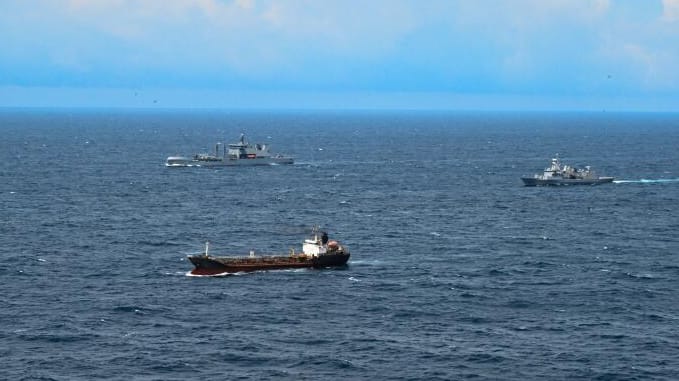
The Royal New Zealand Navy recently completed a three-month deployment designed to bolster enforcement of United Nations Security Council sanctions against North Korea. It was the first time the Anzac-class frigate HMNZS Te Mana was deployed in support of the sanctions monitoring program and expanded on New Zealand’s air and sea patrols conducted since 2018.
New Zealand launched a task force consisting of the 3,600-ton displacement frigate and the sustainment vessel HMNZS Aotearoa. The frigate, which was commissioned in 1999, is one of two Anzac-class vessels built in Australia and deployed by the Royal New Zealand Navy. The Royal Australian Navy also operates eight vessels in the same class.
Joining the New Zealand patrol were two Seasprite helicopters, one embarked on each ship. Navy commanders highlighted that the copters extended the reach of the task group, enabling vessels to be detected over the horizon and beyond the monitoring range of ships alone.
“Following the successful contributions made by Aotearoa and the Royal New Zealand Air Force P-8A Poseidon in previous years, Te Mana’s involvement in the mission has given us the opportunity to utilize the various sensors, systems, and capabilities that enhance maritime domain awareness and genuinely support regional security,” said Commander Tuijo Thompson, Commanding Officer of Te Mana.
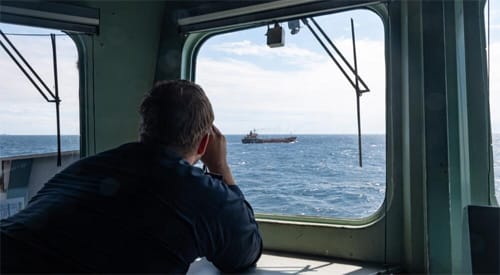
The monitoring was looking for vessels suspected of sanction avoidance activities (RNZN)
The Task Group is on a three-month deployment to the Indo-Pacific region, conducting a series of activities, engagements, exercises, and operations. During Te Mana’s UN Security Council (UNSC) sanctions enforcement, the frigate covered about 180,000 square nautical miles. The Navy reports that seven vessels of interest were monitored and 60 deterrence messages were broadcast via maritime radio.
The maritime enforcement patrol’s mission was to report vessels suspected of undertaking efforts to avoid the UN sanctions. They were searching for vessels suspected of trafficking refined petroleum to North Korea and exporting commodities such as coal, iron ore, and sand used to fund North Korea’s nuclear and ballistic missile production.
To bypass UN Security Council sanctions, North Korea uses a shadow fleet. The vessels have been known to conduct deceptive ship-to-ship transfers and use tactics including turning off automatic Identification systems and spoofing signals. They also conduct “vessel identity laundering,” such as removing flags and painting over vessel names, and draft alteration, where crews manipulate cargo to make it appear that a ship is heavily loaded or empty.

that matters most
Get the latest maritime news delivered to your inbox daily.
The Task Group was monitoring during maritime patrols on international waters in the Yellow Sea and East China Sea. Aotearoa also conducted six replenishments at sea for Te Mana and partner nations’ vessels during the patrols, enabling the frigate to remain at sea for longer during operational patrols.
The effort wrapped up last week with the vessels passing through the Taiwan Strait. The Royal New Zealand Navy vessels made the transit on September 18 on their way to a joint exercise with the Philippines. The Navy termed the transits “routine” and noted it had also transited the Taiwan Strait in November 2025.
