
CENTCOM's Commander Highlights Successes of U.S. Blockade
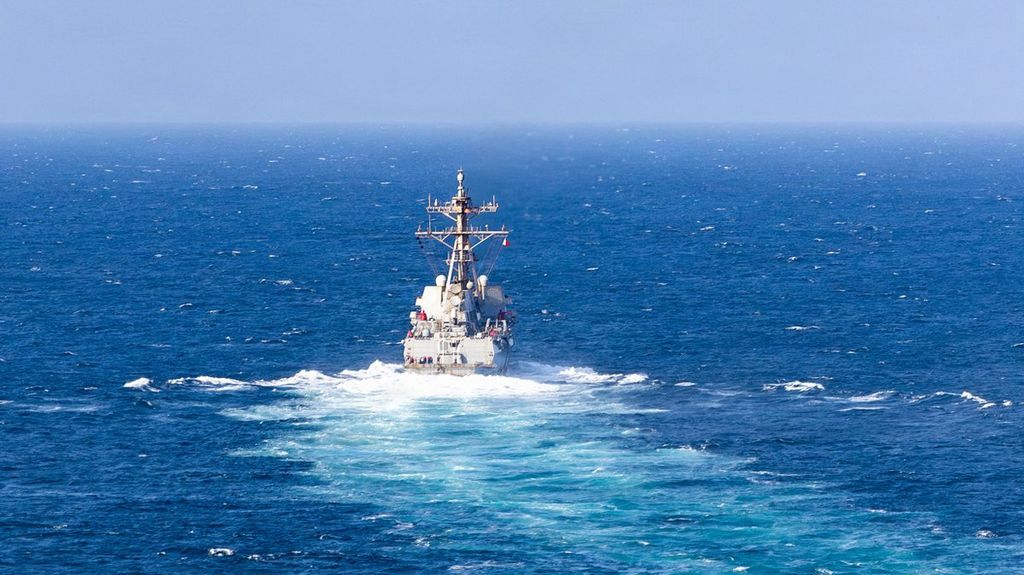
The latest briefing from the Commander of Central Command, Admiral Brad Cooper, gives an important perspective on the current situation, at a time when President Trump says he is reevaluating US strategy in the conflict with Iran. President Trump has said he is considering three options: negotiating a deal, maintaining the blockade and the current status quo, or resuming offensive operations on a wider scale to “annihilate Iran.”
Admiral Cooper gives no public opinion on the merits of the choices President Trump is faced with. In his latest briefing, the Admiral focuses instead on giving clear indications as to the effectiveness of the blockade which the US Navy is enforcing against Iranian ships and ports, but only hinting how this is being achieved tactically. Operational security surrounding CENTCOM operations in the Strait means that much of the reporting on the situation is speculative, relying for example on merchant ship AIS signals when most transiting the Strait are doing so AIS-dark.
CENTCOM is clear that 109 Iran-linked merchant vessels have been turned round whilst attempting to transit the Strait, and the Admiral states that the US Navy blockade of the Strait is 100% effective. Given that Iran has no pipelines through which it can export oil, this means Iran can only raise revenue by selling down stocks built up before the war and held afloat off Malaysia and China. Kpler analyst Homayoun Falakshahir estimated in August that at current discharge rates, and with cargo invoices paid two months after discharge, receipts from Iran’s stocks afloat would dry up early in the New Year. The consensus is that the Iranian government used to derive about 45% of its revenue from sales of crude and LNG, and with increased US Treasury pressure on Iranian financial channels, the dramatic run-down in oil and gas revenues has probably already started. This will impact the Iranian government’s ability to pay its security forces – which will remain a priority to be funded by cutting subsidies and essential services for the majority of ordinary Iranians, thereby fueling discontent.
In his statement to camera, Admiral Cooper also reported that the US had provided “coordinated protection” to assist 2,000+ commercial ship transits and the movement of 1 billion barrels of oil through the Strait “in the last couple of months,” and that “primary transit routes through the Strait are clear of mines.” This implies that the US has sufficient surveillance resources in place to identify, and then interdict, any Iranian attempts to lay any more such mines.
Critically, the volumes of oil, cargo and LNG transiting the Strait were at their highest in the first two weeks of September than at any point since April, and volumes are continuing to grow. To achieve this, the Admiral stressed that CENTCOM was working alongside all six GCC countries, including Oman, which controls coastal areas and territorial waters on the southern side of the Strait, but also with other US governmental agencies and with insurance and shipping companies.
In recent posts, CENTCOM has advertised the presence on operations in the Arabian Sea of the carrier USS George H.W. Bush (CVN 77), USS Boxer (LHD 4) leading the Boxer Amphibious Ready Group with USS Portland (LPD 27) and the 11th Marine Expeditionary Unit afloat, plus the Arleigh Burke Class guided missile destroyers USS John Paul Jones (DDG 53), USS John Finn (DDG 113) and USS Rafael Peralta (DDG 115).
This is not the full picture of naval deployments in the area, which is no doubt being protected because of recent but unsuccessful attacks mounted by what the Iranians describe as the Qasem Basir ballistic missile, featuring a passive thermal imaging target closure sensor.
Nor was mention made of the important role being played by Task Force 59 sea drones, both for surveillance and probably also to clear mines. But given the effectiveness of its blockade, CENTCOM probably feels able to reduce forward naval exposure without comprising control, thereby preserving the operational readiness of both its servicemembers and equipment for a patient, long-haul operation.

that matters most
Get the latest maritime news delivered to your inbox daily.
Whereas Admiral Cooper gave a clear picture on the status of naval operations in the Strait, he was less forthcoming about the state of air defenses covering US bases and the Gulf States. From the evidence of aircraft destroyed on the ground in forward areas, this is clearly a tactical weakness. This necessitates a re-think of how air power is deployed in the region, both tactically and as it would be packaged in any resumed strategic offensive.
This weakness, juxtaposed against the effectiveness of the blockade, are together likely to be the key military considerations shaping President Trump’s options going forward, but he may be inclined to reinforce success. For the merchant marine, it looks like more of the same for quite some time, but with the Iranians making increasingly desperate attempts to get the Strait of Hormuz, and the freezing of its finances, lifted. The final goal shared by all parties is of course to see the war ended, and realistically this can only happen through negotiation.
The opinions expressed herein are the author's and not necessarily those of The Maritime Executive.
