
New Orleans Gets Federal Approval for Construction of Container Terminal
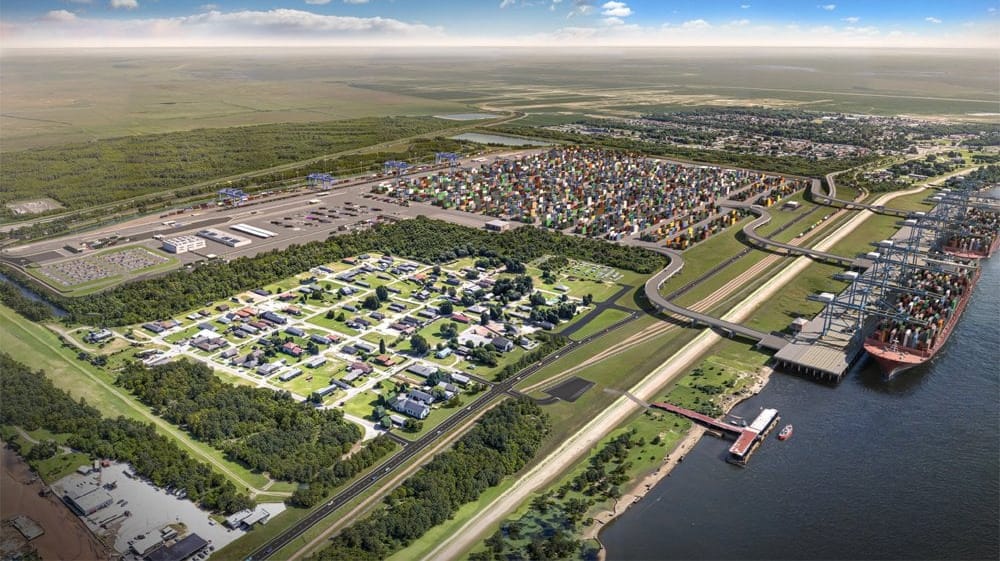
The U.S. Army Corps of Engineers has granted the federal permit authorizing construction of the Louisiana International Terminal, which is seen as a pivotal project for regional growth. The project, which is being developed in partnership with MSC’s Terminal Investment Limited (TiL) and Ports America, is billed as the first new container terminal for the Gulf Coast in nearly 20 years and the only new greenfield container port currently under development.
Located on the Lower Mississippi River with direct access to the Gulf, the project is designed to handle two ultra-large container vessels at one time. Port officials point out that modern containerships have outgrown much of America's existing port infrastructure, with vessels now regularly exceeding 16,000 TEU at the largest U.S. ports. The industry’s largest vessels, which are now exceeding 24,000 TEU, so far, have been limited mostly to the routes between Asia and Northern Europe.
Air draft at the Crescent City Connection Bridge, opened in 1958, spanning the Mississippi River in New Orleans, Louisiana, has become a major limiting factor for the port. It has a maximum clearance of 170 feet (less than 52 meters). Port officials highlight that New Orleans cannot accommodate Panamax and Post-Panamax vessels, meaning that routes go to other competing gateways, such as Houston, Texas. The new terminal will also accommodate a 50-foot draft.
The project is projected to cost $1.8 billion, according to media reports, and the target is for the first vessel to be handled possibly in 2028, with the facility growing from there. The current terminal is reported to have a capacity of approximately 1 million TEU annually, but the largest vessels it handles are in the range of 6,400 to 9,400 TEU. In the first half of 2025, it handled 263,961 TEU (full-year numbers are not available for 2025), but the port projects the new terminal will grow to handle 1.2 million containers over the next 25 years.
Critically, they also highlight the selected location in St. Bernard Parish will connect LIT to more than 30 states and to global markets. It will have direct access to every major Class I railroad and the interstate highway system. It can also be serviced by barges moving along the Mississippi River and inland waterways.
"Today's permit turns years of engineering, environmental review, and partnership into forward motion," said Beth Branch, President and CEO of the Port of New Orleans. "This is not simply a regional port expansion — it is nationally significant infrastructure that will expand American export capacity and position Louisiana to lead the next generation of maritime commerce. We are ready to build."

that matters most
Get the latest maritime news delivered to your inbox daily.
The port promotes that the new terminal is "positioned to redefine Gulf Coast trade capacity, strengthen the U.S. supply chain, and accelerate American manufacturing and commerce." Economics studies said the port currently supports more than $101 billion in total economic value nationwide and more than 342,000 jobs, and they expect it will continue to grow.
Backed by a public-private partnership among Port NOLA, the project advanced through federal review with strong support from Louisiana's bipartisan congressional delegation, the State of Louisiana, and regional economic development leaders. It had to overcome local opposition but was successful in its environmental reviews. The permit application was filed with the Army Corps of Engineers in December 2021. With the USACE permits granted, construction can begin.
