
Canada’s Largest Icebreaker Reaches North Pole on 2026 Scientific Mission
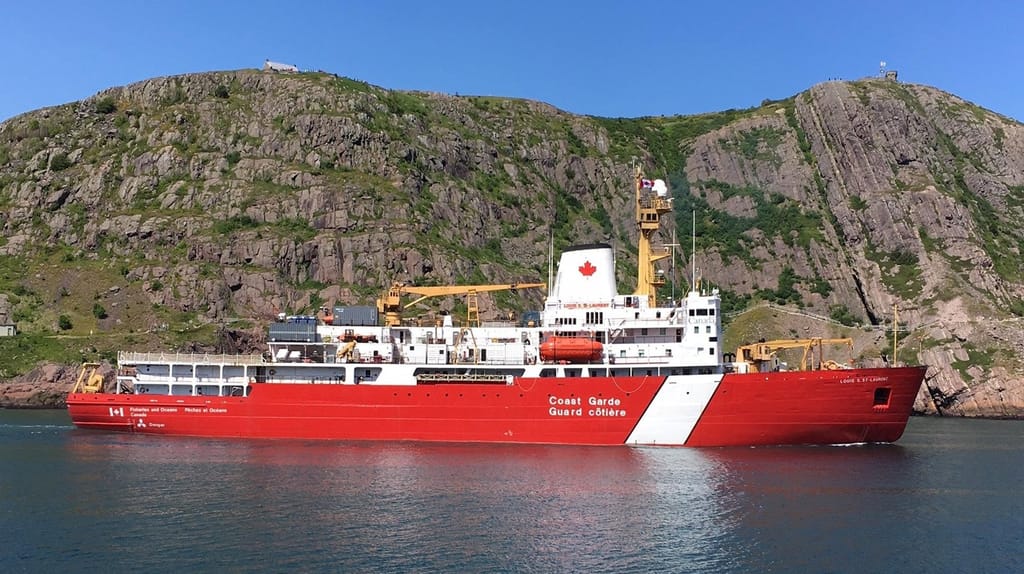
The Canadian Coast Guard Ship Louis S. St-Laurent, Canada’s largest, and most powerful icebreaker, reached the North Pole on August 16 as part of its 2026 Arctic deployment. The vessel is supporting the United Nations Convention of the Law of the Sea, helping to map Canada’s extended continental shelf in the High Arctic, before moving into the Beaufort Sea to support the Joint Ocean Ice Study and concluding Canada’s Arctic season in late November.
The transit supports Canada’s work to define the country’s continental shelf and map its outer limits under the United Nations Convention on Law of the Sea. As part of the ongoing 2024-2027 missions in support of Natural Resources Canada and Fisheries and Oceans Canada, CCGS Louis S. St-Laurent is collecting high-resolution geoscience and hydrographic data in the Arctic.
“The arrival of CCGS Louis S. St-Laurent at the North Pole is an important milestone that reflects Canada’s enduring commitment to the Arctic,” said David J. McGuinty, Minister of National Defence. “Supported by the expertise of Canadian Coast Guard personnel, this mission advances scientific knowledge, strengthens our presence in the North, and reinforces Canada’s sovereignty and security.”
The icebreaker departed from St. John’s in early July. She was scheduled to make stops in Iceland and Norway before proceeding to North Pole. She will then proceed west, including into Cambridge Bay, and then move south to be available to support icebreaking in the High and Low Arctic areas.
CCGS Louis S. St-Laurent (15,300 tons displacement) was originally commissioned in 1969. She is a Polar 4 Class heavy icebreaker, with three fixed-pitch props and 27,000 Shaft Horsepower.
In 2022, the government awarded a C$14.36 million contract to Chantier Davie of Lévis, Quebec for vessel life extension (VLE) work. Work on the vessel was expected to include inspections, auxiliary equipment renewals, propeller renewal, exhaust lagging renewal, piping renewal, and hull and superstructure painting. Additional VLE work was planned over the next few years, so that the CCGS Louis S. St-Laurent could continue to deliver critical icebreaking services and serve Canada throughout the next decade. Canada has commissioned the construction of new heavy icebreakers, expecting them to be commissioned by the early 2030s.

that matters most
Get the latest maritime news delivered to your inbox daily.
The Canadian Coast Guard’s summer operational season runs annually from June to November to support Northern communities, carry out services, and support Government of Canada Arctic missions. This season, Canada will be active with nine CCG icebreakers deployed and operating in the Arctic from June to November 2026 to support Northern communities, carry out services, and support Government of Canada Arctic missions. The Coast Guard says its icebreaking services are crucial to Northern community resupply, enabling the safe delivery of essential goods and materials across the Arctic.
The ships deployed this season will also include CCGS Jean Goodwill, which will support Operation Pacer Goose – the annual resupply of U.S. Pituffik Space Base in Greenland; CCGS Des Groseilliers; CCGS Vincent Massey; CCGS Amundsen; CCGS Sir Wilfrid Laurier; CCGS Pierre Radisson; CCGS Henry Larsen; and CCGS Captain Molly Kool. They will participate in various scientific efforts as well as support icebreaking, navigation, and search and rescue operations.
