


Modern Tech Could Restore Whitewater-Capable Ferry Service
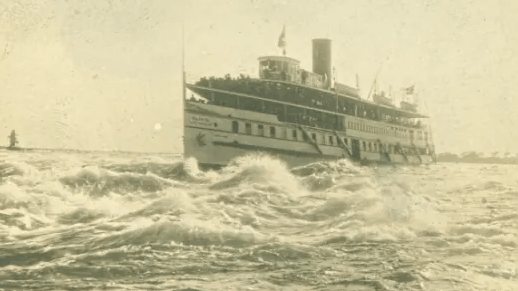
Internationally, chronic road traffic congestion is occurring at several cities that are located next to navigable waterways. There is potential to develop passenger ferry services along such waterways to bypass congestion, along with a need to develop passenger ferry vessels capable of sailing upstream across rapids and through sections of shallow water.
Introduction
During the 1840s, the British colonial government funded development of navigation canals along the St. Lawrence River west of Montreal, to allow steam-powered vessels to sail into Lake Ontario. The navigation canals allowed commercial vessels to bypass a series of rapids along the river. However, when traveling downstream, members of the Aboriginal Mohawk nation bypassed the navigation canals and safely rode their canoes over the rapids. A ship operator offered them money to modify their canoes by attaching vertical wooden sticks that extended 10 feet below the water’s surface.
None of the sticks broke after repeated canoe trips, resulting in ship operators such as Canada Steamship Lines sailing eastbound passenger vessels downstream across the rapids. One of their vessels built in 1910 to 37-feet beam by 210-feet length was named RAPIDS-PRINCE. Over subsequent decades, commercial passenger vessels regularly engaged in the equivalent of white-water rafting as they sailed across a series of rapids along the St. Lawrence River.
Modern day advances in vessel technology provide potential to operate passenger ferry vessels capable of sailing upstream across rapids, where sufficient water depth exists.
Occurrence of Rapids
Rapids manifest along rivers due to water flowing fast above a severely uneven river bed, often with shallower water depth than rapids along the St. Lawrence River. In the modern era, white water rafting companies offer exhilarating rides going downstream across rapids, carrying customers aboard unpowered inflatable rubber boats that can safely bump against rocks and boulders while being steered by oars. They require far less water depth than the large commercial passenger vessels that once sailed downstream across the rapids of the Upper St. Lawrence River.
Modern commercial passenger ferry services require accurate measurement of available water depth along shallow rivers deemed suitable for future passenger transportation service and especially in the vicinity of the rapids. The combination of sufficient water depth and innovative vessel design would be required to assure operation of passenger ferry vessels intended to sail at speed, going upstream and downstream across the rapids and through shallow sections of waterway.
Shallow Water Sailing
While flat-bottom, mono-hull boats propelled by aeronautical propellers easily sail across shallow water, aeronautical propellers pushing air drastically reduce propulsive efficiency of low-speed vehicles, compared to higher propulsive efficiency of marine propellers. While paddle wheels and side wheels can provide propulsion in shallow water, both operate at low thrust efficiency due to water moving sideways and downward from the working surfaces. The combination of low propulsive efficiency of aeronautical propellers combined with imprecise direction control makes operation of hovercraft economically unattractive.
When sailing at speed, “squat” occurs under conventional vessel hulls, pulling the hull toward the river bed due to water flowing sideways away from the boat hull. Hydrofoils could offset the effects of squat, but research would need to develop hydrofoils with ground-effect capability, allowing vessels to travel swiftly through 18-24 inches of water depth as well as across rapids. Initial acceleration would occur in deeper water.
Directional Control
Ferry vessels that sail across shallow water and over rapids would require precise directional control when sailing downstream between bridge piers. On some waterways, side-thrust technology would be essential at both bow and stern. Historically along the St. Lawrence River, steam-powered passenger vessels built during the early 1900s sailed over rapids that provided sufficient water depth for navigation, while captains avoid nearby outcrops of rocks that protruded high above water. When sailing upstream, the ability to sail over rapids bypasses delays that would otherwise occur at navigation locks, as is the case at Montreal.
Shallow Water Propulsion
Sailing a large vessel through shallow water prevents installation of large diameter marine propellers that rotate on a horizontal axis, that generate propulsive thrust at high efficiency. Research would need to combining inboard-mounted high-speed, small-diameter propellers with venturi pump technology to achieve substantial thrust at high propulsive efficiency. Inlet pipes under water-bomber aircraft transfer water from river or lake below the low flying aircraft into onboard tanks. Modified inlet pipes could transfer water from the shallow river to higher elevation, to sustain operation of inboard propellers and venturi pumps.
A small-diameter paddle-wheel might push water into a wide rectangular intake during initial acceleration, to provide sufficient water volume flow rate to sustain operation of the main propulsion system. At higher vessel speed when sufficient water volume flows to the propulsion system, the paddle-wheel would retract and be disengaged. Inboard propellers that produce fast-flowing propulsive water jet streams are well proven on fast ferry vessels, including on white-water rafting boats that ride upstream over the Lachine Rapids at Montreal.

that matters most
Get the latest maritime news delivered to your inbox daily.
Conclusions
Several shallow rivers that flow between cities and between suburbs of the same cities include sections with rapids that are navigable to small watercraft. Increasing urban road traffic congestion requires evaluation and development of water-based urban passenger transportation, where suitable waterways with sufficient water depth is available. Terminal areas would require sufficient water depth for high-powered hydrofoil equipped vessels to accelerate to sufficient speed to travel across shallow water and upstream across rapids.
