
Freedom of Navigation May Not Return to the Strait of Hormuz
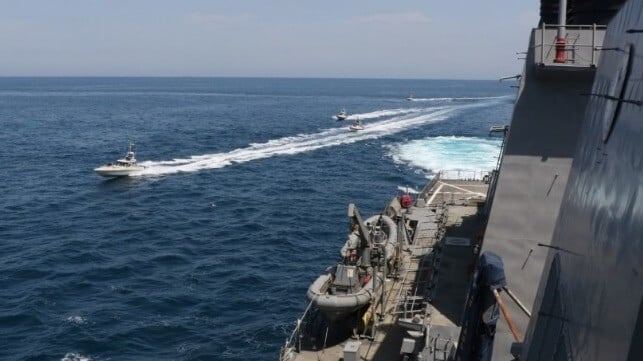
It is possible that shipping interests may have to pay tolls to pass the Strait of Hormuz under any scenario after the Iran conflict ends, President Donald Trump implied at a press conference Sunday.
Trump claimed that since the United States has already won the conflict, America should take over operation of Iran's tolling procedure at the strait. The tolls currently run up to $2 million per ship and would generate tens of billions of dollars per year for the nation in control.
For shipping, this scenario would mean no return to a free and open Strait of Hormuz governed by international law - and a new precedent for other actors to follow in other contested waterways, like the Taiwan Strait.
"What about us charging tolls?" the president suggested, responding to questions about the future of Iran's tolling system at Hormuz. "Why shouldn't we, we're the winner. We won, OK? They are militarily defeated. The only thing they have is the psychology of 'oh, we're going to drop a couple of mines in the water,' alright? We have a concept where we'll charge tolls. . . . Your question would have been more accurate if you'd said 'us.'"
In recent weeks, Trump has said that the strait will automatically open without further action if the U.S. leaves the conflict; that he doesn't think about the strait; then, over the weekend, that he will impose "hell" on Iran's leadership if it does not "open the [unprintable] strait." On Tuesday, he pledged that Iran's "whole civilization will die tonight, never to be brought back again" if Iranian leadership does not accede to U.S. demands.

that matters most
Get the latest maritime news delivered to your inbox daily.
The State Department omits the strait from its list of objectives for the conflict, centering U.S. war aims instead on the destruction of Iran's military. Many analysts predict that given Iran's built-in geographic advantage and its surviving drone, sea mine and missile capabilities, the waterway will remain in Iranian control for some time after the conflict ends. In this view, an outcome ending in U.S. control is possible - but would require a significant escalation of the war in order to eject Iranian forces from the strait or to compel regime change.
"I don’t know what messages Israeli officials are conveying in Washington. But I do know what the strategic reality looks like: the current Iranian leadership is highly unlikely to capitulate. Not under threats, and not under military pressure," predicted former Israeli Defense Intelligence chief Iran analyst Danny Citrinowicz, noting that Iran's leaders do not see themselves as losing the war. "If the underlying assumption is that coercive pressure will force Tehran to concede then that assumption is deeply flawed. In such a framework, escalation becomes the more likely outcome. If this is indeed the logic driving policy, then escalation is imminent."