
Emiratis Hang On in the Gulf of Aden
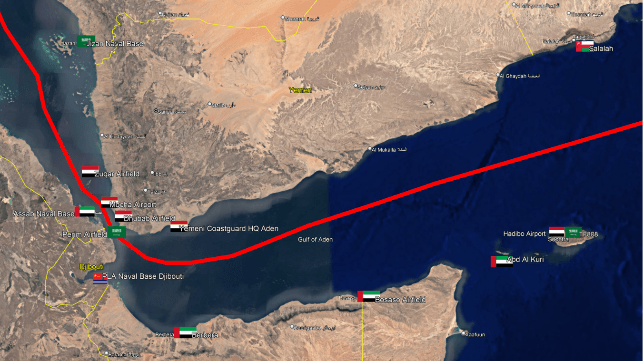
Last December, in a sudden reversal of fortune, Emirati-backed forces of the Southern Transitional Council (STC) were forced to cede much of the autonomy they had secured over areas of southern Yemen. An attempted STC coup de main operation to seize control of eastern areas of Yemen failed when STC forces encountered unexpected resistance from local forces and a robust military response from both Saudi Arabia and Oman.
There were two immediate consequences of this failed operation. The UAE announced shortly afterwards that it had completed the withdrawal of its troops from Yemen as of January 3, 2026, in an operation conducted with remarkable speed and efficiency, leaving the STC forces which they had subsidized, trained and equipped without sponsorship. This resulted in the disbandment of these forces, or the transfer of their allegiance to the Internationally Recognized Government (IRG).
The IRG was in consequence much emboldened, and with Saudi support, it set about bringing all the semi-independent militias nominally under its command into its integrated command structure. Key to this process was the taking of fingerprint and facial records of everybody in uniform, loaded onto a digital ID card without which salaries were no longer paid.
It remains to be seen if the IRG improves its military effectiveness, given that the STC-aligned forces tended to be better trained and led than others in the coalition. But the consolidation process continues across many government departments, and has for example brought much closer coordination by the Yemeni Coast Guard of the disparate marine patrol forces which had previously operated autonomously on stretches of coastline which they taxed and controlled as their own.
Tellingly, at the time of their pullback, the Emiratis indicated that they were not dropping their regional security ambitions, but intended to tackle them in a different way. There remains, nearly a year later, some pro-STC sentiment still unextinguished on the Yemeni mainland, but definitely suppressed. But the Emiratis still retain their influence in the Socotra Archipelago and on the southern Somali coast of the Gulf of Aden. If the Emiratis had originally sought to have influence over the two choke points vital to their position in global trade, these Gulf of Aden positions still give them oversight of the Maritime Security Transit Corridor (MSTC).
It was never clear to what purpose the Emiratis built airfields in the area, on Abd Al Kuri, Perim and Zuqar. No aircraft were stationed there, save drones possibly on Perim. A small number of visits were noted by light aircraft making quick turnarounds – as might be needed to support a small military presence. The larger civilian airfields where the Emiratis maintained a presence, namely at Hadibo on Socotra, Bosaso and Berbera on the Somali coast, and Assab in Eritrea saw larger Emirati visitors and a more obvious Emirati presence, such as the EL/M-2084 coastal surveillance radar which used to operate from Bosaso.
These airfields have made no obvious contribution to maritime security. The airfields in the Red Sea may have been used to support the anti-smuggling activities of the National Resistance Forces, backed then by the STC but now supported on Perim Island by regular appearances of Saudi C-130 aircraft. Conceivably, the airfields could have been developed as contingency and diversionary airstrips. Possibly they could be used to resupply automated intelligence collection facilities with very light manning positioned atop island high points, perhaps part of the Crystal Ball intelligence-sharing network. But there is no evidence to support such conjecture. While the construction of the airfield network appears to be defense-sponsored, little defense utility or maritime security benefit for the investment has yet become apparent. If there was such a use, then it is likely to have been of an intelligence collection nature.
For the moment therefore, the Emirati presence is confined to Somaliland and to Socotra, where it is clear that the Emiratis have a strong determination to maintain their commercial and political influence, despite pushback from the Saudi Task Force 808 garrison. In times of tension in the Gulf of Aden, or when political circumstances change, these lily-pad presences could quickly be reinforced.

that matters most
Get the latest maritime news delivered to your inbox daily.
Such a time could be approaching. Tensions between the Houthis and the Saudis are rising, as the Houthis become impatient that long-running negotiations have produced neither financial subsidies nor a lifting of the blockade. The Houthis somewhat unrealistically are seeking unpaid salaries worth $13 billion, in effect the salary roll for Houthi rebels in the field, fighting those from whom they now seek payment. Mass mobilizations which the Houthis are carrying out in their tribal areas in North Yemen may be a political ruse to improve a hardline bargaining position with the Saudis – but they may also be a precursor to an outbreak of further warfare, and a breaking of the ceasefire which has generally held since April 2022. And the Houthis may yet be pushed into causing disruption in the southern Red Sea and the Gulf of Aden by the IRGC, pressure which they have resisted so far but which has risen since fraternal bonds were heated up during the funeral of the late Supreme Leader Ali Khamenei.
