
After Ceasefire Talks Collapse, Iran Attacks Boxship and Shuts Down Hormuz
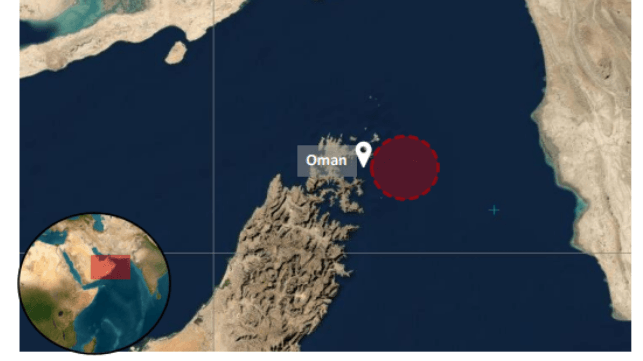
After a day of intense political activity in the Gulf, by nightfall on July 11, the ceasefire in the region appeared to have collapsed.
Earlier on Saturday, Iran's Foreign Minister Abbas Araghchi had flown to Muscat for meetings with Oman's Foreign Minister Sayyid Badr Al Busaidi, and spent 12 hours on the ground in Muscat. After a day of negotiations, the Omani Foreign Ministry said that talks had focused on "navigation in the Strait of Hormuz and ensuring its safety and freedom, in light of the developments and repercussions stemming from recent events." The statement said that the Iranians had not rejected Omani proposals, undertaking to return to Tehran and to present them to Iran's National Security Council, and that there was agreement that talks would continue at a technical level — an understanding that the Iranians were to breach within hours of their delegation returning home.
Also present in Muscat during the talks were diplomatic teams from both Pakistan and Qatar, although it is not known whether they participated directly in the bilateral discussions between the Omanis and the Iranian team. Both departed at about the same time as the Iranian delegation flew out. The presence of a US Navy MH-60 Seahawk at Muscat International Airport during the day does not appear to be connected to the talks, and may have been a medical emergency or a flight moving personnel from Muscat to a US Navy vessel offshore. It would be normal, however, for the Omanis to have kept the United States, as well as the Pakistanis and Qataris, abreast of what transpired during the negotiations.
The crisis talks in Muscat followed what in effect was an ultimatum from the United States, demanding that Iran restore freedom of navigation in the Strait, effectively recognizing the IMO temporary scheme, which envisaged ships being able to use either the northern PGRA-designated route without fees or the Omani coastal route. The ultimatum followed the IRGC's attacks on Al Rekayyat (IMO 9397339), Wedyan (IMO 9524970) and Cyprus Prosperity (IMO 9595216), plus the threats made to many others between July 6-8.
The Iranian response to the discussions of the day was rapid. A few hours later, the Cyprus-flagged container ship GFS Galaxy (IMO 9401271) was attacked off the northeast tip of the Musandam Peninsula while traveling southward along the Omani coastal transit route. The ship was struck aft, causing a fire in the engine room, and 23 members of the crew were rescued from lifeboats by the Royal Navy of Oman. One Indian crewmember remains missing.
Equally rapid was the Central Command response. Within hours, CENTCOM had launched its third and largest counterattack on Iranian targets this week. The 140 targets struck by CENTCOM included IRGC facilities along the Iranian coast at Bandar Abbas, Jask, Bushehr, Qeshm and Chah Bahar. The IRGC then mounted attacks on Bahrain, Kuwait, Jordan, Qatar and the UAE, and — according to one report — on the dock facilities in Oman at Duqm. IRGC attacks on targets in Bahrain continued on the morning of July 12.
In an unprecedented move heralding a change in the long-standing close relationship between Iran and Oman, the Iranian Ambassador in Muscat was called in late in the evening by the Foreign Ministry to receive a written protest over the attacks carried out against Oman, which noted that the IRGC had struck targets in the Musandam Peninsula and in the governorate of Al Wusta, where the port of Duqm lies. Unlike in all the other GCC countries, there are no US forces stationed in Oman, although the US, alongside the Iranians, makes port calls and logistic stops.

that matters most
Get the latest maritime news delivered to your inbox daily.
Over the last week, it has become apparent that Iran intends to stick to its attempt to be the sole controller of transits through the Strait of Hormuz. These actions accord with the political mood in Tehran, where the mob is heavily in tune with the maximalist demands of the Paydari and IRGC hardliners, whose figurehead is Dr. Saeed Jalili, Mojtaba Khamenei's representative on the Supreme National Security Council. Dr. Jalili has emerged as leader of the Paydari/IRGC hardliner faction over the period of the late Supreme Leader Ali Khamenei's funeral, which has strengthened their hand at the expense of the more pragmatic faction led by the Foreign Minister, the Iranian President Dr. Masoud Pezeshkian and the chief Iranian negotiator Mohammad Bagher Ghalibaf.
Iranian press commentary at the end of a busy day stressed that sole Iranian control over the Strait was Iran's main focus at present, that Iran had now closed the Strait completely, and that Iran was prepared for continuing conflict. CENTCOM rebuffed the closure claim and stressed that the Omani coastal route remained open for transits of the Strait.
