


Going Green: Energy Ports Diversify Their Cargo
(Article originally published in Mar/Apr 2026 edition.)
It wasn't so long ago that "energy" ports were mainly lined with huge fuel storage tanks and a myriad of pipes intertwined with each other and eventually leading to a dock to load or unload large tankers and barges.
The adjective "green" wasn't much of a factor when it came to energy, but these days there are many "green energy" projects for ports and related marine services, and they're cashing in.
Moreover, there's disruption in the movement of traditional energy products like oil and gas as evidenced by the conflict in the Middle East, so the development and use of other types of power become critical.
WEST COAST LEADER
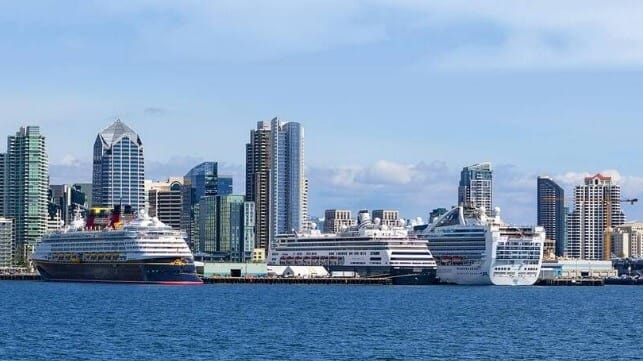
The Port of San Diego, the nation's specialty cargo gateway to the Pacific, is diving into the green energy effort.
With the space, flexibility and expertise to move cargo that doesn't fit in standardized containers, San Diego's non-fossil fuel energy products have included transformers, solar panels, wind towers/blades/hubs/nacelles, batteries and battery shells and electrolyzers.
"Through our cargo operations we've supported various electrification projects throughout the U.S. Southwest such as solar and wind power," says Michael LaFleur, the port's Chief Operations Officer. "Notably, we're currently working with LG Energy Solution, one of the largest battery manufacturers in the world, on handling lithium batteries for its battery manufacturing complex in Queen Creek, Arizona."
In addition, the port has taken a small section of its Tenth Avenue Marine Terminal and reserved it for the Jankovich Company's petroleum operations.
San Diego's new, all-electric cranes give the port the heaviest lift capability of any port crane system currently in place on the U.S. West Coast. "This enables us to handle cargo previously only handled by Gulf ports that supports solar and wind power projects," notes LaFleur.
The port has secured grant funding for infrastructure design improvements at the Tenth Avenue Marine Terminal that will support the energy sector's logistical needs, including upgrading the existing electrical system to support the use of zero-emissions cargo-handling equipment.
At its National City Marine Terminal, the port and the Pasha Group successfully commissioned a roll-on/roll-off vessel – the MV Jean Anne – for shore power, marking a first-of-its kind achievement in the U.S. and the first-ever shore power connection for a domestic pure car/truck carrier.
San Diego is also working with Skycharger on a proposed zero-emissions truck charging hub. It will serve the port's two marine cargo terminals, the arterial corridor Harbor Drive and the region's freeway network.
LaFleur said the port will continue to work with its partners on streamlining the movement of products and cargo that support future energy projects: "We look forward to further expanding the capacity and infrastructure of our terminals to support this cargo while also advancing the port's own green energy and sustainability goals."
EAST COAST LEADER
In Florida, energy fuels the economy and nearly half the state's gasoline, diesel and jet fuel flows through Port Tampa Bay, whose central location along the I-4 Corridor enables fuel and other products to reach the state's growing population efficiently.
Each year the port handles roughly 15 million tons of petroleum products including gasoline, diesel, jet fuel, asphalt and other specialty items.
As Florida's population grows, now over 23 million, Port Tampa Bay's role as an energy gateway becomes increasingly critical. With more than 5,000 acres of industrially zoned land with deep water access, the port has ample room to expand its energy operations, logistics network and cargo-handling facilities.
The port's most important capital project is a multi-phase channel deepening initiative, which will increase the channel depth to 47 feet, improve access for larger vessels and support future cargo growth.
Hooker's Point, home to the REK Petroleum Terminal Complex, is the hub for liquid bulk operations. Upgrades at the complex have expanded storage, streamlined operations and strengthened the port's ability to meet growing energy demands. Tampa Electric Co. (TECO) has invested approximately $5 million to upgrade a substation serving Hooker's Point, further reinforcing the infrastructure for fuel terminals and distribution.
Population growth, expanding transportation networks and increased economic activity will continue to drive demand for gasoline, diesel and jet fuel. Meeting that demand requires ongoing investment in terminals, storage and distribution systems.
"We're seeing tremendous growth across Florida and it's exciting to be at the center of that momentum," states Paul Anderson, Port Tampa Bay's President & CEO. "As the largest economic driver in West Central Florida, every investment we're making – from channel-deepening to critical infrastructure and resiliency improvements – is about ensuring we continue to deliver for the communities and businesses that depend on us every day."
GULF COAST POWERHOUSE
While the Port of Morgan City is not a high-tonnage port, activities include fabrication, manufacturing, shipyards, and recycling and energy support activities. Long a center of the offshore industry, the port hosts the fabrication of offshore mooring piles, production of ROVs that support offshore energy activities, offshore platform and rig decommissioning, and the construction of components for LNG facilities.
Shipyards in Morgan City have been building LNG barges for some time, and LNG support has grown to a new level. Performance Contractors expanded its production capabilities by adding a modular fabrication facility in Morgan City in late 2022. It's delivered 14 process modules to the Venture Global LNG facility in Plaquemines, Louisiana and is currently working on 14 more process modules and five HRSG (heat recovery steam generator) modules.
"It's through our partnership with the Corps of Engineers that the Atchafalaya River and Bayous Boeuf, Black and Chene federally authorized channel is being consistently maintained," says the port's Executive Director, Raymond "Mac" Wade, "allowing energy projects to be transported to the Gulf of America for delivery to industry clients."
Historically, Morgan City has a significant connection with the early energy industry as the birthplace of offshore oil and gas exploration. The first producing offshore oil well – out of sight of land – was completed on November 14, 1947, 43 miles south of Morgan City.
"The energy market has changed significantly over nearly 80 years," says Wade, "and situations throughout the world can impact businesses at the port. However, it's evident that, given Morgan City's strategic location at the intersection of the Atchafalaya River and the Gulf Intracoastal Waterway and the innovative industrial base in the area, Morgan City is poised to support energy-related activities for years to come."
Construction will begin soon on the West Dock expansion project at the port's marine terminal facility on the Gulf Intracoastal Waterway. The multimodal facility will provide 1,900 feet of waterfront, 500,000 square feet of laydown and a storage area with a 20-foot berth depth to support future energy activities.
GOING GREEN
But it's not just ports that are pushing the green effort. Other maritime sectors are also getting in on the action.
Donjon Marine, for example, based in Hillside New Jersey, is a marine services organization that specializes in marine casualty response, dredging and marine support services.
"As marine salvors," says John Witte. Jr., Donjon's President & CEO, "we consider ourselves an important part of the green energy effort as the salvage community provides front-line defense of our environment by responding to casualties that often involve protection of our waterways from numerous pollutants that, if allowed to escape, would cause significant environmental issues."
He adds that "Donjon has provided dredging and construction support for a number of the offshore wind farm facilities that are being prepared," but the effort has slowed due to recent politically driven and practical concerns.
"When and if it begins to ramp up," he notes, "Donjon has plans to try to engage in this work through the addition of assets that will be specifically designed to fill the needs of the continuing green energy efforts. We say this based upon the fact that we own a shipbuilding facility and have preexisting relationships with the groups that are looking to be prime contractors in the construction of green energy facilities."

that matters most
Get the latest maritime news delivered to your inbox daily.
He concludes by saying, "We will continue to upgrade our marine and land-based assets to be as pro-environment as possible as we understand and agree that we only have one world, so it's in our best interests to make sure we keep it safe for human existence."
Ports columnist Tom Peters writes from Halifax, Nova Scotia.
The opinions expressed herein are the author's and not necessarily those of The Maritime Executive.
