
Chinese and Korean VLCCs Clear Hormuz as Iran Claims to Increase Traffic
Iran continues to control the flow of tankers through the Strait of Hormuz for political and propaganda gains as the war of words continues over the peace negotiations. The Islamic Revolutionary Guard Corps (IRGC) Navy is claiming to have increased the flow with Chinese tankers and the first South Korean tanker permitted to make the transit, while many other vessels continue to wait.
Iran is highlighting the latest transits as Donald Trump again made statements that time was running out in the negotiations. Iran responds with its proposals and a new threat to widen its retaliation if the United States resumes attacks.
The IRGC Navy released a statement claiming that in the past 24 hours, a total of 26 vessels safely transited the Strait of Hormuz. It said this included tankers as well as containerships and other vessels. It asserted, however, that they were all “under the coordination and security support” of the IRGC Navy. They said all the ships making the transit had obtained prior authorization and required close coordination with the IRGC.
This came after Iran announced the launch of its new Gulf Strait Authority. Iranian officials called it the legal entity and authority for managing passages.
Using Kpler data, Reuters was able to account for around 10 vessels crossing the Strait of Hormuz in the past 24 hours, saying this included a small cargo ship and an inbound chemical tanker. The Financial Times cites data from Kpler saying that only six VLCCs have transited Hormuz so far this month, with all of them bound for Asia. It calculates that about 17 million barrels had passed through the Strait after 28 million barrels in April.
South Korea’s Ministry of Foreign Affairs announced today, May 20, that its first tanker had been able to make the transit carrying about two million barrels of crude bound for Ulsan. It said there are 25 other South Korean-flagged vessels still caught in the Persian Gulf, but it was significant after Iran refused transit a month ago to another South Korean tanker that was reportedly bound for Pakistan.
The ministry said the passage came after four rounds of discussions, possibly stretching two weeks, with Iranian officials. They are emphatically stating that there were no tolls paid or exchange of money to obtain the passage. It, however, said it had also consulted the United States while securing permission for the tanker to proceed.
The release of the tanker comes as tensions have been elevated with Iran. South Korea’s foreign minister demanded a call with Iranian officials last weekend as the Koreans increasingly believe Iran struck the HMM general-purpose cargo ship HMM Namu on May 4 with two projectiles. The Koreans are reportedly analyzing debris with the intent to identify the source of the components in the projectiles.
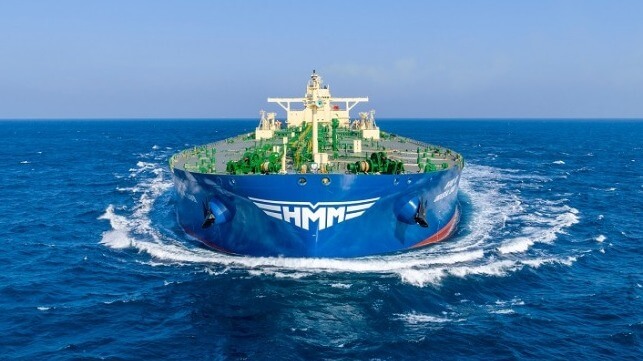
Tehran reportedly notified the Korean Embassy in Iran late on Monday that the tanker had clearance to transit the Strait. The vessel is being identified as the Universal Winner (300,000 dwt), operated by HMM. Its last AIS signal showed it toward the eastern side of the Strait, reporting it would reach Ulsan on June 8.
This transit came after analysts identified two Chinese VLCCs making the transit on May 19. Iran had announced last week, ahead of the meeting between the U.S. and Chinese presidents, that it would be escorting Chinese vessels through the Strait. The VLCC Yuan Gui Yang (319,700 dwt) owned by COSCO and registered in China, was identified as one of the vessels making the transit. It is operating for a subsidiary of Sinopec. The other VLCC was the Hong Kong-flagged Ocean Lily (299,170 dwt). It is operating for Sinochem.

that matters most
Get the latest maritime news delivered to your inbox daily.
These three tankers are collectively bringing about six million barrels of oil from Iraq and Kuwait. The IRGC is implying that non-belligerent nations that cooperate with its protocols will be permitted to bring additional vessels out of the Strait. Reuters is also reporting that a Greek-owned, Cyprus-flagged VLCC, Grand Lady (300,000 dwt), was permitted to enter the Persian Gulf and anchored near Dubai.
While the slow pace of transits is continuing, the U.S. continues to assert that its blockade is in full force. Today, CENTCOM is saying it is up to 90 vessels redirected, increased by two from yesterday and increased from 84 as of May 18.