
China Rushes to Complete Paracel Island Militarization
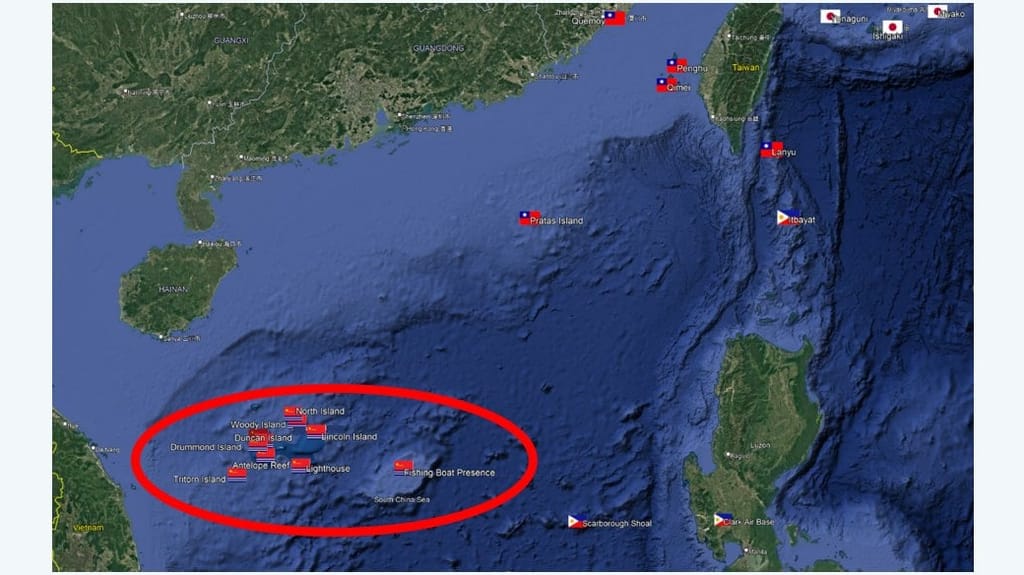
Satellite imagery shows that China is rushing to complete building work on what used to be the Antelope Reef in the South China Sea, which will be nearly the last reef or rock in the Paracel Islands that has not been covered in concrete and converted into a military base.
Recent imagery shows that since building work and an expansion of the Chinese presence on Antelope Reef began in December 2025, a 3,000-meter runway is nearing completion. This will be the longest of many that China has built on disputed islands in the South China Sea, and the new runway will be able to host the full range of Chinese aircraft types. China has already built a 2,750-meter runway on Mischief Island, 50 nautical miles to the northeast, and there are now only two reefs or islands remaining in the Paracels on which China has not yet built military outposts.
China’s development of Antelope Reef creates a major military node in the northern South China Sea, extending persistent surveillance while supporting air & naval operations from a position close to the mainland,
— Damien Symon (@detresfa_) August 20, 2026
????imagery via Reuters, annotated to show the current buildout pic.twitter.com/kYj2WtGm91
These bases on the Paracel Islands are no longer isolated outposts capable of being neutralized one by one, but part of an integrated defensive system with built-in redundancy, which will be able to put up an integrated defense against a sophisticated attack. Further south in the South China Sea, islands occupied by the People’s Liberation Army (PLA) have near-neighbors occupied by other countries with their own sovereignty claims, such that the Chinese bases are staking a claim more than fitting into an integrated defensive system. In the Paracels, however, the PLA managed to evict the Vietnamese entirely in 1974, so that there are no threatening presences nearby. Thus, the Paracel bases act as an extension to Chinese operational capability based on Hainan Island and the mainland, posing an offensive threat to the southern flank of Taiwan and to the Vietnamese coast.
Vietnam lost 75 sailors and marines when China managed to evict the Vietnamese from the Paracel Islands in January 1974. Vietnam fought (and won) a war against China in 1979, and also has bitter memories of the Chinese takeover of some of the Spratly Islands in 1988, during which 64 mostly unarmed Vietnamese soldiers were killed in cold blood by the PLA Navy. Vietnam has certainly not forgotten its claim to the Paracels, and is probably the most belligerent of the Asian nations who are having to deal with Chinese takeovers of disputed islands, notwithstanding the 2016 ruling of the Permanent Court of Arbitration negating Chinese claims within the First Island Chain under the terms of the United Nations Convention on the Law of the Sea.
Having also embarked on a naval expansion program earlier this year, Vietnam is on course to become the third country in the region to buy BrahMos anti-ship cruise missiles from India, a decision which can be attributed to the Chinese expansionism in the South China Sea. Vietnam is believed to be planning to acquire six coastal batteries of the missiles, which can also be used against land targets. BrahMos is a two-stage solid-fueled supersonic anti-ship cruise missile that can reach speeds of Mach 3. It has a fire-and forget capability, with multiple target acquisition sensors to avoid jamming as it closes on its target. With a 200kg warhead, it is able to engage targets on land or at sea out to a range of 180 miles, and can be launched from ships, aircraft, and coastal batteries.
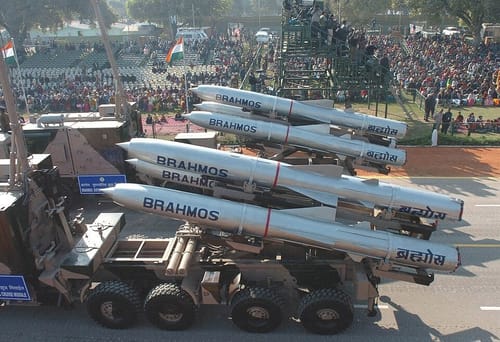
BrahMos missiles on parade in India (India's Ministry of Defence)

that matters most
Get the latest maritime news delivered to your inbox daily.
The Philippines ordered three BrahMos coastal batteries in 2024, and Indonesia announced a $450 million deal with India last month, which includes BrahMos missiles. The popularity of the system has soared since 11 Indian BrahMos missiles, out of a total of 13 fired, hit Pakistani airbases in the opening phase of the May 2025 war.
Notwithstanding procurement programs in most of the ASEAN countries to build up defense capability in the face of Chinese intimidation, the nations being threatened are reluctant to antagonize China. Most of them, however, have not given ground diplomatically to China, and while keeping their responses as passive as possible, are being more robust in their defensive measures when subject to Chinese incursions – hoping the Chinese will acknowledge the reputational damage, realize that nobody accepts their claims and all see Chinese action in the South China Sea as bullying.
