


Grounding of the Ever Given: When Hydrodynamics Turns Into Financial Risk
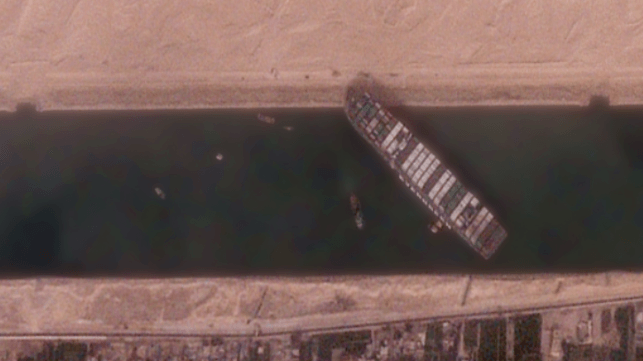
On March 23, 2021, the ultra-large container vessel Ever Given grounded in the Suez Canal during sandstorm conditions, blocking one of the world’s most critical trade routes.
Public discussion often framed the casualty as a case of human error. From an operational risk perspective, however, the more relevant question may be different: Did nonlinear hydrodynamic forces in a confined channel create a loss-of-control scenario before the bridge team fully recognized it?
The Environmental Setup
The vessel entered a narrow, shallow canal under strong crosswinds. In such waterways, large ships are simultaneously affected by three interacting forces:
• Bank suction – a low-pressure effect pulling the stern toward the bank
• Bow cushion – high-pressure water build-up pushing the bow away from the bank
• Squat – increased draft and reduced under-keel clearance as speed increases
Individually, these forces are manageable. Together, in confined waters, they become highly sensitive to speed, water depth and distance from the banks.
For ultra-large vessels with substantial block coefficient and significant windage area, like an ultra-large container ship, even moderate speed can disproportionately amplify these effects.
Wind, Drift and Early Instability
Strong crosswinds act primarily on the vessel’s large exposed container stacks, generating lateral drift. The bow begins to move off the intended track. To counter this, rudder is applied.
However, in shallow water, squat reduces under-keel clearance and diminishes rudder effectiveness. At the same time:
• Bow cushion may push the bow further away from the bank
• Bank suction pulls the stern toward the opposite bank
This combination creates a pivoting moment, increasing yaw. At this stage, the vessel may still appear controllable. Heading is being corrected. Rudder angles respond. The situation does not yet look critical.
But hydrodynamic forces may already be entering a nonlinear regime.
The Nonlinear Threshold
In confined waters, there is often a critical combination of speed, position and environmental force. Below this threshold, corrections stabilize the vessel. Beyond it, corrections may amplify deviation.
If speed remains too high relative to wind and channel geometry:
• Squat increases;
• Rudder efficiency decreases;
• Bank suction intensifies;
• Wind continues to generate lateral force.
More rudder is applied to compensate. Yet as stern suction strengthens, corrective inputs may increase yaw instead of reducing it. This is the transition point — where controllability shifts from stable to unstable.
From the outside, it can appear sudden. Operationally, it is the cumulative effect of interacting forces.
The Point of No Return
Once lateral deviation exceeds a recoverable margin — in angle or distance from the centerline — the ship's own inertia becomes dominant.
Even if engine power is reduced:
• The vessel’s mass maintains forward momentum;
• Hydrodynamic asymmetry persists;
• One end of the vessel may strike a bank while the other swings across the channel.
At that moment, grounding becomes highly probable.
This sequence is not necessarily the result of a single error. It may be the predictable outcome of operating a very large vessel within tight environmental margins.
How It Could Be Mitigated
The purpose of this analysis is not to assign fault, but to highlight systemic prevention.
Three practical barriers are essential:
• Explicit Pilot–Master agreement on maximum safe speed under crosswind conditions;
• Predefined abort thresholds (yaw rate, lateral deviation, wind limits);
• Active bridge team monitoring rather than passive pilotage.
Most confined-water casualties do not originate from one dramatic mistake. They develop progressively — until recovery is no longer possible.
Why This Matters to Maritime Executives
Every bridge decision carries financial exposure. When ultra-large vessels operate within legacy infrastructure designed for smaller tonnage, new risk regimes emerge. Hydrodynamic margins narrow. Consequences expand.
Operational risk becomes strategic risk.
For shipowners and operators, the lesson is not simply “reduce speed.” It is to integrate hydrodynamic risk awareness into voyage planning, pilotage procedures and executive-level safety policy.

that matters most
Get the latest maritime news delivered to your inbox daily.
In modern shipping, vessel size magnifies both efficiency and vulnerability. And in confined waters, small deviations can evolve into nonlinear events with global financial consequences.
Volodymyr Smirnov is a Master Mariner with over 25 years of experience on large ocean-going vessels, including more than 18 years in command with senior operational accountability. His professional focus includes operational risk management, bridge team decision-making, and confined-water navigation strategy.
The opinions expressed herein are the author's and not necessarily those of The Maritime Executive.
