
A Divided Libya Supports Both Ukrainian and Russian Naval Operations
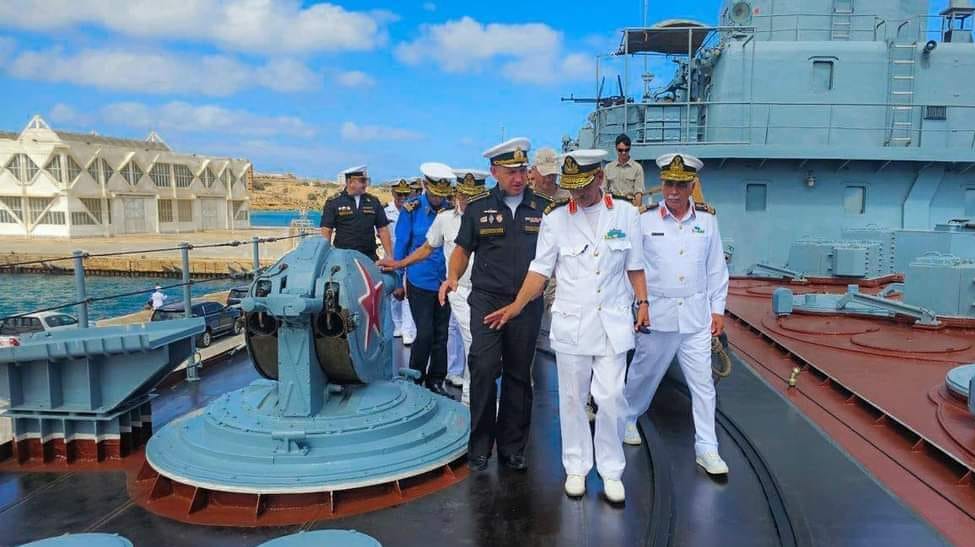
A number of geospatial intelligence firms have tracked the departure of a Russian convoy from the Baltiysk naval base in the Kaliningrad, and its subsequent movement through the Strait of Gibraltar to the port of Tobruk in Eastern Libya. The Maritime Executive reported the movement of the convoy, the Ropucha Class Aleksandr Shabalin (L110), escorting the cargo vessels Anastasiia (IMO 9349291) and Yuriy Arshenevskiy (IMO 8406705) cruising between Sicily and Tunisia on September 10. Both the cargo vessels are sanctioned and have well-established histories of moving military cargos. Ural trucks and armored vehicles were seen on the quayside in Baltiysk and being loaded onto the two cargo vessels, and as a landing ship the Aleksandr Shabalin would have had a capacity to transport heavy armored vehicles as well.
Just who the final end-users of this military equipment will be is uncertain. It could be Libyan National Army forces led by US citizen (lately a resident of Virginia) Field Marshall Khalifa Haftar, whose faction controls Tobruk and Eastern Libya, facing off against the Islamist-inclined recognized government based in the capital Tripoli, whose principal foreign backer is Turkey. The equipment might be destined instead for the rebel Rapid Support Forces (RSF) in Sudan, who are backed by the Emirati government and supplied through southeast Libya and from eastern Chad. Or the equipment could be for Russia’s Africa Corps, who are currently supporting government forces in six Central African countries on a mercenary basis, albeit for the strategic benefit of Russia.
This Russian activity, in particular its maritime element, is an obvious target for Ukraine, which seeks to harry and weaken Russia wherever it can. A recent report in the Libyan Observer denied reports that the Ukraine is maintaining a drone detachment at the Misrata Air Base, where Turkey also has a presence, but both CNN and French broadcaster RFI have substantiated the presence by interviewing Ukrainian members of the detachment.
The Ukrainian SBU detachment in Misrata, which in effect is a semi-independent city state loosely aligned with the government in Tripoli, would most likely have been responsible for attacks on Russian and dark fleet shipping in the Mediterranean. These Ukrainian-acknowledged attacks have included that on the Omani-flagged dark fleet Aframax Qendil (IMO 9310525) in December last year, and on the Russian military cargo vessel Lady Mariia (IMO 9220641), more recently on September 7. These two attacks both employed bomb-dropping hexacopter drones, at too great a range to be launched and controlled directly from Misrata. The Ukrainian Volyniaka hexacopter for example has a range of about 15nm, so would need to be launched from a nearby vessel based out of Misrata. Such a vessel within 15nm of its target might be vulnerable to interception by a Russian warship, particularly if it had a helicopter on board, so the Ukrainians are unlikely to act against Russian or dark fleet shipping if it has a naval escort.
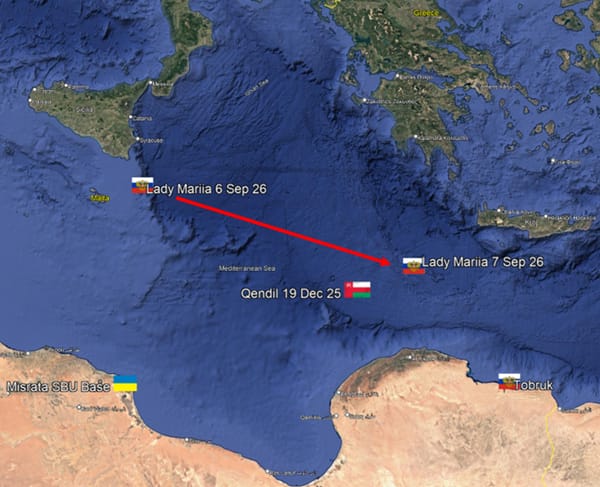
Russian and dark fleet ships targeted by Ukraine off Libya (Google Earth/CJRC)
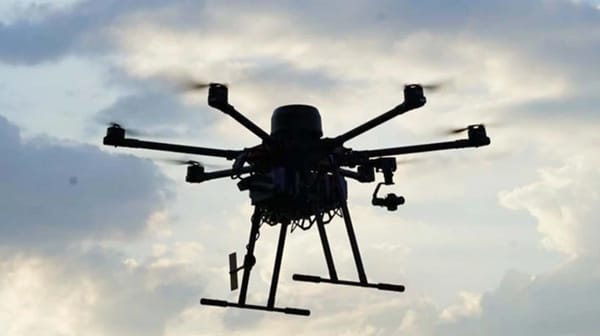
The Volyniaka bomber drone (Ukrainian Ministry of Defence)

that matters most
Get the latest maritime news delivered to your inbox daily.
The city government of Misrata is at odds with Field Marshal Haftar, so it would not be surprising if the leaders of Misrata urged on the Ukrainians detachment to launch attacks even on Russian vessels docked in Tobruk.
The Lady Mariia, having survived its attack, was still at anchor at the northern end of the Suez Canal on September 17. She may be about to head south through the Canal, beyond which there a number of possible customers if it has military cargo on board. The Russians have in the past supplied arms to both sides in the Sudanese civil war. But Lady Mariia may also be waiting for a Russian naval escort before passing back though the same area of the Mediterranean where she was attacked on her outward journey, and over which the Ukrainian drone teams are ranging.
