


The Hidden Operational Value in Your Emissions Data
Collecting environmental data is often seen as a box to be checked, a mandatory chore. However, some waterfront organizations are beginning to shift their thinking. Of course, environmental data is necessary for compliance. But that very same data contains hidden operational insights that waterfront executives depend upon. It's about much more than energy efficiency or environmental impact; it's about operational efficiency and business impact too. The question has become: how can waterfront operations alleviate this burden while still gaining the benefits?
“In a world that is increasingly report-driven, every other day there's something new that's required,” said Allison Ryan, program manager at Green Marine, “and these organizations are looking to find ways to make their lives easier.” Waterfront facilities need data for multiple purposes: to adhere to regulations, to compose grant applications, and to achieve (or maintain) voluntary certifications, like Green Marine's. But small ports struggle to handle the workload. That's something Rosemarie Fusco, now a project manager at GZA, realized when working on her dissertation. “In their day-to-day operations, it's hard for them to identify where the data gaps are and where the opportunities are. Through my Ph.D. research at URI, I spoke to a lot of ports and harbors that were just two people,” said Fusco, “and smaller ports and harbors don't really know how to access federal and state funding that could help them, like PIDP grants.” Good reports require good data, but with the right tools, both can be readily produced, even by facilities with limited resources. The right data strategy opens doors for these organizations to secure new funding, cut costs, and find efficiencies they never thought possible. These benefits are well within reach when waterfront operations begin to think of data collection not as a requirement but as part of a larger strategy.
One early example of this shift is playing out at Waterson Terminal Services of ProvPort in Rhode Island. Environmental consulting firm GZA led a team of specialty consulting firms, working closely with both the City of Providence and ProvPort, to develop a 30-year master plan for the port. The master plan was meant to, in part, identify opportunities to reduce the port's environmental impact and improve its port operations through sustainability and resiliency initiatives. “As our environmental requirements are now more stringent, the level of data we had was insufficient to accurately display our true greenhouse gas footprint,” said Steve Curtis, facility operations manager at Waterson Terminal Services. Waterson proposed an idea: to demonstrate progress, they would obtain a Green Marine certification, which verifies waterfront operations are taking steps towards meeting environment standards, including tracking and lowering emissions. It was an ideal move, but the small team quickly realized the administrative burden was bound to grow. “We have been in a pen and paper system for a long time with just one big spreadsheet being made at the end of the year,” said Kolby Goryl, a project manager at Waterson. However, with a smart partnership, that was about to change.
Waterson chose Tydal Technologies to build out its emissions tracking system. With the company's signature app, TydalFlow, Waterson produced its first-ever comprehensive asset registry. “Before this project, we were really only capturing fuel usage for equipment in the port. We didn't really have any sort of system for tracking our fleet vehicles,” said Goryl. Liz Messier, Waterson's CFO, has identified the overarching problem: too many disconnected data sources. With TydalFlow, Waterson can see emissions data in one place, complete with a dashboard to monitor trends and generate reports automatically. Importantly, the platform integrates into a facility's existing workflows, avoiding the need to retrain workers or disrupt processes. “Everyone knows how to deposit a check at their bank with their phone, and everyone knows how to text,” said Eric Wisch, founder of Tydal Technologies, “so we combined these two concepts into one data ingestion workflow. It’s critical to get data from the field into the system of record as easily as possible, with as few steps as possible.”
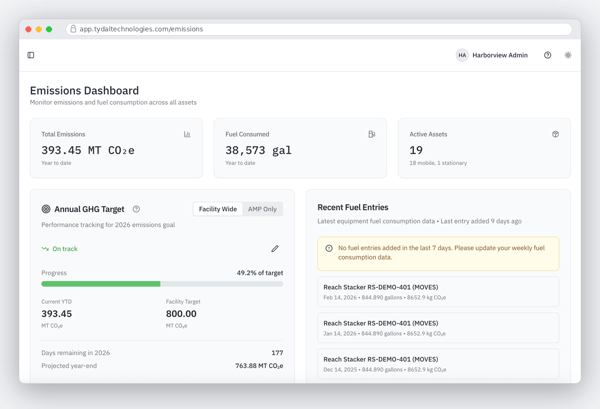
TydalFlow's dashboard (shown here with mock data) centralizes fuel consumption, asset tracking, and GHG targets all in one place.
The change is clear as day. “Their record keeping, awareness, and presentation of the data improved this year,” said Brian Lesinski of EA, the consulting firm that conducted Waterson's 2026 Green Marine verification. Clearing Green Marine's bar secures a solid marketing win, as the certification is held in high regard, but it’s an operational win too. Generating the required reports automatically saves time, allowing workers to focus on what matters most. In the end, Tydal could support environmental reporting that would have initially been spread across 3 to 4 people. Those same reports allow managers to notice efficiency gaps and implement changes that cut costs meaningfully. Instead of examining trends once annually, managers can track issues in real time, creating a more nimble working environment.
Remarking on Waterson's asset data, Messier said, “We're beginning to ask new questions, like ‘why do I have 15 forklifts on this list but we're only using 10. Is that a real operational difference or did we miss something?’” Data collection is, therefore, worthwhile as a tool that can change day to day operations from the bottom up. “We plan to make environmental reporting a value driver,” said Wisch. The idea is to empower ports to use the data already being collected to surface new opportunities for the facility, rather than treating it as an arduous task to be minimized.
The same realization has emerged at other waterfront facilities. Nick Grandy, vice president of finance at Boston Ship Repair, found that what began as a narrow reporting requirement quickly revealed something larger. “What started as ‘we just need some data for a government grant’ has become a full operational revamp,” he said. It’s a sentiment that gets to the heart of what forward-thinking waterfront operators are beginning to understand. “Emissions data is a byproduct of how efficiently you're operating,” said Wisch. Facilities that recognize this—that environmental data can be treated not merely as an obligation but as a strategic asset—are the ones that will find themselves better equipped to out-operate their competitors.
This article is sponsored by Tydal Technologies.
The opinions expressed herein are the author's and not necessarily those of The Maritime Executive.
