


ZeroUSV Achieves World First with Autonomous Deployment of Surface Drones
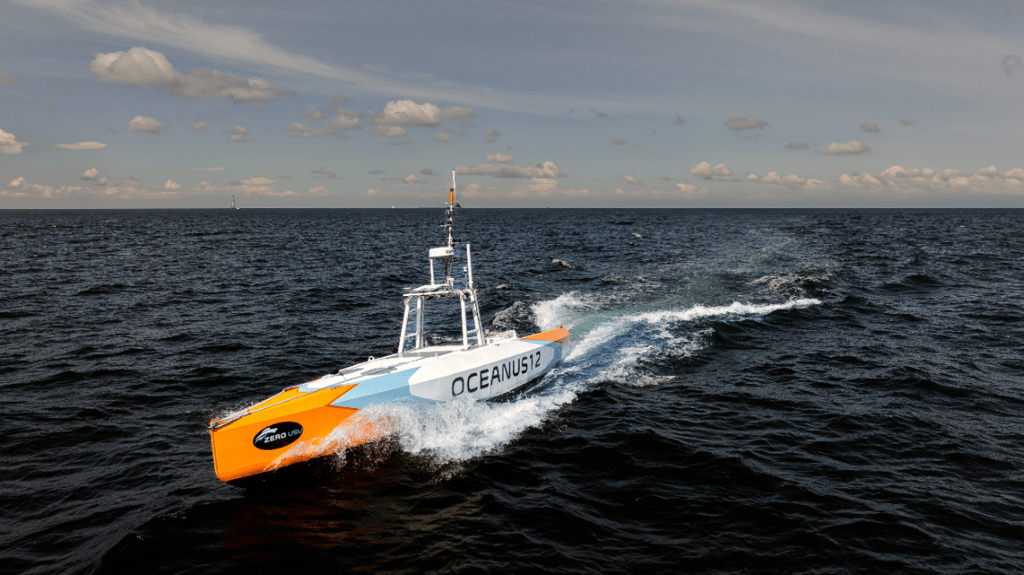
ZeroUSV successfully demonstrates the autonomous launch of multiple drones from its Oceanus12 vessel.
[By ZeroUSV]
ZeroUSV has achieved a world first by successfully demonstrating the autonomous deployment of multiple autonomous surface drones (ASVs) from a 12 metre Oceanus class uncrewed surface vessels (USVs), marking an important milestone in proving the payload flexibility of the Oceanus class USV platforms.
During trials in Plymouth, ZeroUSV's Oceanus12 deployed two Oshen C-Star’s, demonstrating for the first time how one autonomous surface vessel can deploy multiple marine surface drones as part of a coordinated mission.
The demonstration was part of ongoing UK Defence Innovation (UKDI) backed programme, led by ZeroUSV alongside partners Oshen and MarineAI.
Centred around ZeroUSV's Oceanus12 USV, the project brings together, Oshen's C-Star and MarineAI's GuardianAI autonomy software technology, proving the integration of drone payloads and deployment with an integrated, multiplatform autonomous capability for defence and security applications.
For the trial, the lightweight, sail and solar-powered C-Star was configured to collect high quality acoustic data, though it can also be equipped with a wide range of sensors to support environmental monitoring, defence operations and critical underwater infrastructure monitoring.
MarineAI’s Guardian autonomy suite provides the navigational autonomy software that enables autonomous platforms to safely plan, coordinate and execute complex missions with minimal operator input, whilst integrating multiple payloads for autonomous deployment capability allowing execution of tactical missions.
The Oceanus12 USV has been developed as a flexible, modular autonomous platform capable of rapidly deploying a wide range of payloads and being re-configured for different missions and different payloads quickly and effectively.
The successful trial demonstrates how the Oceanus class can deploy and support multiple assets, extending the reach of autonomous operations while reducing the need for personnel to operate in hazardous maritime environments, and freeing up crewed platforms for dedicated taskings.
Beyond deployment, Oceanus12 USV also enables operators to verify the location, status and performance of deployed autonomous assets in environments where traditional communications may be unavailable, unreliable or deliberately denied.
This provides greater mission assurance during complex autonomous operations and reinforces Oceanus class role as an active participant in autonomous mission execution, rather than simply a launch platform.
The next phase of the programme will see Oceanus12 USV autonomously deploy four C-Star vehicles simultaneously, demonstrating how distributed autonomous systems can operate together at greater scale.
Matthew Ratsey, Managing Director of ZeroUSV, said: "This is a significant milestone, not only for ZeroUSV, but for the take up and use of Oceanus USV in theatre. Oceanus12 has been designed as a highly flexible autonomous platform capable of supporting a wide range of mission requirements, and this demonstration proves its ability to rapidly deploy autonomous systems while maintaining a low operational footprint.
"Autonomous operations are becoming increasingly complex, requiring multiple systems to work together seamlessly. Oceanus12 enables operators to deploy autonomous assets where they are needed, while also providing greater confidence in their location, status and performance in situations where traditional communications may not be available.
"Demonstrating the launching of maritime robots is another important step towards delivering truly scalable autonomous capability for defence and security customers. It shows how a single autonomous platform can support multiple operational requirements while reducing risk to personnel and increasing operational flexibility."
Anahita Laverack, CEO of Oshen, said: "This demonstration represents an important step towards a future where autonomous systems work together to undertake missions that would otherwise expose people to unnecessary risk. Having robots launch robots means we can safely, and rapidly, deploy sensing capabilities into tactile locations at short notice, without putting crews in harm's way.
"That not only improves safety, but also expands our ability to collect valuable maritime and underwater data from places that have traditionally been difficult or dangerous to access. Successfully launching two C-Star vehicles is an exciting milestone, but this is the tip of the iceberg. We're now looking forward to demonstrating the deployment of 100’s of autonomous systems operating together."
By combining Oceanus12's deployment capability with Oshen's C-Star autonomous surface vehicles and MarineAI's Guardian autonomy software, the programme is demonstrating how distributed autonomous surface platforms can work together to deliver persistent sensing, intelligence and mission assurance in contested and communications-constrained environments.
As demand continues to grow for autonomous maritime capability across defence and security, the trial further reinforces Oceanus12's versatility as a rapidly deployable, multi-role autonomous platform capable of deploying and supporting distributed autonomous systems across a broad range of maritime missions.
Oliver Thompson, Technical Director of MarineAI, said: "This demonstration shows how maritime autonomy is evolving beyond individual autonomous platforms to coordinated autonomous teams. Guardian provides the decision-making framework that allows multiple autonomous systems to work together safely and intelligently, enabling Oceanus12 and the C-Star vehicles to operate as a single coordinated mission capability rather than as separate assets.
"Bringing together multiple autonomous surface systems creates a much more capable operational solution. It enables complex missions to be carried out with minimal operator intervention, extends operational reach and helps keep people out of harm's way, particularly in environments that are hazardous, remote or where communications are constrained.
The products and services herein described in this press release are not endorsed by The Maritime Executive.
