


Wrecked Tanker Continues Uncontrolled Oil Discharge off Oman
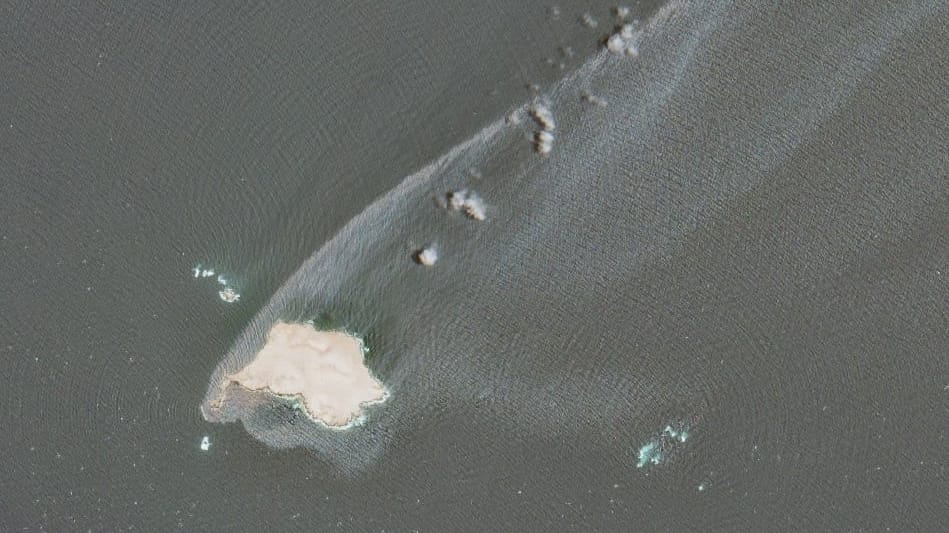
Oil is continuing to flow from the wreck of a Russian dark fleet Suezmax, the Cameroon-flagged Caroline Bezengi (IMO 9224439), beached on rocks off Jazirat Al Qibliyyah on the Dhofar coast of Oman.
The Caroline Bezengi was hit by an explosion on June 8 while off the coast of Oman. The tanker had completed a transit of the Suez Canal on May 30 and had left the Maritime Security Transit Corridor when the explosion occurred. The crew was taken off without injury some four days later, and the tanker subsequently was driven onto the rocks on the southwest tip of Jazirat Al Qibliyyah, one of the Hallaniyat Islands off the coast of Dhofar in the south-west of Oman. The tanker was laden with oil taken on board at Novorossiysk and was destined for Gujarat. The tanker has a past association with Russian state ship-owner Sovcomflot, and had been sanctioned by the EU, UK and US (OFAC).
The position of the ship does not appear to have shifted in recent days, despite having settled and developed a more pronounced list since it came aground. Nor from the imagery resolution available does it appear that the ship has broken up to any degree, although it is exposed to heavy seas in the Khareef monsoon which normally prevails at this time of year.
Although the Khareef brings rain to the Dhofar area, transforming the desert into a spectacularly lush and beautiful green landscape, at sea the winds and waves can be strong, and offshore islands are often isolated for the duration. While the ship appears still grounded on rocks forward, there are outcrops to port which could also catch the ship if it shifted. There are also exposed rocks 500 yards off the stern of the ship.
There is no indication as yet that the registered owners of the Caroline Bezengi have accepted their responsibility under UNCLOS for the clean-up. The Cameroon-flagged tanker is apparently owned by Rentoor Ship Management based in Huangpu Qu, Shanghai, and their reluctance to answer the telephone and step forward is likely to be a consequence of the tanker being under-insured. It is common for Russian dark fleet tankers to have no insurance whatsoever and to operate with fake insurance certificates.
Another issue for the Omani authorities may be that expert salvors who have the expertise to unload the cargo may be reluctant to become involved in a project to remediate a ship that is sanctioned by the US Treasury’s OFAC. This problem would dissipate if the Omani authorities took action to formally sequester the ship and its cargo, in a manner which the US Treasury has done for Russian dark fleet tankers which have been seized off Venezuela and elsewhere.
Experienced ship salvage experts examined the wreck on July 12, and identified a feasible plan for offloading the cargo via a 1,000 yard pipeline to a receiving tanker anchored in safer waters in the lee of the island. The tanker potentially could be refloated as it was lightened. But as there has been crude leakage into ballast and also into the double hull spacing, there is a risk of an on-board explosion from fumes during a salvage operation, as well as continuing risk that the wreck will break up in heavy weather.
From Sentinel-2 satellite imagery obtained Friday, taken at better than 10m resolution on a cloudless day, there appears to be no salvor or patrol vessel keeping watch over the wreck, nor conducting preliminary salvage activities.
It also appears that the oil plume is moving in a more north-easterly direction, such that the bulk of the oil will miss the coast between Sharbithat and Ras Madrakah. Instead, the oil is skirting Ras Madrakah and flowing into the North Arabian Sea, an area from where the US Navy is maintaining its blockade of Iranian ships and ports. This is good news for nesting turtles coming ashore to lay eggs along this coastline, but bad news for petrel sea birds and rare Arabian Sea humpback whales, for whom this area of sea is a prime and protected habitat.
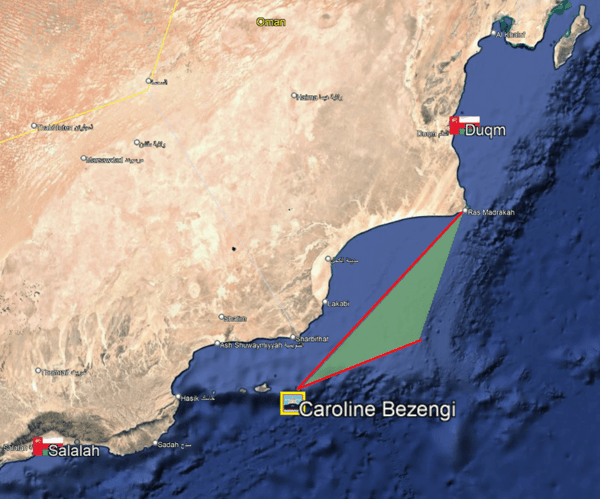
An approximate depiction of the spread of oil from the Caroline Bezengi, as seen on August 7. The northern edge of the oil plume now is edging Ras Madrakah, with the bulk of the plume heading for the Northern Arabian Sea (Google Earth/CJRC)

that matters most
Get the latest maritime news delivered to your inbox daily.
The Caroline Bezengi appears to have been a victim of a limpet mine attack, possibly orchestrated by Ukraine. A limpet mine would most likely have been placed on the ship since it left Novorossiysk, and while at anchor. Ships customarily anchor while waiting to enter the Suez Canal, but also often do so to complete exit procedures at As Suways as well.
The Omani Ministry of Transport, Communications and IT in Muscat has been approached on a number of occasions to ask how the salvage operation is proceeding, but no response has been received as yet.
