


U.S. Navy Fighter Jet Disables Two More Iranian Tankers
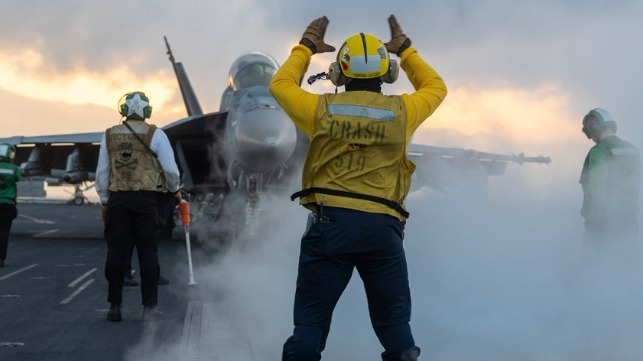
In what appears to be a new operational pattern, U.S. Central Command has disabled two more Iran-bound tankers in the Gulf of Oman using Navy fighter jets - this time, by striking their stacks. The strikes are a resource-efficient alternative to boarding and seizure, and appear to be effective in preventing tankers in ballast from reaching Iranian ports, where they would provide floating storage and extend Iran's ability to continue production.
Central Command said Friday that it had dispatched an F/A-18 Super Hornet from USS George H.W. Bush to interdict two Iranian-flagged tankers in ballast, which were bound for a port on Iran's Gulf of Oman coastline. The fighter used "precision munitions" to hit each tanker's stack, "preventing the non-compliant ships from entering Iran."
The stack is an uncommon location to target for disabling fire, but would reduce risk of flooding or pollution when compared with an attack on the rudder or the engine room. Unclassified video of the strikes appears to show that both vessels had stopped and were stationary before they were hit.
U.S. Central Command (CENTCOM) has announced that earlier today U.S. forces disabled two vessels, the M/T Sea Star III and M/T Sevda, earlier today in the Gulf of Oman in support of the naval blockade of Iran. pic.twitter.com/i213ms3SSM
— OSINTdefender (@sentdefender) May 8, 2026
In the previous strike, conducted Wednesday, another Super Hornet used its 20mm cannon to disable the exposed rudder of the Iranian-flagged tanker Hasna, which was also attempting to reach Iran's Gulf of Oman coast.
All three of the tankers have ceased their transits, CENTCOM said. Plans for salvage, seizure or assistance have not yet been released.
Overall, CENTCOM says that it has redirected 57 tankers attempting to enter or leave Iran's ports since the start of the U.S. blockade in April, plus an additional four vessels disabled. Independent tracking consultancies have identified leakage of a smaller number of empty tankers through the naval cordon over the course of the last several weeks; the new tactic of airborne interdiction provides Central Command with an efficient way to tighten the blockade, without the additional resourcing needed to board, secure and store noncompliant vessels.
"U.S. forces in the Middle East remain committed to full enforcement of the blockade of vessels entering or leaving Iran," said Adm. Brad Cooper, CENTCOM commander. "Our highly trained men and women in uniform are doing incredible work."
Separately, CENTCOM released footage of the destroyers USS Truxtun (DDG 103), USS Rafael Peralta (DDG 115), and USS Mason (DDG 87), now reportedly operating safely in the Arabian Sea. Iran previously claimed to have damaged U.S. warships in a multi-pronged attack overnight Thursday; NASA FIRMS infrared sensing data showed signs of fires at sea northwest of the Musandam Peninsula in the same timeframe, prompting speculation of a shipboard fire incident in the general region of the skirmish.

that matters most
Get the latest maritime news delivered to your inbox daily.
The U.S. military confirmed that the three destroyers had an intense engagement with Iranian forces. Central Command conducted retaliatory strikes on Iranian positions in Qeshm, Bandar Abbas and nearby locations overnight Thursday - but denied the Iranian claim that any damage had occurred to the warships.
USS Truxton and Mason were exiting the Arabian Gulf at the time of the encounter, having transited Hormuz westbound under fire earlier this week. The confirmation of their safe return to the east side, in the Arabian Sea, suggests that the Navy has curtailed its surface combatant presence in the Arabian Gulf for the time being, consistent with the abrupt suspension of the "Project Freedom" shipping security umbrella.
