


Maersk to Restore Second Route with US-Flagged Vessels in the Suez-Red Sea
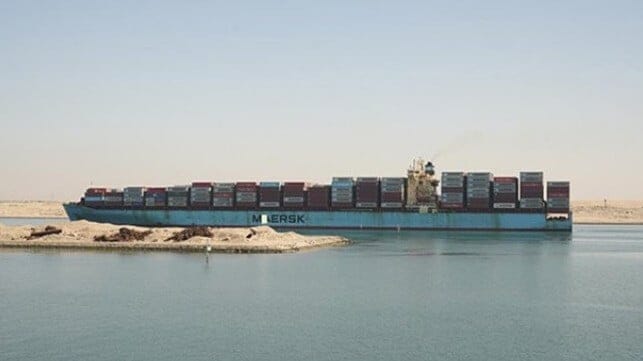
Days after reporting it would begin a gradual resumption of routes transiting the Suez Canal and the Red Sea, Maersk announced plans for a second route to resume the transits. The company, so far, has stuck to its plans to restore a few routes while saying it continues to monitor the security situation and has contingency plans in place.
The second route to resume the transits is one operated with U.S.-flagged vessels sailing from the East Coast of the United States to the Middle East and India. The Maersk Denver (6,200 TEU), which is currently heading to India, will make the first westbound sailing. The Maserk Chicago (6,188 TEU), which has recently departed Tangier Med and just entered the Mediterranean via Gibraltar, will make the first eastbound transit early next week.
“By making the structural change of returning to the trans-Suez route for the MECL service, we will offer significantly improved transit times,” Maersk reports. It notes that for westbound sailings, transit times will improve by an average of 7 days, while on eastbound sailings, transit times will improve by an average of 14 days.
The company highlights that the Majestic Maersk (19,076 TEU) earlier today completed a transit through the southern portion of the Red Sea as its first vessel back into the region since February. AIS signals show the vessel south of Jeddah, Saudi Arabia, and report it will reach Port Said, Egypt, on July 13. It is coming from Salalah, Oman, and is operating on a route from the Gemini Cooperation with Hapag-Lloyd that sails to the Mediterranean and Turkey.
Maersk is calling this “a further step towards a gradual return to the trans-Suez corridor.” The company had abandoned the routes at the end of 2023 after its vessels were targeted by the Houthis. All the ships were diverting around South Africa.
The company had previously tested the Suez-Red routing in December 2025. The Maersk Denver made the transit in January, and the company reported that several routes were being restored, including ones in its Gemini Cooperation with Hapag-Lloyd. The return, however, was short-lived as the company again suspended all transit at the end of February after the outbreak of hostilities and the threat of new attacks by the Houthis.

that matters most
Get the latest maritime news delivered to your inbox daily.
So far, CMA CGM has been the primary carrier to continue transits through the Suez and Red Sea. It recently sent several of its largest and newest vessels through the Suez. The EUNAVFOR Operation Aspides, however, continues to post photos showing its vessels sailing with the containerships in the southern Red Sea and Gulf of Aden.
Analysts are closely tracking the highly anticipated return to Red Sea routing. The longer sailing distances with the diversion were one of the elements cited as supporting the container sector and occupying potentially excess capacity. A return to the routes is expected to free capacity while the sector also continues to add new vessels, all contributing to further expectations of overcapacity.
