


Judge Dismisses Most of Remaining Dali Civil Damage Claims
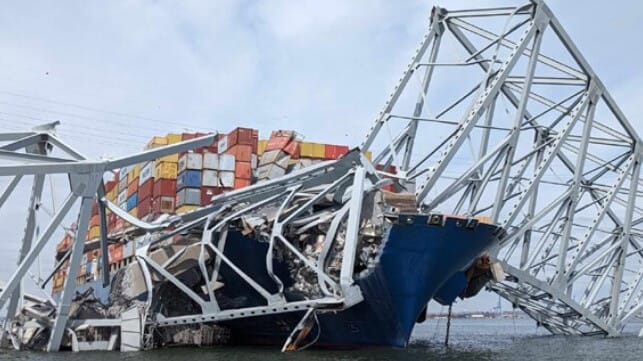
The district court in Maryland, hearing the civil portion of the claims related to the containership Dali destroying Baltimore’s Francis Scott Key Bridge, ruled on August 25, dismissing many of the economic loss claims while also letting several claims proceed. The court up until this point had declined to decide on issues related to a 1927 U.S. Supreme Court ruling that had limited economic losses only to claimants that had a direct property interest in the damaged property, in this case the Key Bridge.
Among the claims being issued was one from Star Bulk that argued the carrier’s ships were unable to reach the loading berth in Baltimore harbor because of the bridge collapse and, as such, it lost profits or earnings potential. Also dismissed was a class consisting of longshoremen who lost work, an insurance syndicate and Ports America Chesapeake, American Sugar Refining, and a large group of businesses and individuals, including a yacht sales company and American Publishing, that said the blocked harbor and loss of the bridge interfered with their business.
The owner of the Dali, Grace Ocean, and the manager, Synergy Marine, had filed at least since October 2024 to block the economic claims that were seeking recovery damages, citing the 1927 case, Robins Dry Dock & Repair Company. Additionally, in April 2024, they filed a motion that sought to invoke the Shipowners’ Limitation of Liability Act of 1851 as it related to the economic claims.
Judge James K. Bredar writes in his opinion that the Robins Dry Dock decision had “loomed large over these proceedings.” He also notes that there is nearly a century of case law that has interpreted and applied Robins and developed clear exceptions.
The court moved to decide the application of Robins after it was agreed in June to delay the remaining claims. The companies and their insurers settled key elements of the civil claims, including all the wrongful death and personal injury claims, and the claims from the state of Maryland. All but 10 of the 54 initial claims filed in the civil case have been settled or voluntarily dismissed.
At issue is the 1927 U.S. Supreme Court decision that bars economic loss recoveries caused by negligence unless there were also physical damages to properties. Most of the remaining claims cite economic losses due to the closure of the port and the loss of the bridge. In Robins Dry Dock, the propeller of a vessel was negligently damaged while undergoing scheduled maintenance and delayed the vessel’s return to operation for two weeks. A suit was brought to recover for the lost profits while the vessel was out of operation, and was rejected when it reached the Supreme Court.
In the 75-page opinion, the judge considers each of the claims against the Robins decision and subsequent exceptions that have been established in case law.
The decision lets several claims survive and proceed. Included in this is one from the City of Baltimore for damages to a water main that was in the harbor below the bridge, while the court dismisses other claims from the city related to the loss of the bridge and damage to other streets and bridges. The court says the City of Baltimore failed to establish a proprietary interest in the Key Bridge sufficient to license recovery of the economic damages beyond the physical damage to the water main.
A claim for Baltimore County was also permitted to survive specifically for damages to the county’s waterways. The county claims debris from the bridge reached its shoreline, and the court is letting those claims stand, but dismissed claims similar to the city regarding roadways.

that matters most
Get the latest maritime news delivered to your inbox daily.
The final claim that survived is a class action filed by the trucking company R.E. West, which alleges physical damage to cargo from various companies aboard the Dali. A portion of the claim from West was dismissed, but the elements specific to damage of cargo resulting from the allision and the collapse of the bridge onto containers survive.
The judge notes in his conclusion that the plaintiffs had asserted that Robins would be transformative to the civil claims against the Dali, and the court agrees. It notes that the scope of the civil case has been significantly narrowed. It is likely the decision in this case will also further add to the case law in the century since the Supreme Court’s Robins Dry Dock & Repair decision.
