


Japanese Shipbuilders and Owners Team Up to Design LCO2 Carrier
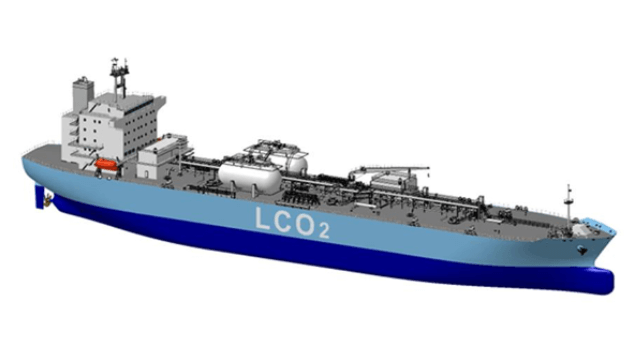
The leaders in the Japanese shipbuilding industry and joining up with several of the largest Japanese shipping companies in a new effort to develop a standardized design for a liquified CO2 carrier (LCO2). The effort is designed to increase efficiency in the building of the vessels to meet the anticipated demand from the sector.
Analysts have forecast a strong and growing market for large, commercial CO2 carriers. It is part of the anticipated move for CO2 capture and reuse or sequestration. So far, just a few smaller carriers have been commissioned, although orders are expected to grow quickly in the second half of this decade.
The initiative is being conducted by MILES (Marine-design Initiative for Leading Edge Solution), a joint venture launched in 2013 by Mitsubishi Heavy Industries and Imabari Shipbuilding Co. It was originally established for the design and sales of LNG (liquefied natural gas) carriers. It was originally known as MI LNG Company, but rebranded in January 2025 to provide functional design for other emerging market segments. They said it would add work on commercial ships that use alternative fuels such as ammonia and methanol and for the design development of new liquefied CO2 carriers.
Joining in the effort, in addition to Mitsubishi Heavy Industries and Imabari, are Nihon Shipyard Co., which was already working with the group on a range of designs, and Japan Marine United Corporation. Both are also investing in MILES.
Among the shipowners and operators, NYK and Mitsui O.S.K. (MOL), and “K” Lines are also joining the initiative. All three will also be investing in MILES to accelerate the cross-industry collaboration.
The goal is to establish a standard design framework for the LCO2 carriers. According to the group, it will promote efficiency to develop and carry out the design for the initial LCO2 carriers and the next generation of alternative fuel ships. MILES will be responsible for developing the initial designs so that other shipyards in Japan will also be able to carry out the functional and production design based on the common initial designs. They aim to promote construction at multiple shipyards in Japan, utilizing the standardized design framework.

that matters most
Get the latest maritime news delivered to your inbox daily.
They report the initiative is expected to help Japan in regaining its global competitiveness for the shipbuilding industry.
Nihon and Mitsubishi Shipbuilding had already started joint development of new LCO2 carriers. In August 2024, the two companies, together with Kawasaki Kisen Kaisha (“K” Lin es), Mitsui O.S.K. Lines, NYK, Imabari Shipbuilding, and Japan Marine United Corporation, had also started joint studies to establish standard specifications and designs for LCO2 carriers.
Japan has used the approach of standardized designs shared among multiple shipyards successfully in other segments. The yards build standardized dry bulk carriers and have been able to maintain the market despite growing competition from China. The industry is racing to develop LCO2 carriers to meet the anticipated demand for the segment.
