


Israel Protects Azerbaijan With Strike on Iran's Caspian Fleet

Israel's strike on Iranian naval assets in the Caspian Sea, which took place on the evening of March 18, were the first attacks on the Iranian Navy's Northern Fleet, but unusual in one other regard: on the surface, the assets destroyed did not immediately threaten Israel, which is normally a target qualification requirement.
Although Israel did not publish the names of the vessels destroyed either in Bandar Anzali harbor or at sea, video of the attack is of sufficient quality to be able to accurately guess which Iranian vessels were destroyed. The Moudge Class frigate IRINS Deylaman (F78), the only ship of its class on the Caspian, was a certain casualty.
???????????????????? - IDF Strikes Iranian Naval Targets in Bandar Anzali and the Caspian Sea
— ????????The Informant (@theinformant_x) March 19, 2026
Last night, Israeli Air Force strikes hit Iranian Navy assets in the port city of Bandar Anzali on the Caspian Sea and at sea, destroying several vessels and naval infrastructure, according to the… pic.twitter.com/SaOmK42Rpt
Israel also reported that four missile attack craft were destroyed; these are likely to have been the Sina Class fast attack craft Derfash (P223), Paykan (P224), Joshan (P225) and Separ (P234), the most active members of the Northern Fleet's 4th Naval Region. A likely taget will also have been the IRGC Navy’s Nasser Class auxiliary Martyr Basir (117) which is equipped with Zafar/C704 anti-ship missiles, as well as a number of smaller speed boat and similar patrol craft.
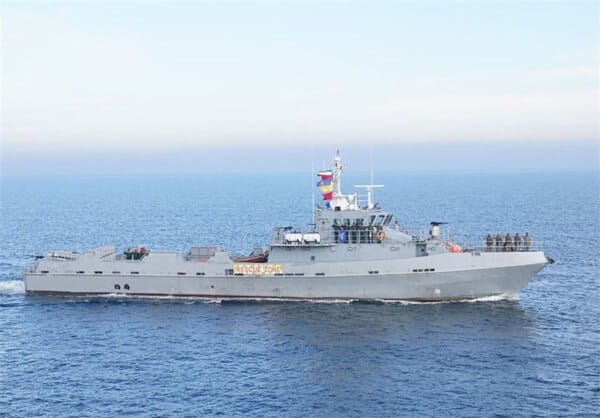
The IRGC Navy’s Martyr Basir (Tasnim - CC BY 4.0)
Dockside facilities and weapons stores in Bandar Anzali were also destroyed. The Israeli attack would not have primarily been designed to cripple trade in arms and ammunition between Iran and Russia across the Caspain, for which Bandar Anzali is the Iranian hub. Providing support for the defense of Ukraine has never been an Israeli preoccupation, although this could change if Russian components are discovered in Iranian drones and missiles used to target Israel.
The national security imperative which prompted the Israeli attack is much more likely to have been the support and protection of Azerbaijan, with whom Israel has a secretive defense cooperation agreement - likely vital to the continued prosecution of the current war.
In recent weeks, Iran has taken an aggressive stance with Azerbaijan, following its Arash-2 drone attack on Azerbaijan’s Nakhchivan International Airport, which caused damage to a terminal building and injured two civilians, and following which Azerbaijan closed its land border with Iran.
Iran in recent times has tended to treat Azerbaijan as if it is within its sphere of influence and should obey orders. It has occasionally threatened or issued Azerbaijan instructions, usually ignored. Or it makes policy announcements affecting both countries without coordination beforehand – as when Iran announced that road and rail routes to Russia were to be opened, without noting they would need to pass through Azeri territory. Prior to the current war, there were two particularly serious incidents – an attack in January 2023 on the Azeri Embassy in Tehran which killed a member of staff, and thwarted attempts to set up a Hezbollah-type organization in Azerbaijan.

that matters most
Get the latest maritime news delivered to your inbox daily.
The Azeris have suffered these insults stoically, borne of nationalist confidence particularly boosted since the successful war in 2023 to re-integrate Armenian-populated Nagorno-Karabakh. Nor has Azerbaijan yet sought to inflame tensions amongst the Azeri ethnic minority – Iran’s largest – in Northern Iran.
Relations however have not stabilized since the Nakhchivan attack at the beginning of March and the consequent closure of the land border. Hence the Israeli attack may have been intended to remove the Iranian capability to further threaten Azerbaijan - and to enable the now-dominant Azeri navy (post the destruction of the sea-going capability of Iran's 4th Naval Region) to close down the Iranian-Russian sea channel which passes through Azeri territorial waters, should it choose to do so as a retaliatory measure against Iran.
