
A Mediterranean Residence Worth Pursuing for American Families
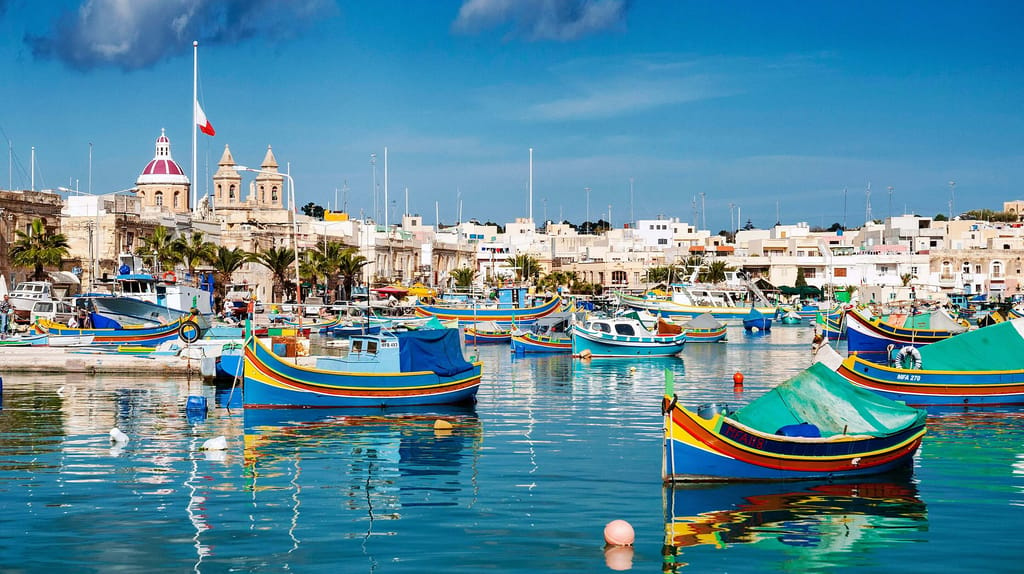
For American families with business interests on both sides of the Atlantic, Malta can offer more than a change of address. It provides a permanent base from which business owners and maritime executives can remain connected to the United States while operating closer to major ports, shipping routes, clients, and partners across Europe, North Africa, and the Middle East.
Malta combines long-term residence rights with an English-speaking environment and established maritime infrastructure. This makes it particularly attractive to families seeking greater mobility, continuity for their business interests, and a stable setting for education and long-term family planning.
Permanent residence rather than a temporary solution
Temporary permits are normally issued for a limited period and must be renewed. Renewal may depend on continued employment, income, investment, property, or other conditions. Permanent residence is designed to continue over the long term.
This difference matters when a family is planning beyond a short assignment. A temporary permit may suit a limited stay, while permanent residence provides a more predictable legal framework and reduces dependence on repeated renewals.
The terms must still be understood correctly. Permanent residence is not Maltese citizenship and does not provide a Maltese passport. It is also separate from tax residence, which depends on tax laws, physical presence, and personal circumstances.
American applicants should obtain specialist cross-border advice before changing where they live or spend substantial time.
English-speaking environment
English is an official language in Malta and is understood by around 96% of the working-age population. It is widely used in education, business, healthcare, and public administration. For American families, this removes one of the main difficulties of settling in another country.
Children can enter an English-speaking school environment without first needing to master a new language. Parents can speak directly with teachers, doctors, property agents, and legal advisers. Routine tasks such as arranging insurance, signing a lease, or opening local accounts can also feel more manageable.
The country, of course, has its own culture, systems, and pace of life. But the shared language can make the transition more accessible and allow a family to focus on adaptation rather than translation.
Practical location for internationally mobile people
Malta's location between Southern Europe and North Africa, together with direct air links to many major cities, makes it a practical base for maritime executives and business owners working across several markets.
From Malta, meetings, vessel visits, and industry conferences across Europe and the Mediterranean are generally easier and quicker to reach than from the United States. Shorter travel distances can reduce time in transit and make frequent regional trips more manageable, particularly for executives whose work connects Southern Europe, North Africa, and the Middle East.
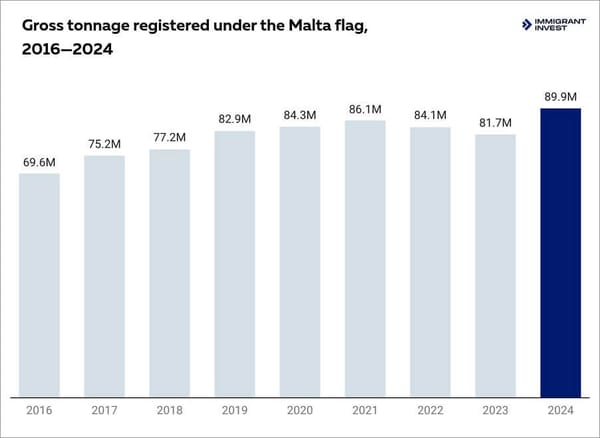
Malta flag gross tonnage chart
Permanent residence route for the whole family
High-net-worth families rarely make residence decisions for one person alone. A suitable programme should support the principal applicant as well as their relatives, while providing a clear framework for long-term residence.
The Malta Permanent Residence Programme is available to eligible nationals from outside the EU and EEA. A main applicant may include a spouse or partner, dependent children under 29, and parents or grandparents, subject to the programme's eligibility and dependency rules.
The programme requires applicants to fulfil several mandatory conditions:
– rent or purchase a residential property in Malta;
– pay government and administrative fees;
– make a donation to an approved Maltese organisation.
In addition, the applicant must demonstrate either:
– assets worth at least €500,000, including at least €150,000 in financial assets; or
– assets worth at least €650,000, including at least €75,000 in financial assets.
The full commitment goes beyond the property and government contribution. Families should also budget for professional services, document preparation, insurance, and the cost of maintaining the qualifying arrangements.
Life in Malta beyond the residence programme
A permanent residence card is useful only if the country works for the family in practice. Malta offers international and private schools, public and private healthcare, established international communities, and a range of residential areas.
The country's compact size can make daily routines more manageable. Schools, offices, clinics, ports, and residential districts are often closer together than they would be in a large country, although traffic and commuting times still need to be considered when choosing where to live.
Malta also offers a Mediterranean climate and an outdoor lifestyle shaped by the sea. For maritime families, that environment may feel familiar.
Families should compare school places, healthcare arrangements, property locations, and transport needs before choosing where to live.
Malta's main commercial ports are located around Valletta and Marsaxlokk, which gives executives direct access to vessel operations, port services, and regional shipping activity.
Conclusion: choosing Malta for long-term stability
For American maritime executives and high-net-worth families, Malta brings professional relevance, permanent residence, and everyday practicality into one jurisdiction. This combination may suit families that want to remain internationally mobile while creating clearer long-term arrangements.
The Malta Permanent Residence Programme is a regulated route to permanent residence in Malta. However, it is not citizenship or a tax solution. To assess your family's eligibility and the full cost of participation, contact Immigrant Invest for an individual consultation.
This article is sponsored by Immigrant Invest.
The opinions expressed herein are the author's and not necessarily those of The Maritime Executive.
