


Ship-Ready: Onboard Carbon Capture Has Arrived
Onboard carbon capture and storage (OCCS) is ready for ships. The bottleneck lies ashore.
(Article originally published in Mar/Apr 2026 edition.)
It's a work in progress. IMO has approved a work plan to build an OCCS regulatory framework, and the E.U. is leaving the door open to future recognition. But as DNV and Carbon Ridge both make clear, the bigger constraints are port-side infrastructure, access to storage, carbon accounting and the economics of getting captured CO2 off the ship and into a verified value chain.
The regulation is moving, but it's not finished.
At MEPC 83 in April 2025, the IMO approved a plan to develop a regulatory framework for onboard carbon capture and storage (OCCS), reestablished a correspondence group on measurement and verification, and set the technology on a path toward a more formal structure by 2028.
In Europe, FuelEU Maritime took effect January 1, 2025, but the European Commission was candid about why OCCS was excluded: limited maturity, limited demonstrated results and no international framework for traceability and long-term sequestration.
That leaves the sector in a familiar position. The technology is moving faster than the rulebook.
DNV
Merten Stein, DNV's Head of Shipping Advisory for West Europe & the Middle East, was direct: OCCS is not a winner-take-all rival to alternative fuels.
"Onboard carbon capture could be a third complementary solution in a portfolio," he says. "It's not which one will win; it's rather all of these will be in place." Efficiency first, alternative fuels essential, carbon capture joining them as a third tool for fleets managing both decarbonization pressure and fuel scarcity.
DNV's February 2026 OCCS report modeled onboard capture across five major container lines in the North Europe-Asia corridor and found that OCCS could become cost-competitive alongside low-GHG fuels if regulation, offloading infrastructure and cost conditions align.
Stein reduces the scaling question to three factors: regulation, offloading infrastructure and offloading price. "The lower the offloading cost, the more attractive the onboard carbon capture case becomes," he explains. Owners should run a total cost of ownership calculation weighing CAPEX, parasitic load and remaining carbon liabilities against simply paying the carbon bill.
On what is actually blocking scale, Stein is clear that it's not the shipowners.
"I think it's really the CO2 terminals and the permanent storage solutions that need to come," he states, noting those investments are being driven by land-based carbon needs, not shipping. At the port of Rotterdam, the CO2next and Aramis projects are targeting a final investment decision (FID) in 2026 or 2027, but the logic is cluster-first, not shipping-first.
Maritime OCCS will piggyback on that infrastructure rather than drive it.
Stein flags two make-or-break variables: purity and energy penalty. CO2 captured from dirty exhaust streams must still meet storage-provider standards, and DNV's assumption of a 20 percent energy penalty at a 75 percent capture rate keeps the commercial model viable.
Underlying both variables is a classification question that nobody has formally answered: Should captured CO2 be treated as waste, a commodity or an entirely new legal category? How that gets resolved will determine the chain-of-custody rules, cross-border transport permissions under the London Convention and Protocol, and how measurement, reporting and verification (MRV) frameworks are built across the whole value chain.
CARBON RIDGE
Chase Dwyer, co-founder and CEO of Santa Monica-based startup Carbon Ridge, says the company was built around three maritime realities: size, the ability to retrofit quickly and energy consumption – areas where many conventional capture concepts run into trouble. A system can look good on paper and still fail the ship-fit test.
Carbon Ridge's answer is a centrifuge-based approach that retains conventional amine solvents but changes how the solvent cycle is handled onboard. "The centrifuges allow us to reduce the size of the CO2 capture system by about 75 percent," Dwyer says, with 30 to 50 percent reductions in thermal heat requirement. Known solvents, more maritime-compatible architecture, components already familiar in engine rooms and a design built to run over a 15-to-20-year operating life are some of its other features.
The company has focused heavily on flue-gas pretreatment before capture. As Dwyer puts it, "The CO2 purity is very critical for the ability to either utilize it or sequester it permanently." The same purity challenge Stein flagged at the system level, Carbon Ridge is solving directly in hardware.
Carbon Ridge is past the concept stage.
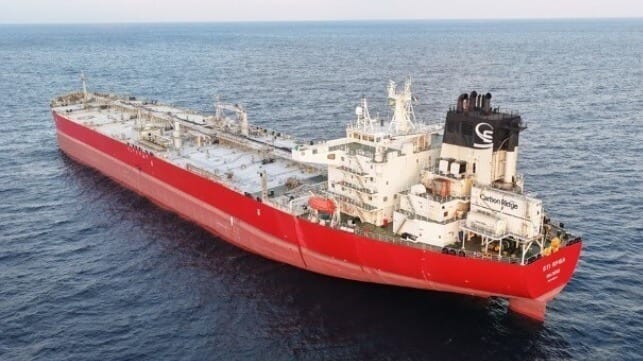
Its first pilot deployment aboard Scorpio Tankers' STI Spiga, an LR2 product carrier, has been running since July with strong CO2, sulfur and NOx removal results. Systems are modular and standardized, ranging from 0.25 to 10 tons per hour of CO2 capture, with current shipowner interest concentrated in the 1-4 tons per hour range.
For context, a 3-ton-per-hour system delivers approximately 70 percent CO2 removal for an LR2 tanker, or roughly 25 to 100 tons per day depending on configuration.
What separates Carbon Ridge from a pure equipment play is what happens after capture. The company acts as an intermediary between shipowners and storage developers, having active agreements with oil and gas majors and a service model designed to handle captured CO2 from ship to terminal to storage or utilization.
Storage providers want volume certainty. Owners want offload certainty. By absorbing that coordination layer, Carbon Ridge is removing what would otherwise be a serious commercial friction point for any owner considering the technology.
On traceability, Dwyer makes a point worth underscoring: "The benefit of carbon capture is that it's very traceable and measurable," describing a method that tracks inlet CO2, captured CO2, supply chain losses and parasitic energy use to build a verified net reduction figure. Alternative fuels often carry layers of upstream opacity that make lifecycle emissions difficult to audit. A capture system generates a far tighter, more defensible data chain from the exhaust inlet to permanent storage.
Dwyer also offers the sharpest commercial framing of the market's current position: "It feels to many like this is 2016, 2017 for scrubbers right now." That doesn't mean OCCS will scale the same way or at the same speed. It does mean the market may be entering the phase where a technology moves from pilot curiosity to fleet planning.
THE ECONOMICS
Both Stein and Dwyer kept returning to the same variable from different directions: the cost of capturing CO2 on the ship and transporting it to verified storage, measured against the cost of not doing so.
That second number is now concrete.
E.U. Emissions Trading System (EU ETS) compliance reached full implementation in 2026 with shipping companies required to surrender allowances for 100 percent of covered emissions, up from 70 percent in 2025 and 40 percent in 2024. With European Union Allowance prices averaging around $100 per ton of CO2 equivalent, the EU ETS is now adding approximately $319 per ton of VLSFO consumed on intra-EU voyages.
For a large containership on the North Europe-Asia corridor, annual carbon exposure ranges from $8.7 million to $12.4 million. For bulk carriers and tankers with meaningful E.U. port exposure, the bill ranges from $1.4 million to $2.7 million per year.
Those are the numbers OCCS has to compete with, not beat. If a shipowner can capture 75 percent of onboard CO2 at a 20 percent energy penalty and offload that carbon below the prevailing allowance price, the case begins to close.
Stein's framing is the total cost of ownership: Onshore infrastructure has to exist to receive the carbon at a competitive price. Dwyer's answer is a service model that covers the entire chain, so owners don't have to build a new market on their own.

that matters most
Get the latest maritime news delivered to your inbox daily.
Whether the captured CO2 at the end is classified as waste, a commodity or something new will determine what that market is actually worth.
Sean M. Holt is a regular contributor and writes from Southeast Asia.
The opinions expressed herein are the author's and not necessarily those of The Maritime Executive.
