


Growing the Legacy
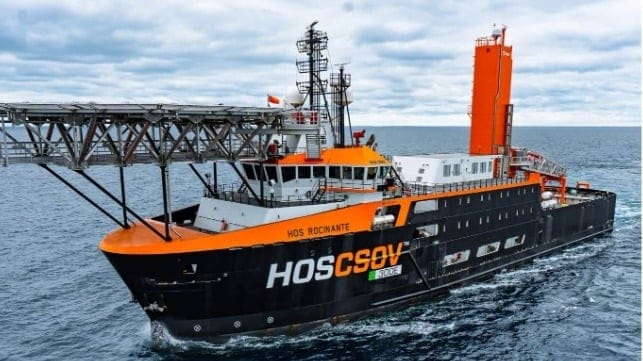
(Article originally published in May/June 2026 edition.)
"It's been an honor to move up within the company and ultimately get chosen to succeed my father and carry on the legacy," says Joey D'Isernia, Chairman & CEO of Eastern Shipbuilding Group (ESG). The sixth of founder Brian D'Isernia's 10 children, he assumed his current position three years ago when his father retired and became Chairman Emeritus.
He enjoys the challenge. "I always tell our customers and especially our bankers that I'm the boring one," D'Isernia quips. "My father was the adventurous one who went out and explored the world and founded a business and did all sorts of cool stuff. I don't have the stories, the Indiana Jones-type stories, that he does."
Maybe not, but the low-key, deliberate manner of someone who majored in finance in college may be just what the company needs at this stage of its development – a person who knows how to read a balance sheet and also knows his way around a shipyard.
And while he may not have inherited his father's swashbuckling style, he did inherit his drive and smarts and, most of all, his values – honesty, hard work, fair-mindedness, humility and family. "I never ask an employee or expect an employee to do something that I personally wouldn't be willing to do for the company," he says.
"Sustainable growth" is his goal, growing responsibly and in an enduring manner that can weather the inevitable ups and downs of the business cycle – building a company that will last for another 50 years and more. After all, the livelihood of not just his family and the company are at stake, but that of the 1,300+ employees who work there and their families as well.
It's a big responsibility, and he loves it.
PROFILE
Headquartered in Panama City on the Gulf of Mexico in the northwest corner of Florida, ESG today is a leading Tier II shipbuilder with three yards and a diverse portfolio. It can build anything from small fishing boats (which is how it started) to offshore workboats to giant dredges and 400-foot passenger and vehicle ferries for Washington State Ferries, which it's doing right now. And that's just the commercial side.
On the government side, there's the Offshore Patrol Cutter program for the U.S. Coast Guard and a growing business in "distributed shipbuilding" for the U.S. Navy as the Trump Administration prioritizes revitalizing the U.S. shipbuilding industry. This involves building modular units for U.S. Navy vessels and shipping them off to Tier I shipyards like Ingalls Shipbuilding in Mississippi for inclusion in the final product.
Distributed shipbuilding is common practice in foreign yards, says D'Isernia, and now that the U.S. is getting serious about shipbuilding, it's catching on here too and should mean big opportunities ahead.
Tier II yards like ESG are known for their craftsmanship and reliability, and ESG has a definite edge given its bigger size and product range. It boasts three yards – two in Panama City and one in nearby Port St. Joe – and a large, talented workforce.
Of the three yards, the original Nelson Street yard in Panama City does mainly government work. The Allanton yard, the company's biggest, is focused on commercial work, and the Port St. Joe yard – the newest – does final outfitting and will be the future site of a 10,000-ton floating drydock, part of ESG's plans for growing its ship repair business.
Asked if there's an ideal mix between commercial and government work, D'Isernia says no, there really isn't.
"I think the ideal mix is, ultimately, you have to have enough volume to efficiently cover your overhead and make money and reinvest that money back into the ground, the people, the processes, the infrastructure, and become more competitive and move up and move on," he explains. "So I wouldn't say there's an ideal mix. I think it just depends on where the market's at, and the market's pretty dynamic. So I think for us, we want to remain diversified, not just across the various types of commercial vessels, but we want to remain in government and in commercial shipbuilding so that we have a better opportunity to weather the various ups and downs in different segments. We want to maintain a foot in as many of the right doors as we can and remain competitive in those so that we're a much more sustainable operation in the long term."
TALENT PIPELINES
Perhaps the biggest challenge facing shipyards these days is a growing scarcity of skilled workers, and ESG is no exception.
To combat this, D'Isernia has established a whole network of what he calls "talent pipelines."
"We invest heavily in training programs," he states. "We call them talent pipelines, and we've got 14 or 16 regional institutions that we partner with to develop talent pipelines. These are high schools and trade schools with welding and fitting and electrical classes to teach specific core skills like shipfitting, pipefitting, welding, electrical work – essential trades in a modern shipyard."
There's even a planned maritime training academy in the works – a partnership between ESG and Gulf County to be called the Gulf County and Eastern Shipbuilding Group Maritime Academy. Based next to ESG's Port St. Joe facility, the project is still in development, but initial funding has been secured. The goal is to produce workers who can make an immediate contribution in the company's shipyards.
In the interim, the company uses non-skilled trades like general labor as a farming ground to get workers excited about shipbuilding and then move them into a trade like fitting, welding, electrical work and engineering.
"There's lots of opportunity for upward mobility in our shipyard through that route," says D'Isernia. "We try to show people that there are various paths to success, and you can do a number of different things or just stay in one trade, whatever your preference. It's all part of the shipbuilding value chain."
Safety is an integral part of that training, and in May ESG received recognition from the Shipbuilders Council of America for the second year in a row. The annual awards recognize shipyards for their dedication to safety, operational excellence and accident prevention.
"Year over year, improvement in safety performance reflects a deeper cultural strength within our industry," stated Matt Paxton, President of SCA. "What we are seeing from shipyards like Eastern Shipbuilding Group is not just compliance, but continuous refinement in how they protect and support their workforce."
MISSION-READY
As it looks to the future, the company describes itself as "mission-ready" – the mission being not just the next project or the next contract but also helping reestablish shipbuilding as a core strength of the U.S. economy. D'Isernia takes great pride in the fact that he runs a family-owned and operated American shipyard and applauds the Administration in Washington for "shining a light" on shipbuilding and its importance as a strategic asset.
"We're working very closely with the folks who are putting the plans together," he says, "and we've tried to give some good solid feedback on what we think would really help shipbuilding expand in the U.S."

that matters most
Get the latest maritime news delivered to your inbox daily.
He's pleased with the recently released Maritime Action Plan and is keen to see it develop into legislation and appropriations that make their way down to the shipbuilders and operators so that "We can grow the merchant fleet, we can grow our national defense fleet, and we can grow our industrial base, our shipbuilding industrial base that ESG is a very important part of."
So the future looks promising. More government work and more commercial work should be coming, and Eastern is "mission-ready." Here's to the next 50 years!
Jack O'Connell is the magazine's Senior Editor
The opinions expressed herein are the author's and not necessarily those of The Maritime Executive.
