
Securing the Strait: The Need to Reclaim the Disputed Islands
Predictably, given that their control over the Strait of Hormuz is their strongest negotiating card, the Iranian regime has ignored President Donald Trump's demand that they reopen the waterway to international traffic. President Trump says that constructive talks are now underway with Iran, something that Iran denies, although President Trump has followed up by suspending his threat to destroy Iran's power infrastructure. Any such attempt would no doubt in turn bring an Iranian response in kind, albeit with the power and desalination infrastructure of the Gulf states targeted and suffering the damage, rather than the United States.
The United States does, however, have a number of ways it could respond to Iranian intransigence.
Iranian crude oil and LNG traffic is still passing through the Strait, with Iran enjoying huge increases in the price of these cargoes created as a consequence of their closure to traffic carrying the crude and LNG produced by GCC states, and Kuwait, Qatar, and the UAE in particular. The United States has the wherewithal to shut down this Iranian traffic immediately, thereby starving the Iranian regime of the funds to keep the repressive internal security apparatus of the IRGC motivated, and for the subsidies on basic essentials, which dampen the ardor of ordinary Iranians to rise up against the regime.
A similar effect could be delivered by closing down loadings of crude oil from Kharg Island, which could be achieved simply and efficiently either by imposing a no-sail zone around Kharg Island, enforced remotely by air and sea power, or at huge cost in casualties with boots on the ground by seizing and then holding on to Kharg Island with U.S. Marines.
Otherwise, Admiral Brad Cooper, Commander CENTCOM, may have to resort to a complex military operation to clear the Strait. This would entail a continuation of the current program of attacks on Iranian naval and missile infrastructure used to keep the Strait closed, followed by a mine clearance operation, expulsion of any Iranian vessel, large or small, from the Hormuz area, and finally convoy operations through the Strait with a heavy aerial overwatch in place over areas from which any convoy might be threatened. With the Iranian side of the Strait stretching to about 250 miles of coastline, this would be an operation fraught with risks and ample opportunities for things to go wrong. Even when the first convoy was ready to set sail, risks for merchant traffic would have been reduced - but not eliminated.

that matters most
Get the latest maritime news delivered to your inbox daily.
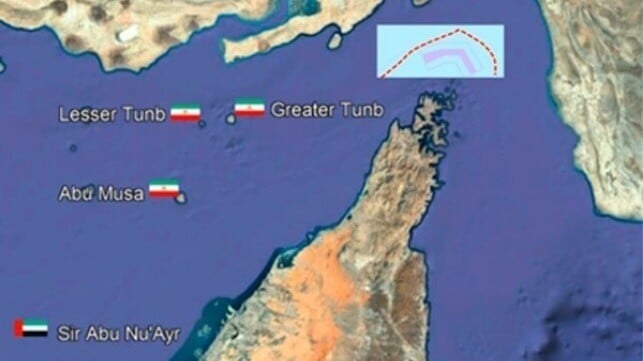
There is a further complication, not widely appreciated outside maritime circles. Once through the Strait, traffic in the Gulf remains under the guns of the Iranians. Indeed, whereas both inward and outward channels of the TSS within the narrows of the Strait are actually within Omani territorial waters, once inside the Gulf, the TSS channels then switch into Iranian waters. Indeed, the TSS channels pass either side of the Greater and Lesser Tunb islands, which, along with Abu Musa island that dominates the southern Gulf, are islands seized by Iran from the British on November 30, 1971, hours before they should have been handed over to the newly-independent United Arab Emirates.
There can be no security for international maritime traffic if Iran remains hostile and in charge of these three Disputed Islands, armed with drones and missiles which can dominate the surrounding waters; as such, they are a more worthwhile (and safer) target for occupation than Kharg Island. Hence, there is a strong argument that the Disputed Islands should be returned to their rightful owners, and that the United Kingdom has a residual responsibility under international law for completing the handover of what should have formed an integral part of the United Arab Emirates on December 2, 1971.
The opinions expressed herein are the author's and not necessarily those of The Maritime Executive.