
Op-Ed: The Most Important Meeting in the World is About Oil
On the morning of March 1, a tanker called the Skylight was moving through the narrow waters north of Khasab, Oman, when a projectile struck its hull. Omani authorities said all 20 crewmembers were evacuated. Later reports confirmed that two had died. By the time news reached trading floors in London and Singapore, the Skylight had already become something larger than itself — a data point in a disruption that analysts were beginning to describe, with the careful hedging of people who deal in understatement, as the worst energy crisis since the 1970s.
The Strait of Hormuz is 21 miles wide at its narrowest point. Generations of planners and strategists have studied it, war-gamed it, written contingency documents about it. Over the years, Iran threatened to close it many times but never did. When the closure finally came, after the United States and Israel launched Operation Epic Fury on February 28, it arrived not through naval blockade or mines or the sophisticated anti-ship missiles that analysts had always imagined. It came from drones — cheap, expendable, deployed selectively near the strait's narrow S-curve until insurers and shipping companies made the rational calculation that the waterway was no longer safe. The physical infrastructure of the global oil trade, it turned out, wasn’t undone by the Iranian navy but by the actuarial mathematics of risk.
Iraq had roughly six days of storage when Hormuz effectively closed. Kuwait had fourteen. The UAE seventeen. Those numbers mattered in ways that were easy to state and difficult to fully absorb: when tankers stop moving, oil has nowhere to go, and fields that cannot store output have only one option. Iraq's largest fields are shutting down now, not because of bombs or sanctions, but because the arithmetic of production without export has only one answer. Brent crude, which traded near $60 before the first strikes, is now trading north of $100. The IRGC has since announced that no vessel will transit the strait and that oil will reach $200. Whether any of this is literally true is, in some sense, beside the point. The market believes enough of it to behave accordingly.
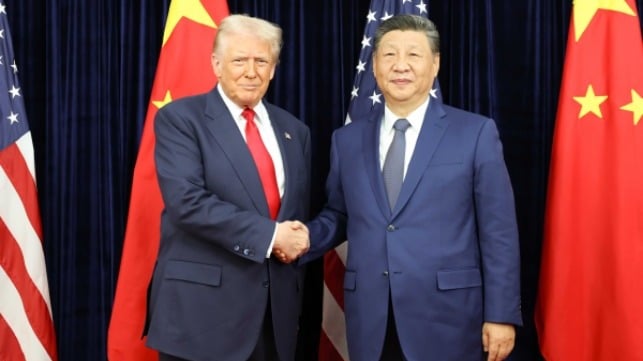
President Donald Trump is scheduled to land in Beijing on March 31 to meet with Xi Jinping. The meeting was conceived in a different moment — a world in which the central frictions between the two countries were tariffs, semiconductors, and TikTok. That world still exists, technically, but it has receded. What has not receded is the fact that roughly forty percent of China's oil imports normally transit the strait that is now closed, and that Beijing — Iran's largest crude customer — has already dispatched a special envoy to Tehran urging a ceasefire. China is not panicking. It spent 2025 building storage, accumulating what analysts estimate as roughly four months of import coverage. It has Russian pipeline gas and domestic coal. But it is also the country with the most direct influence over the party that closed the strait, which makes the coming summit something stranger and more complicated than a trade negotiation.
The country with the most to lose is not in the room. Japan gets roughly 70 percent of its Middle Eastern oil through Hormuz. Its refiners are already asking the government to release emergency stockpiles. There is no adequate bypass, no comparable storage buffer. South Korea sits in nearly the same position. American allies, in other words, are absorbing the sharpest edges of a crisis that an American decision set in motion — a fact that will not be spoken aloud in Beijing but will be present in every exchange.
One detail keeps returning. At its narrowest, the Strait of Hormuz is only 21 miles wide. On a map it hardly seems like a place that could carry so much weight. In an age of satellites, carrier groups, and supply chains that run across entire oceans, 21 miles ought to be manageable. It ought to be ordinary. But the people closest to the water see it differently. The Indian sailors aboard the Skylight. The tanker captains who have quietly turned their ships around and begun the long voyage away from the Gulf. The refinery managers in Osaka who now spend their mornings looking over inventory reports, counting the days of crude still in storage. None of them think of the strait as an abstraction.
For years the strategic documents treated Hormuz as a problem that could always be solved. The waterway was narrow, but it was also heavily watched, heavily studied, heavily protected. Planners wrote contingency plans. Analysts ran simulations. And beneath all of that was a quiet belief that the strait would remain open, because it always had. But openness was never really a policy. It was a habit. And habits are strange things. They grow slowly, through repetition, until they begin to feel permanent. Only when they break do people realize how little was holding them in place. In places where the normal rules stop applying, that lesson arrives quickly. The people who live or work near those places tend to learn it first.

that matters most
Get the latest maritime news delivered to your inbox daily.
Trump arrives in Beijing in eighteen days. Xi will be waiting.
Erik Bethel is a General Partner at Mare Liberum, an investment fund at the intersection of critical technologies and the maritime domain. Previously, he served as US Director of the World Bank.
The opinions expressed herein are the author's and not necessarily those of The Maritime Executive.