
Op-Ed: Carrier Deployments Prompt Speculation About a U.S. Attack on Iran
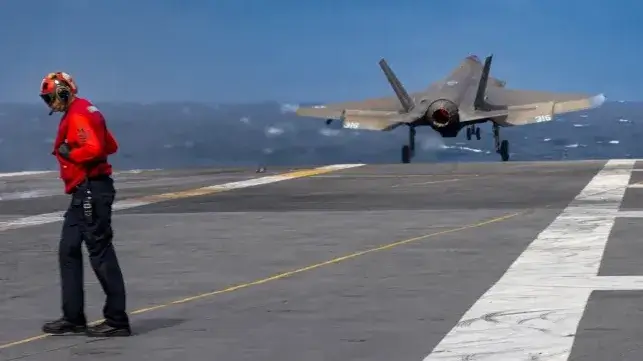
Open source intelligence sleuths posting on social media are closely monitoring US force deployments into the Middle East region, like the movements of the supercarriers USS George H.W. Bush and USS Abraham Lincoln, and some are concluding that a window is opening up for an attack on Iran towards the end of January.
The situation is extremely difficult for those without operational planning experience and access to classified information to read. Surprise is still a highly important ingredient of offensive activity, and those charged with maintaining operational security demonstrated in the run-up to US and Israeli attacks on Iran in June last year that they were well aware of their vulnerability to open source speculation.
Both Israel and the United States managed last year to mask their tactical intentions, despite close open source oversight. This was achieved by executing a sophisticated deception plan, part of which involved feeding the open source intelligence community plausible, expected but diversionary narratives. The best practice deception plan which still inspires operational planners dates to 1944 - the ruse that persuaded the Germans that the Allied invasion was heading for the Pas de Calais, which the Germans were still convinced was the case several days after the landings had commenced in Normandy.
Politically there is little doubt that the United States would like to effect regime change in Iran. Moreover, President Donald Trump has threatened military action, and is probably committed personally with following through with his promise to the Iranian people that ‘help is coming’. Multiple factors - the Iranian nuclear threat, the threat from their still substantial ballistic missile force and the IRGC unwillingness to row back from regional expansionism and destabilization - all suggest further years of regional instability.
The difficulty which military planners and neighboring regional states have impressed upon President Trump is that while a military strike could decapitate the Iranian leadership, it would not immediately collapse the regime. There also needs to be a post-attack constitutional plan for government – otherwise the organs of state will remain in the hands of those still loyal to the concept of Velayat-e Faqih religious rule. Without a credible post-attack plan, chaos for the entire region could ensue.
The attitude of Israel is also particularly important, especially as it has unique operational capabilities which would greatly enhance the effectiveness of any American attack. Whatever might be on its wish-list, Israel has a well-established practice of launching military offensive action only when its national security is directly and immediately threatened. There is no such immediate threat at the moment – although without regime change, one can be expected to emerge sometime in the future.
If the dangers of post-attack chaos are to be averted, then one of two options must be achieved. The first would be an initial attack so massive as to neutralize the Islamic Revolutionary Guard Corps' huge capability. There is no indication yet that a capability to deliver such a massive blow is being assembled.
The second option would be an attack launched in support of a widespread resumption of street protests, or protests in areas with substantial concentrations of ethnic minorities, which would stretch the IRGC’s internal security apparatus and put the regime on the back foot.

that matters most
Get the latest maritime news delivered to your inbox daily.
After the brutality which the IRGC’s Basij internal security forces have meted out, with reliable estimate of between 10,000 and 16,500 street fatalities - such that every family in Iran knows of someone killed - the regime has no legitimacy left and anger is at peak; a resumption of protests is more likely than not. The USS Abraham Lincoln (CVN-72) and its carrier strike group may be in the region for some time in anticipation of this contingency.
Current US deployments moving to the region appear to be more a contingency to support a resumption of street protest when they occur, rather than preparations to initiate an imminent massive attack.
The opinions expressed herein are the author's and not necessarily those of The Maritime Executive.