
Op-Ed: Arctic Bypass Emerges as Alternative to US-Centric Shipping Networks
Red Sea attacks and Arctic ice melt are now part of the same story: as one corridor has become a live-fire risk for seafarers, planners sketch a Nordic-Arctic bypass that could weaken the networks the United States relies on for leverage, and that underpin today’s US-centric maritime system. The emerging question for US-linked maritime actors is whether American sea power is becoming less a guarantor of open routes and more an architect of “coercive connectivity” that accelerates the search for alternatives.
Red Sea: when protection becomes a pressure point
In the southern Red Sea, Houthi attacks have turned a core lane of Asia-Europe trade into a corridor where every transit is a calculation about risk, insurance, and crew safety rather than just time and fuel. Rerouting container services around the Cape of Good Hope increases transit times and absorbs effective capacity, with estimates ranging from about 3% higher global ship demand to around 9% less effective container shipping capacity, depending on trade mix and assumptions.
Operation Prosperity Guardian has reintroduced convoy-style escorts, with US and partner warships shadowing commercial ships through Bab el-Mandeb and the Gulf of Aden. Washington and its allies present this as a defensive “highway patrol” to protect seafarers and keep vital trade moving through an active conflict zone. This feels less like a “freedom of navigation” mission and more like route-specific risk management, where naval protection, flag, and compliance posture determine who can move, where, and at what premium.
Greenland and the Nordic passage: credible but constrained hedge
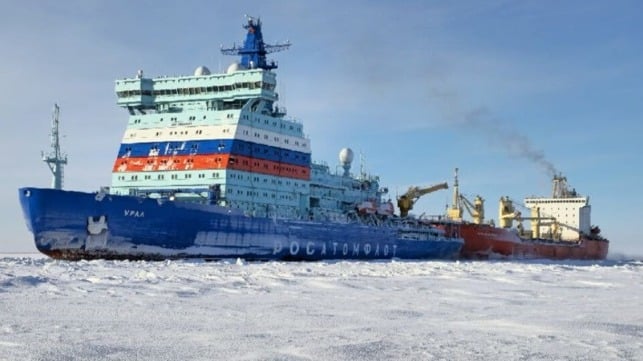
Thousands of miles north, retreating sea ice and better ice class capability are opening frequent seasonal windows along Arctic and sub-Arctic routes, including options that bend around Greenland and the North Atlantic rather than squeezing through the Suez-Red Sea axis. Today, these flows remain tiny compared with Suez traffic, as Arctic transits number in the hundreds per year, versus tens of thousands through the canal, and are constrained by seasonality, ice-class requirements, environmental concerns, and limited port infrastructure.
The point is not that a Greenland-adjacent “Nordic passage” is about to replace the Suez Canal, but that it is becoming a serious hedge and investment thesis for certain cargoes, asset owners, and states. For now, that thesis is most compelling to a relatively narrow set of Arctic-capable shipowners, energy cargo stakeholders, and Nordic governments seeking to leverage their geography while limiting exposure to US-centric maritime chokepoints. In this emerging map, Greenland and nearby hubs are about resilience, optionality, and strategic advantage: backup corridors, diversified bunkering and insurance portfolios, and the ability to re-route around weaponized straits without shuttering supply chains.
US strategy: the move from sea power to chokepoint control
The 2025 US National Security Strategy orders agencies to secure ‘independent and reliable access to critical goods and to deny rivals control of ‘strategically vital assets’, while pledging to prevent ‘non-hemispheric competitors’ from owning such assets in the US hemisphere, embedding them at the core of a US-centric maritime and financial network. It also stresses alliances, shared maritime awareness, and partner resilience, recognizing that no single navy or legal system can underwrite international sea lanes alone. That language places ports, canals, and terminals squarely inside national security doctrine, treating them as levers of state power as much as infrastructure for trade.
This has driven a more assertive posture at chokepoints. Panama’s long-running debate over Hong Kong-based Hutchison Whampoa’s concessions at Balboa and Cristóbal is one example: US lawmakers have repeatedly framed those leases as a security threat, and recent discussion of a US asset manager taking a stake in the operations shows how quickly commercial arrangements can be pulled back into Washington’s domestic politics. The same coercive logic is visible at sea in the boarding, diversion, and detention of tankers suspected of carrying sanctioned Iranian or Russian crude, signalling to shipowners and insurers that specific flags, routes, and ownership structures now sit in a zone of heightened enforcement risk.
Market response: weaponized interdependence, weaponized choice
American naval reach and US-centric legal and financial networks underpin a relatively predictable environment for high-value, dollar-denominated trades across the Atlantic and Indo-Pacific, and US forces remain uniquely capable of sustaining presence at multiple chokepoints simultaneously. Yet research on “weaponized interdependence” shows that when a hub state leans heavily on its central position in trade and finance to coerce others, the long-term effect is to push those others to rewire around alternative ports, routes, currencies, and legal regimes.
The Red Sea and Greenland sit on either side of this dynamic. Every time a corridor like Suez-Bab el-Mandeb becomes a theater for recurring interdictions, escorts, and insurance shocks, cargo owners and financiers gain another reason to invest in physical bypasses such as Nordic and Arctic routes, and in financial and legal alternatives that dilute exposure to US-centric systems, even when those same US-backed operations are credited with helping thousands of ships transit safely. At the same time, the scale and speed of diversion remain uneven: some carriers and segments are returning to the Red Sea as risk eases, and Arctic options will likely remain niche for years, making the erosion of US centrality a medium-term risk trajectory rather than a fait accompli.
A leader’s playbook in an age of coercive connectivity
US-linked shipping and logistics providers, embedded in US-centric legal and financial networks through dollar clearing, P&I cover, and technology, are squarely within the scope of US sanctions and export control law. At the same time, routing and investment patterns show some non-US actors experimenting with Chinese-financed ports, Gulf and Asian transhipment hubs, and insurance and finance providers less tightly bound into US legal frameworks to diversify their exposure.
Boards and executive teams should consider five priorities that follow from a Red Sea-to-Greenland view of coercive connectivity:
- Assign ownership of corridor risk: Make a board-level risk or strategy group/team explicitly responsible for mapping corridor-specific exposure (Red Sea, Suez, Panama, Arctic/Nordic options) across fleets, customers, and counterparties, using digital twins and scenario tools where available.
- Align internal decision-makers: Link procurement, network planning, and customer-facing teams into a single corridor-risk process so that routing, contracting, and customer commitments reflect the same assumptions and triggers.
- Quantify exposure and thresholds: Define numeric triggers, like war-risk premia, delay days, security incidents, at which routes will be changed, contracts reopened, or options such as Nordic diversions considered, and embed these thresholds into internal playbooks and customer service level agreements.
- Treat strategic concessions as political assets: When bidding for or operating terminals in places like Panama, the wider Caribbean, or key energy routes, price in the risk that arrangements may be revisited under national-security frames over the life of the concession, and structure contracts with review and exit mechanisms accordingly.
- Diversify legal and financial channels: Where consistent with law and corporate values, avoid over-concentration in any single jurisdiction’s currency, insurance, classification, or tech stack so that enforcement spikes in one system do not automatically paralyze global operations.
- Invest in seafarer safety and communication: In an environment of convoys, diversions, and sudden enforcement actions, credible, proactive engagement with crews and unions on routing decisions, protection measures, and support in crisis is a strategic necessity, not just a compliance box.

that matters most
Get the latest maritime news delivered to your inbox daily.
The leaders in this environment will be those who master weaponized choice: the ability to walk away from any single corridor, currency, or chokepoint and still deliver on time. The strategic question, viewed from the Red Sea to Greenland, is whether US policymakers and maritime actors can calibrate their use of chokepoint control and enforcement to protect seafarers and supply chains without accelerating diversification that could erode US-centric networks over time.
Wolfgang Lehmacher is a global supply chain and logistics expert. The former director at the World Economic Forum and President and CEO Emeritus of GeoPost Intercontinental is an advisory board member of The Logistics and Supply Chain Management Society, an ambassador for F&L, and an advisor to Global:SF and RISE. He contributes to the knowledge base of Maritime Informatics and is a co-editor of the book Maritime Decarbonization.
The opinions expressed herein are the author's and not necessarily those of The Maritime Executive.