

Norway is Building the Most Advanced Testing Basin Ever Constructed
[By Henriette Louise Krogness and Tore Stensvold]
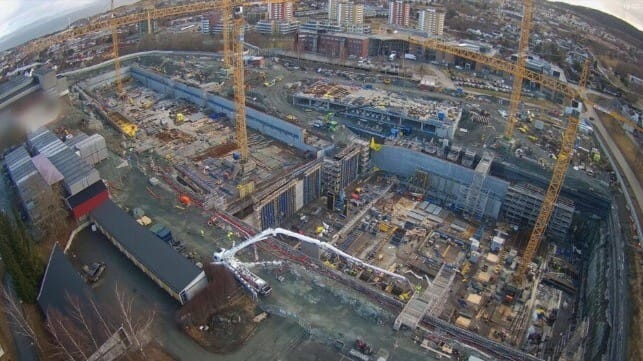
It was no easy task for Statsbygg when the Norwegian Ocean Technology Centre was given the go-ahead to put shovels in the ground at Tyholt in Trondheim, Norway. Statsbygg oversees the Norwegian government’s building and property development affairs.
“I have never had a more challenging task in my entire career,” says Statsbygg project director Arild Mathisen.
“That’s because nothing like this has ever been built in Norway, or anywhere else in the world,” he says.
Construction pit
The huge construction pit will house two state-of-the-art test basins. Vegar Johansen, CEO of SINTEF Ocean, says that customers who want to be first in line when everything is ready have already submitted requests. The need is still great for testing outside of computers.
“I have never had a more challenging task in my entire career,” says project director Arild Mathisen at Statsbygg.
“There’s simply a lot that cannot be simulated or calculated, even with advanced computer programs. It’s when we combine simulations and physical tests that we can see what may need to be changed and adjusted,” says Johansen.
Testing ship models, a cage or offshore wind turbines in the basins can be conducted under realistic conditions.
“The tests provide us with reliable and absolutely necessary data for how the structure would handle conditions at sea,” says Johansen.
But it is no small task to build what is being described as “beyond state of the art”. It’s a little like taking a construction kit home, but the pieces aren’t finished and there are no instructions. What do you do then?
Gray hair and sky-high requirements
When SINTEF Ocean set up the specification requirements for the wave and current facility in the Ocean Basin, they found that what they needed did not exist.
“We had to connect experienced engineers in the construction industry with specialists and researchers at NTNU and SINTEF to find a solution,” Johansen says.
And that challenge is precisely what has given Statsbygg project director Mathisen his gray hairs. The requirements for accuracy and quality at all levels are rigorous, but also absolutely necessary for the basins to carry out the tests they are built to perform.
“We have to get this right. It’s what will set the Norwegian Ocean Technology Centre apart from all other facilities,” says Mathisen.
The currents and measuring equipment are the “beyond state of the art” factors that impact the basin’s wave quality the most. They require very specialized components. Shavings and loose pieces of steel in the pool are a no-go for the advanced flow system. That is why Nordic Steel has prefabricated 2500 components in stainless steel – almost like a giant Lego Technic set to be assembled. Fortunately with instructions this time.
“Everything has to be screwed and bolted into place. The concrete work, the rails and the fastening plates have to be accurate to the millimetre,” says Dariusz Fathi, research director for Ships and Ocean Structures at SINTEF Ocean.
Extreme conditions and unmatched concrete
The flow system will be powered by approximately 90 pumps that push water, equivalent to 2.5 times the amount of the river water in the Nidelva, around the ocean basin. This is necessary when future structures are required to be tested with both waves and currents. Water volumes on this scale are sometimes necessary in order to recreate extreme environmental conditions.
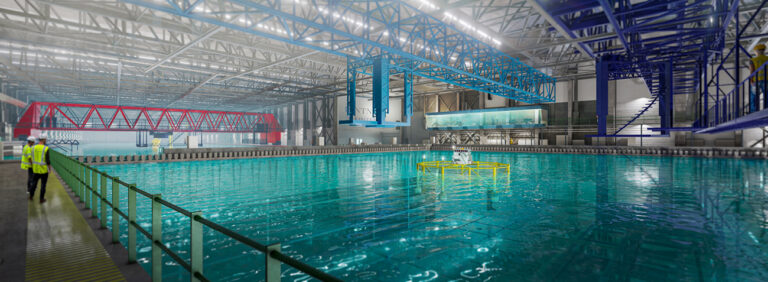
The new ocean basin will be 60 meters long by 50 meters wide. The depth can be adjusted from zero to twelve meters. A smaller part of the basin is 30 meters deep. Illustration: LINK Architecture.
“With the wave and flow system here, we’ll be able to create complex wave systems that are more similar to real conditions. We’ll have the world’s most advanced ocean laboratories with all the options to simulating reality on a model scale,” says a smiling Fathi.
Neither Fathi nor Johansen knows of any other laboratories that are able to test ships and structures in realistic sea conditions, in terms of their seaworthiness, manoeuvrability and energy efficiency.
The concrete that is being used is not an off-the-shelf item either. It needs to be membrane-free and 100 percent waterproof. In addition, it has to withstand extreme forces from waves. NTNU and SINTEF’s concrete experts have worked closely with the contractor firm HENT (Construction and Engineering). The result is a type of concrete that has not been used anywhere else.
Blue whales, Earth’s curvature and millimeter precision
The seakeeping basin is 180 meters long. That is equivalent to a Hurtigruten cruise ship and an Olympic swimming pool. When the model boats are to be tested there, a special vehicle weighing just under 200 tonnes is driven on rails along the entire basin. That is about the weight of the world’s largest animal, the blue whale. Or four railway cars if you like.
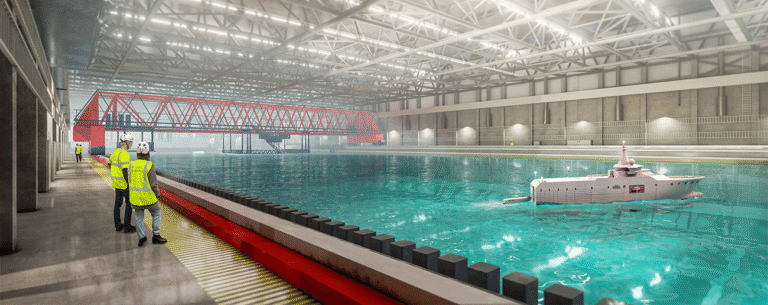
The new seakeeping basin will be 180 meters long, 40 meters wide and six meters deep. Illustration: LINK Architecture
This special vehicle makes it possible to test fast-moving vessels in all conceivable wave directions at up to 80 knots. That is almost 150 km/h.
For the tests to be good enough, there is no room for deviation. The tests must be able to be repeated several times under exactly the same conditions. So absolutely no external reasons can move even a millimeter. The support systems in the roof and walls are pure engineering art.
Large amounts of extra reinforcement have also been used in the concrete to strengthen the building. However, all of this is not quite enough. The curvature of the Earth must also be taken into account in the calculation. The special vehicle must follow the Earth’s radius, which in this basin is between six and seven millimeters.
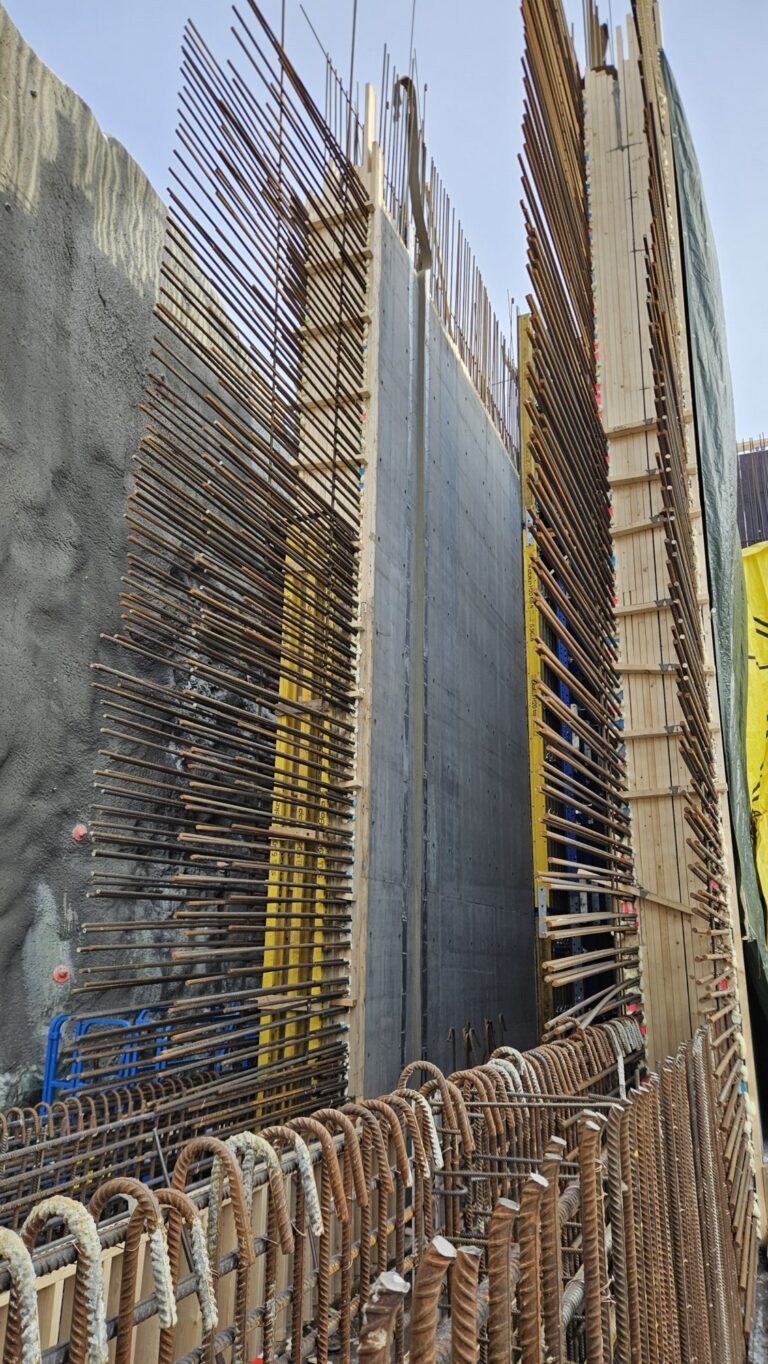
The extra reinforcement is intended to ensure that the building is extra stable. Photo: Tore Stensvold
Since 1939, the research community at Tyholt has been involved in developing most of the components in ships and floating structures. Almost all the oil platforms on the Norwegian continental shelf have been tested in the Ocean Basin. This has given Norway a unique position and created enormous income for the state and the business community.
“The research community in Trondheim has always worked closely with the marine industries, and together we have contributed to our companies being at the forefront of technology. This has provided Norway with large revenues for the oil fund, created jobs in rural areas and ensured Norwegian competitiveness globally,” says Johansen.
With the new center, Johansen expects he will be able to continue to contribute to the nation’s revenues and maintain the social welfare state.
An eldorado for students and researchers
The students will have their own house in the new centre with their own laboratories where theory can be put into in practice.
“We educate candidates for the entire maritime industry and have many research projects where these laboratories will be useful,” says Sverre Steen, a professor and head of the Department of Marine Technology at NTNU.
The students’ playground will be called Archimedes’ House. It will be located under the same roof as the ocean basins and the office and teaching building that are already completed. The teaching building has received BREEAM Outstanding rating, the highest international certification for sustainable buildings.
The proximity between students, researchers and world-class laboratories means that students become part of the research and can contribute ideas and development proposals. The goal is for the building to facilitate interaction between people, machines and the environment. They will not just be traditional laboratories.
“Physically observing what is learned theoretically is worth gold for today’s students, many of whom do not have practical experience either in shipping or industry,” says Steen.
The students will take what they learn here with them into the workplace. And they do not need to go abroad to be at the forefront. Now foreign researchers will come here instead.
A green future
Customers at the ocean basins test ships, cages, offshore wind structures, floating solar panels and other floating structures. They are tested to check that the design is safe and can withstand increasingly demanding conditions at sea – before investing in construction.
“When Norwegian marine industries are expected to develop more profitable and sustainable solutions, it matters whether the construction is tested in Trondheim or abroad. Increased competence and knowledge in Norway is an investment for all of us. The investment here contributes to jobs and has ripple effects along the entire coast,” says Johansen.
The founders of the Ship Model Tank were extremely far-sighted when they planned and built the Towing Tank, which was completed already in 1939.
“The fact that world-leading research is still being carried out in the same basin in 2026 is simply incredible,” says Johansen.

that matters most
Get the latest maritime news delivered to your inbox daily.
However, this 87-year-old landmark is starting to get tired. Soon younger forces will take over.
This article appears courtesy of Gemini News and may be found in its original form here.
The opinions expressed herein are the author's and not necessarily those of The Maritime Executive.