
Video: SMIT Helps Egyptian Port Authority Refloat FSRU After Drone Strike
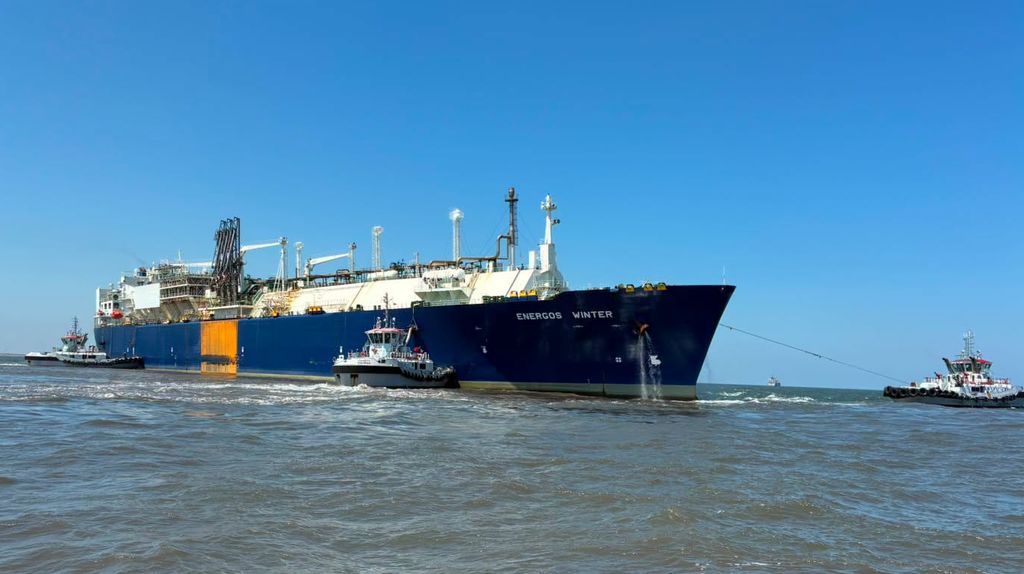
In conjunction with SMIT Salvage, the staff of the Damietta Port Authority have completed a delicate operation to refloat the LNG FSRU Energos Winter and remove it to a safe anchorage.
Energos Winter was attacked by a drone from an unknown adversary on July 29, causing a blast and a fire on board. The blaze spread to a second nearby LNGC, the GasLog Salem. Both fires were brought under control, and no injuries were reported. Egyptian authorities confirmed that the casualty was caused by a drone strike, but have not identified the suspected perpetrator.
At about 1400 hours on the day of the attack, Energos Winter left her berth in the inner harbor and ran aground just outside of the entrance channel, roughly 1000-2000 yards offshore. The grounding was not publicized at the time, and the cause was not disclosed.
The Damietta Port Authority and the shipowner brought in SMIT to handle the salvage work of refloating the ship. SMIT formulated a salvage plan after careful examination and calculations, and the joint team prepared for a refloat and towing operation.

that matters most
Get the latest maritime news delivered to your inbox daily.
On August 6, the day planned for the refloat, surface conditions on scene were rough but the team decided to proceed anyways. The senior pilots and administrators boarded the vessel, despite difficult conditions for a transfer, and four tugs got into position on either side of the hull. The crew of the Energos Winter pumped off ballast, and the tugs pushed and pulled.
While initially successful in shifting the vessel's position, it could not be refloated completely due to a large surface area and high winds. Two more large tugs were called in to add more bollard pull to the job, bringing the total available power to 360 tonnes BP. To adapt to the effects of the wind conditions, the salvors switched to pulling astern, in a direction at 90 degrees to the navigation channel. This strategy worked and the ship came free from the bottom, ready for towing into deeper water. At about 2000 hours, the vessel went to anchor about 10 nm offshore at a designated anchorage. All work was completed by about 2200, 14 hours after the task began.
