
USS Ford's Sewage System Failures Affected Large Sections of the Ship
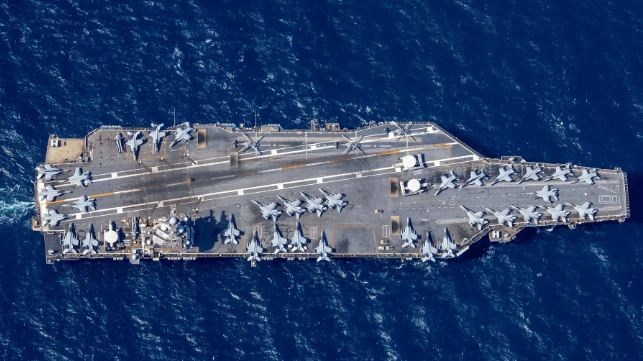
The carrier USS Gerald R. Ford has had a challenging year, including a 334-day deployment and a significant shipboard fire. The vessel was also dogged by persistent media leaks from crewmembers about sewage system breakdowns, which reportedly had an effect on morale. NPR has recently obtained email correspondence detailing the problem, which was more widespread and complicated than initially reported.
Ford was the first vessel in her class, and was designed with the latest high-end tech throughout - some of which did not work on delivery. Her electromagnetic weapons elevators, catapults and arresting gear all required years of repairs after commissioning. For sanitation, the Navy picked a cruise ship-derived vacuum flush sewage system, also known as a Vacuum Collection, Holding, and Transfer (VCHT) design.
Though this particular system had not been used on a Navy warship, before, VCHT systems are not new to the Navy: they date back as far as the Cold War-era Kidd-class cruiser series, and are in use on many classes today, including Arleigh Burke-class destroyers. VCHTs generate a far lower volume of wet waste, and the pipe runs don't have to be arranged in vertical drops like a conventional system (there can even be long upward lifts in the middle of the run).
The system aboard Ford connects to about 650 heads and is divided into four separate sections. Since it relies on vacuum to pull waste down the pipe, it has to be airtight throughout. A leaking control valve in any one head can take out the functioning of the system in a large section of the ship, according to documents obtained by NPR. If the failure occurs in the wrong place, that section could be large indeed, sailors reported. "If you were in the forward section of the ship, you’d have to walk all the way to the aft section, just to find a toilet that worked," one Ford crewmember told CNN.
The problem could be hard to diagnose for maintenance crews under way, since a loss of vacuum in one section could be caused by one of dozens of different heads. The most frequent problem aboard the $13 billion aircraft carrier, according to the email records, was a hose that attaches to each head. If this part worked loose, it would cause loss of suction, and Ford's crew was instructed to keep an eye on it. The problem persisted as late as mid-March, the email shows - suggesting that it was still an issue while sailors were dealing with the aftermath of the March 12 laundry fire, which damaged berthing compartments and forced some of the crew to find temporary accommodations.

that matters most
Get the latest maritime news delivered to your inbox daily.
The Navy plans to fix the sewage system by splitting it up into more sections, which will make it easier to isolate faults and find out where they are located. This fix was implemented 15 years ago aboard the carrier USS George H.W. Bush, which had similar problems.
Repairs to the Ford's systems (sewage included) and the damaged berthing compartments are expected to take at least one year to complete, according to CNN.