
Report: Mooring Lines Pulled Experienced Docker to His Death
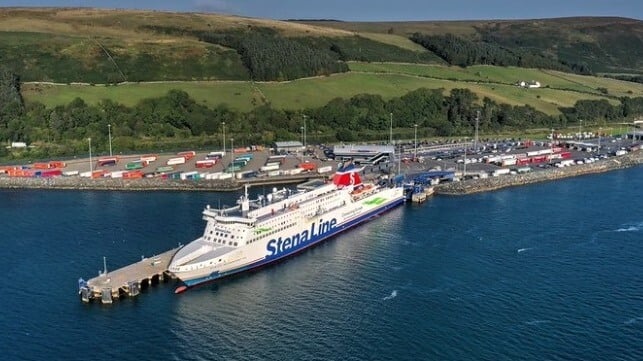
A 2024 mooring fatality at a ferry terminal in Cairnryan, Scotland highlights the risks - and tradeoffs - that come with everyday quayside operations, even in controlled environments. A newly-concluded sheriff's inquiry into the death of a docker has concluded that he was following reasonable safety rules when a line pulled him into the air and off the quay.
At about 0700 hours on July 23, 2024, John Alexander Hamilton, 60, was working the quay at the Loch Ryan Port dock at Cairnryan. Hamilton was a respected docker, and had worked for Stena for 40 years. It was the end of his shift, and he was helping the ferry Stena Superfast VII to unmoor and depart. He was working alongside a colleague, Michael Hughes, who had a similar level of experience.
The quay at Loch Ryan is relatively new, having been built as a replacement facility in the 2010s. It has auto-docking arms to speed up mooring and unmooring at the stern, where the ro/ro ramp is located. One of the arms was not working that morning. As was procedure, the master of the vessel directed the use of extra mooring lines at the stern to substitute for the mooring arms.
As the vessel prepared to depart, the Superfast's crew paid out on the mooring winches, and Hamilton pulled two lines off of the aft-most bollard, next to the docking arm structure. Following company procedure, he lifted both lines by the affixed tails on the eyes, one in each hand. He walked the eyes towards the edge of the quay as the crew winched in. This was standard practice at the pier in order to keep the line out of the water and minimize the risk of fouling the props.
As this evolution proceeded, Hughes - who had worked with Hamilton for decades - noticed that his colleague was getting much closer to the edge of the quay than he normally would. As he neared the edge, Hamilton said something to the effect of "hold on" at normal volume, but did not appear distressed. Hughes perceived something wrong and shouted for the winch operator to stop.
The winch operator let go of the controls to stop the machinery, but the mooring winch took 2-4 seconds to wind down, and in that time it continued to pull in the line. Hamilton was hoisted off his feet, pulled into the air and over the frame of the docking arm, then dropped about 4-5 meters into the water. The CCTV footage of the scene was too grainy to make out precisely, but it is believed that Hamilton had become somehow entangled in one or both of the five-foot-long tails affixed to the lines' eyes. The tails recoiled into the air after he fell, having released his weight.
Hamilton's PFD inflated when he hit the water, as designed, but it did not right him. He floated face-down until Hughes - in an act of bravery - climbed into the water and swam over to hold him upright. Together they waited by the quayside ladder for 15 minutes until the Superfast's rescue boat arrived. Hamilton's neck was broken from the fall, and he may have inhaled water; he did not recover, and was pronounced dead at the scene.
Following the casualty, the quay's managers took action to mitigate risk. The tails on the eyes of the mooring lines were shortened; all possible obstructions that could catch on a line on the quay were ground down or removed; and the policy of walking the eye to the edge of the dock was abandoned. A white "no-go" zone was painted onto the dock between the bollards and the edge, and dockers were instructed to stay clear of it - and crewmembers were directed to halt winching if anyone entered it. The tradeoff required accepting a certain level of risk that lines could go into the water, but management deemed this acceptable.

that matters most
Get the latest maritime news delivered to your inbox daily.
"Stena learned lessons from the accident, implementing immediate and comprehensive measures to seek to ensure that something similar does not happen again," determined Sheriff Garry Sutherland in a ruling. "In many respects Stena has preempted the outcome of this inquiry in doing so, doubtless to ensure that no time was lost in taking steps to ensure the safety of its employees."
Top image: The pier at Loch Ryan Port, Cairnryan, Scotland (Glen Wallace / CC BY SA 2.0)