
USN Incident Reports on Truman’s Deployment Cite Preventable Errors

The United States Navy released four independent reports on the key incidents that happened while the carrier Harry S. Truman and its Carrier Strike Group were deployed to the Red Sea region, including a nearly calamitous collision and the loss of multi-million-dollar fighter jets. While saying, it is fully committed to learning from the incident, they also cited the high pressure and adversity during the high-intensity deployment, which was one of the most intense for the Navy in recent years.
The Truman and its carrier group were repeatedly targeted by the Houthis with missiles and drones. The Navy emphasized the overall success of the deployment between September 2024 and May 2025, while admitting human error, bad judgment, systems issues, and fatigue contributed to the incidents. It says the focus of each investigation was the underlying procedural issues and compliance, as well as how the crews were reacting to adversity.
“The Navy is committed to being a learning organization,” said Vice Chief of Naval Operations Adm. Jim Kilby in the official statement on the release. “These investigations reinforce the need to continue investing in our people to ensure we deliver battle-ready forces to operational commanders.”
Key among the incidents was the February 12, 2025, collision between the carrier and a commercial vessel near the Suez Canal. What was portrayed as a minor “fender bender” appeared to come far closer to a major casualty. The investigating officer notes that if the timing or angle had changed even slightly, it could have been catastrophic.
Captain Dave Snowden had left the bridge of the carrier to get some rest, but left orders to call him if vessels got within 1,000 yards. The report says the carrier was traveling at speeds of 19 knots, much faster than ordered, and that the officer of the deck failed to act or alert others, including the captain, as vessels came close to the carrier. The bridge team on the carrier misjudged the direction of a turn by the merchant vessel and only summoned the captain back to the bridge when the merchant ship was 500 yards away.
The first impact was a gash 20 feet long and 7 feet wide on the hull, followed by a 15-foot gash in the structure. It damaged the aviation parachute equipment shop, which was manned by eight sailors when the impact happened, as well as unnamed storage rooms. The impact the report determined came within 100 feet of the space where the sailors were working and only yards away from a compartment where 120 sailors were sleeping. The commander of the carrier strike group noted that if it had been 100 feet forward, the impact would have pierced the sleeping compartment.
The commanding officer of the Truman was relieved shortly after the incident “due to a loss of confidence in his ability to command.”
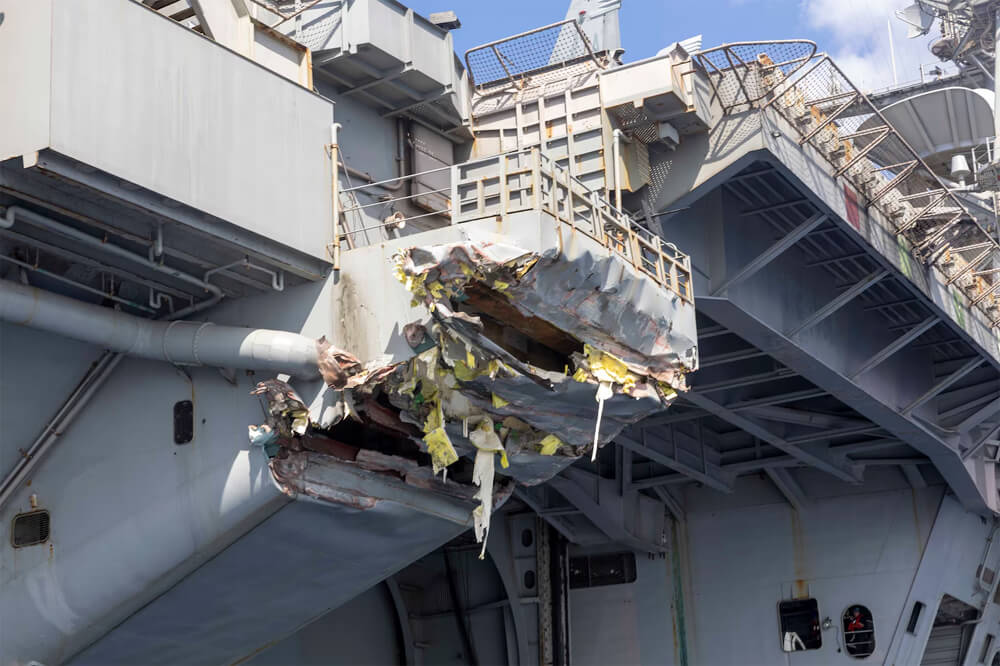
Some of the collision damage which came far closer than reported to the sailors onboard (USN)
The reports are equally hard on the “friendly fire” incident in which the USS Gettysburg shot down an F/A-18F Super Hornet and fired at a second fighter jet in December 2024. It cites a lack of training and integration between the Gettysburg and the Carrier Strike Group. They point to a lack of “forceful backup” on the cruiser, and a lack of cohesion in the group, leading to a misidentification of the two planes.
The report highlights culpability “up and down” the chain of command, saying people did not recognize or speak up about concerns and were too reliant on technology instead of judgment. It says they had “low situational awareness,” and concludes the decision to engage was “neither reasonable nor prudent.” They said it was incorrect across the “totality” of the information available to the crew.
While the “friendly fire” incident came early in the engagement, another F/A-18E Super Hornet and a tow tractor were lost overboard in April, late in the deployment. The carrier took evasive maneuvers due to an incoming ballistic missile in the Red Sea. While saying they were within standard operating procedures, the report also cites insufficient communication between the bridge, flight deck control, and hangar bay control. They also cite a failure with the aircraft bake system.
The last incident was another loss of an F/A-18F Super Hornet. It is blamed on the failure of an arresting wire on the Truman. However, they found inadequate maintenance practices, low manning levels, limited knowledge, and insufficient training were each contributing factors to the incident.

that matters most
Get the latest maritime news delivered to your inbox daily.
The reports emphasize the “high operational tempo and combat conditions” as contributing to a strained environment. During a briefing, Navy officials say they had learned from these high-profile incidents and pointed to the Office of Warfighting Advantage, which is tasked to make improvements in training and procedures, learning from the mishaps during the deployment.
Harry S. Truman and the strike group returned to its home port in Virginia at the end of May 2025 after one of the most demanding deployments for the Navy. The ship has only received interim repairs to make it watertight after the collision, and in August was back underway for two weeks. The Navy reports complete repair of the damage is scheduled during the ship’s upcoming Refueling and Complex Overhaul at HII-Newport News, which was due to begin after her final underway in October.