


USCG Polar Star Marks 50 Years by Aiding Cruise Ship Caught in Pack Ice
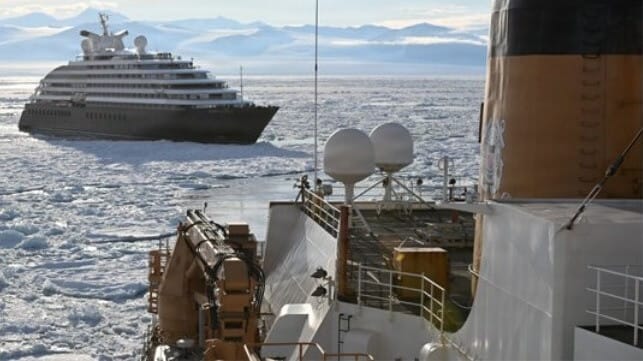
USCG Cutter Polar Star marked 50 years since her commissioning with a special achievement, aiding a luxury expedition cruise ship that had been beset by pack ice. The United States’ only active heavy icebreaker is on her 29th deployment to Antarctica in support of the annual resupply and tactical mission named Operation Deep Freeze.
Commissioned on January 17, 1976, Polar Star is 13,500 tons and, according to the U.S. Coast Guard, remains the world’s most powerful non-nuclear icebreaker. The vessel, which is 399 feet (122 meters) in length and has a 34-foot (10-meter) draft, USCG data says, is capable of breaking through solid ice up to 21 feet (6.4 meters) thick using a backing and ramming technique. It can steam continuously through 6 feet (1.8 meters) of ice at 3 knots. She produces up to 75,000 shaft horsepower.
According to the report, the icebreaker, which has been on station in the Antarctic region all month, received a call Friday night, January 16, from the Scenic Eclipse II (17,592 GT) reporting it had “become beset in pack ice roughly eight nautical miles from McMurdo Sound.” The luxury yacht cruise ship has an ice-rated hull and carries up to 200 passengers when in Antarctica.
Polar Star went to the aid of the cruise ship, making two close passes to break the ice and free the cruise ship. The cutter then escorted the cruise ship approximately four nautical miles to open water.
Scenic Cruises issued a statement saying, "Due to changes in the pack ice, progress was slower than planned, and the Captain requested assistance from the nearby vessel USCG Polar Star to clear the area together and avoid a longer sailing period at reduced speed. While Scenic Eclipse II was never in need of rescue services, the coordination between both vessels ensured we could navigate the changing pack ice safely and efficiently."
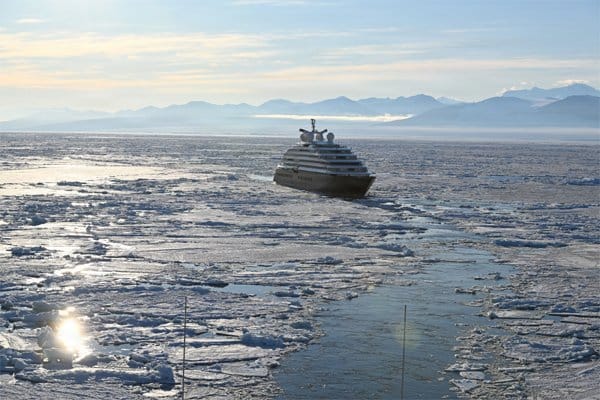
Scenic Eclipse II was escorted to open water (USCG)
“At 50 years old, Polar Star remains the world’s most capable non-nuclear icebreaker,” said Cmdr. Samuel Blase, Polar Star’s executive officer. “That’s a testament to the crews that have maintained it over the decades. With years of service left to give, Polar Star will continue to guide the way in the high latitudes well into the future.”
The icebreaker departed Seattle on November 20 for the annual mission to Antarctica. While on station, her role includes breaking a navigable channel through miles of dense ice to allow the cargo and fuel vessels to reach the McMurdo Station. During the second week of January, the icebreaker was spotted in the Ross Sea and was recently seen bringing the fuel tanker Stena Polaris to the dock at the McMurdo Station ice pier.

that matters most
Get the latest maritime news delivered to your inbox daily.
The Stena Polaris (65,000 dwt) operates as a U.S.-flagged tanker to support operations. She came into Antarctica from South Africa with the key fuel delivery. The Dutch-flagged heavy lift vessel Plantijngracht is transporting containers and heavy cargo from California to Antarctica. She is currently reaching New Zealand before making her way to McMudro.
Polar Star has received extensive life extension work during the offseason in recent years. She is expected to remain in service at least till 2030, when the first of the new U.S. heavy icebreakers is due to be delivered.
