
Ukrainian Strikes Hit Novorossiysk Naval Harbor
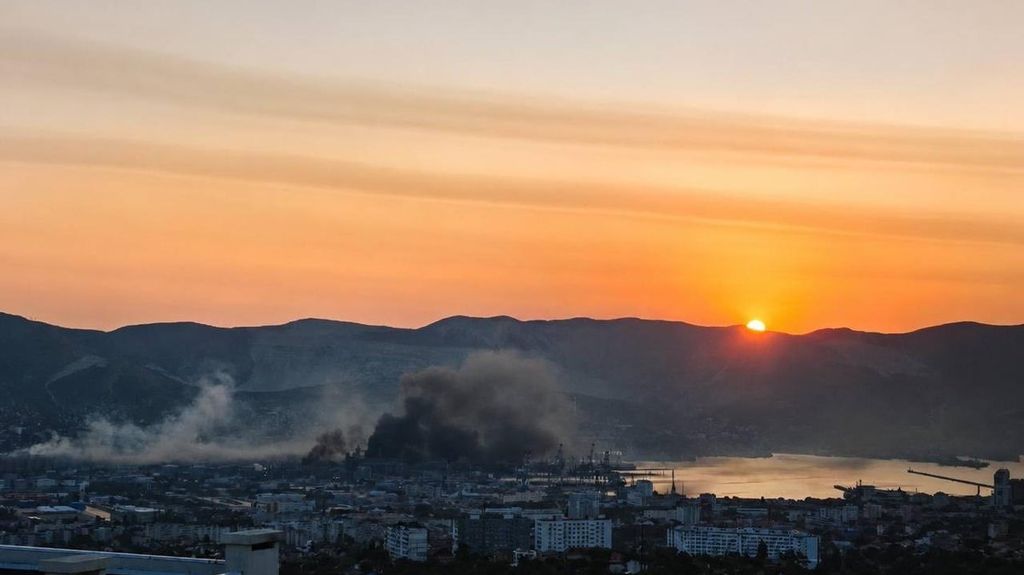
On Wednesday morning, the waterfront at the Russian Black Sea port of Novorossiysk was once again blanketed in smoke, the result of yet another Ukrainian drone strike on the strategic port facility.
Novorossiysk is a key export hub for Russia's Black Sea oil trade, including both all-Russian volumes at the Sheskharis terminal in the inner harbor and the primarily-Kazakh volumes at the CPC single-point mooring facility just off the coast. Inside the harbor, the Russian Navy has accumulated a large concentration of warships, many of which were previously stationed at Sevastopol. The threat of Ukrainian seaborne drones has forced the Black Sea Fleet to retreat to the relative safety of the northeastern Black Sea - but that safety is increasingly at risk.
Hundreds of Ukrainian drones descended upon the port overnight Tuesday, according to Krasnodar's regional government. Despite intense air defense activity, some number of drones appear to have reached their targets in the harbor. NASA FIRMS infrared remote sensing shows bright fires burning inside the naval yard at Novorossiysk, including some areas that are directly on the waterfront. Defense analyst MT Anderson assesses that in this area, current Russian assets include nearly two dozen warships and auxiliaries, ranging from rescue tugs up to an improved Kilo-class sub. Notable elements of the list include Russian tank landing ships (both Ropucha-class and older Tapir-class) and two Admiral Grigorovich-class frigates.
Quick analysis of what was in port the morning of Aug 11, focused on the 5 piers where the anomalies are located plus the sub pen
— MT Anderson (@MT_Anderson) August 12, 2026
analysis based on imagery from @vantortech from 11 Aug 2026 https://t.co/iyOoPJ8G8n pic.twitter.com/X2eyGkZyjH
Wild AAA fire seen over the Russian port of Novorossiysk last night as the area came under heavy Ukrainian drone attack. pic.twitter.com/ADWsPOWkmm
— OSINTtechnical (@Osinttechnical) August 12, 2026
Novorossiysk is far from the only target. Throughout the Black Sea and the Sea of Azov, the Ukrainian threat to Russian shipping is forcing "shadow fleet" operators to make adaptations, including physical modifications to the vessels. Newly-spotted examples include cables strung from the bridge forward; netting and IBC totes arrayed around a pilothouse; and dazzle paint, an innovation of World War I designed to confuse enemy forces about the vessel's true heading.
Russian cargo ships have begun sporting naval “dazzle” camouflage in the Black Sea after numerous Ukrainian drone strikes. pic.twitter.com/kp1xbdze3w
— OSINTtechnical (@Osinttechnical) August 11, 2026
EXCLUSIVE: The 28-year-old Suezmax tanker CARUZO (IMO 9137648), which is under UK, EU, New Zealand, Canadian, Swiss, and Australian sanctions (but not US sanctions), sailed past us in Istanbul carrying one million barrels of Russian crude oil.
— TankerTrackers.com, Inc. (@TankerTrackers) August 12, 2026
The first thing we noticed was that… pic.twitter.com/SEQkGmPhL3

that matters most
Get the latest maritime news delivered to your inbox daily.

