
UAE Plans to Build a New Jebel Ali to Bypass Strait of Hormuz
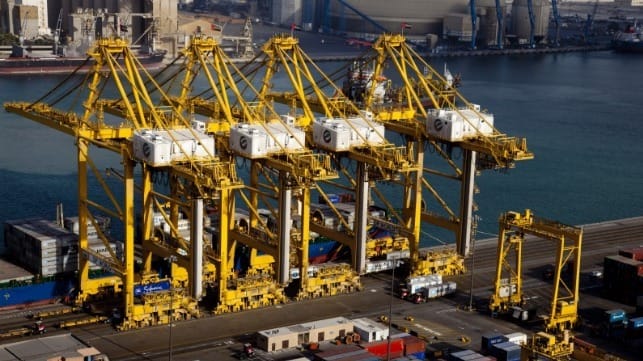
The Financial Times has added to a number of reports that the UAE is planning to expand its port and freight-handling capacity on its East Coast, accessing the Gulf of Oman and bypassing the Strait of Hormuz. The Financial Times says that DP World is planning not only to build an entirely new port on the Fujairah coast, but also to expand capacity at the existing Fujairah container terminal.
It is not clear what coordination arrangements DP World has made with the existing Fujairah terminal, which is operated by the AD Ports Group under the brand name Fujairah Terminals, following the signing of a 35-year concession agreement in 2017 with Fujairah Ports, which in turn is controlled by the Fujairah Al Sharqi Royal Family.
DP World is a global logistics network which handled 88 million TEU in 2024, or 10% of global container traffic, operating about 80 terminals in 40 countries. DP World is owned by the government of Dubai, and the rather smaller AD Ports is largely owned by the government of Abu Dhabi. Fujairah Ports — the carefully conserved crown jewels of the Al Sharqi family, ruling an emirate lacking Abu Dhabi's oil wealth and Dubai's commercial success — has historically struggled to match the efficiency and profitability of the DP World and AD Ports operations, but will have sought to capitalize on its increased strategic value since shipping through the Strait of Hormuz has been disrupted.
Plans are already afoot to speed the completion of a second crude pipeline to parallel the Habshan–Abu Dhabi Crude Oil Pipeline (ADCOP), doubling capacity from 1.5 to 3 million barrels per day. Fujairah Ports also operates a bulk products terminal at Dibba, on the border with Oman's Musandam Peninsula, and Dibba has also been slated for development and upgrade.
When the UAE decides to make a capital investment, the pace of project delivery is consistently very fast, and the UAE's rulers will be doubly keen to reduce their dependency on the Strait, where no easy solution to the interruptions and restrictions in sea traffic is yet in sight. Regular passenger services on the new high-speed railway linking Fujairah with Dubai and Abu Dhabi get underway this summer, and integrated container delivery systems are being deployed.

that matters most
Get the latest maritime news delivered to your inbox daily.
DP World's Jebel Ali Port, alongside Emirates Airline and the Jumeirah hotel group, was one of the original engines of Dubai's spectacular economic growth in the 1970s and 80s, and DP World will be keen to replicate the success of Jebel Ali in an expanded operation in Fujairah. The plan will face some obstacles, namely the greater distances between existing infrastructure and the new terminals. Nor is the new terminal likely to benefit as much as Jebel Ali did from the import/re-export trade with Iran, even if the current conflict can be brought to a satisfactory conclusion. Few corporate planners will be willing in future to take the risk of dealing with Iran while it remains under the economic management of Paydari/IRGC hardliners, so DP World will be looking to tie into economic growth further east in Asia-Pacific.
While the new high-speed Emirates Railway linking Fujairah to the west is also delivering the Hafeet rail link to Sohar in Oman — 70% complete and perhaps ready by the end of this year — there does not appear as yet to have been serious consideration of integrating other Omani ports into the wider GCC logistics network, albeit container throughput through Sohar, Duqm and Salalah has grown rapidly in recent years. Duqm and Salalah have the advantage of being round the corner from the Gulf of Oman, further away from Iran and facing directly onto the Arabian Sea. But even at greater range, these two ports have also been attacked by Iran. Individual GCC states are now wary about relying on anybody else or sharing dependency on critical infrastructure even with close neighbors, such is the mistrust which Iranian behavior has engendered in the region.
