
Seatrium Delivers WTIV to Maersk Offshore Wind
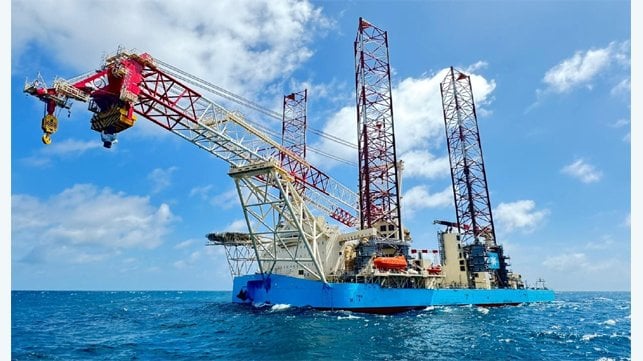
The next-generation wind turbine installation vessel, which became the center of a dispute before it was completed, has been successfully delivered, with both companies now celebrating the possibilities. Seatrium reports it completed the delivery on February 26 after sea trials and final readiness evaluations at the Tuas Boulevard Yard in Singapore, while Maersk Offshore Wind is calling the ship the first in its journey towards growing a future-ready fleet.
Maersk Offshore Wind, which is owned by the investment company A.P. Moller Holding, was formed with the sale of the former Maersk Supply Services offshore business. The company became a pure play for the offshore wind sector and designed its vessel to target the U.S. market. Last fall, with the market under pressure and an uncertain outlook, the company announced it was cancelling the construction contract, despite Seatrium’s protestation that the vessel was more than 90 percent complete.
The companies settled their dispute with Maersk Offshore Wind agreeing to pay the construction contract price of $360 million with a cash payment of about $110 million on delivery. Seatrium is providing a mortgage on the ship secured by its future earnings.
Seatrium celebrated the delivery, highlighting that the vessel was custom-engineered and built to install some of the world’s largest offshore wind turbines and using a first-of-its-kind design to potentially set a new benchmark for global offshore wind installation. For Seatrium, the unique vessel is a calling card as it seeks to leverage its long heritage in offshore vessels into the offshore wind segment.
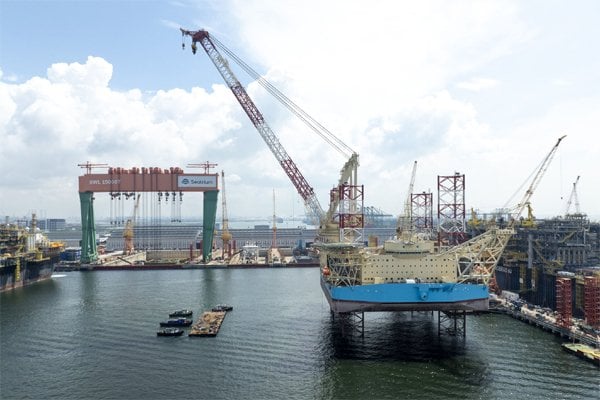
Wind Turbine Installation Vessel was built at the Tuas Boulevard Shipyard in Singapore (Seatrium)
The new ship uses a feeder-based design for installations so that it can remain at the site while smaller boats ferry out the components. Maersk Offshore Wind formed a partnership with Edison Chouest for the feeder barges and tugs to supply the vessel. With the feeder components built in the United States, the concept was to focus on the U.S. market with a system that could meet the Jones Act requirements while having been built internationally.
The unique feeder system locks the barges to the vessel, which Maersk Offshore Wind highlights for providing “absolute stability for a stable, fixed-to-fixed transfer.” It will permit the feeders to supply the jack-up vessel even in higher sea states, extending the working time and reducing the cost and time for installation.
Maersk highlights that the feeders will also permit the use of smaller, shallower marshalling points. They will also be capable of reaching ports behind bridges, locks, or hurricane gates.
Seatrium highlights the installation of a 1,900-tonne main crane with a 180-meter hook height. It is capable of placing 15 MW or larger turbines.

that matters most
Get the latest maritime news delivered to your inbox daily.
The vessel was contracted in 2022 to handle the installation for Equinor’s Empire Wind project off New York’s Long Island. The project has faced and beaten back two stop-work orders from the Trump administration. It is currently proceeding after having received a preliminary injunction against the latest efforts by the U.S. Department of the Interior to derail the project.
Maersk Offshore Wind reports the WTIV will depart Singapore in March. It will be proceeding to New York to begin its assignment for Empire Wind. After having planned to focus on the U.S. market, it is believed Maersk Offshore Wind is pivoting into the international market to find later assignments for the vessel.