
Russian Navy Augments its Long-Term Presence in English Channel
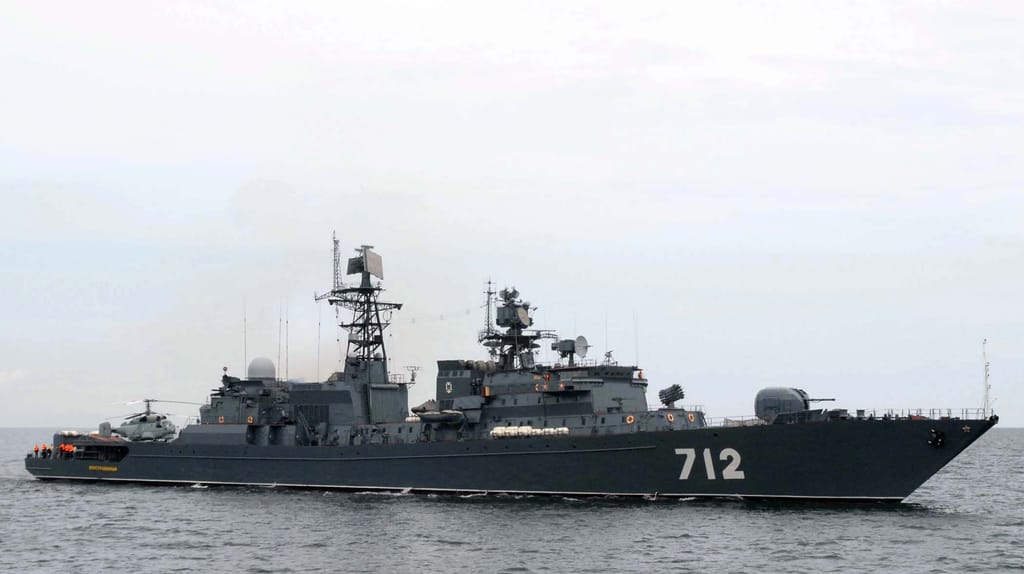
The Russian frigate RFS Neustrashimy (now F722) has settled into its role as the Russian Navy’s piquet ship stationed in the English Channel, suggesting she is a permanent replacement for RFS Admiral Grigorovich (F494), which arrived back in Baltiysk, its home port in the Kaliningrad enclave, on July 16.
On August 1, the Neustrashimy was seen stationary and tied up alongside the Vishnya Class specialist intelligence collection vessel RFS Vasiliy Tatishchev (SSV-231) close up to the Galloper Wind Farm, 15nm off Clacton and the Suffolk coast. It is not clear why the Russian Navy has chosen the Galloper Wind Farm as a regular logistics transfer point, possibly because it is difficult to miss as a rendezvous point, or because the wind farm provides some form of protection.
The two vessels were not seen transferring fuel, although this could have been undetected, but the trans-shipment will have at least included fresh rations. The RFS Vasiliy Tatishchev appears to have come out the Baltic Fleet headquarters at Baltiysk in Kaliningrad to undertake the replenishment task. Hitherto, a full replenishment with fuel has been conducted by the warship tying up alongside the Amur Class base repair ship PM-82, which has now returned home.
On August 3, the Neustrashimy revealed that it had been hiding a Ka-27 helicopter in its aircraft hangar, a type which this frigate class was designed to carry. The presence on board of a Ka-27 will prove something of a headache for the Royal Navy, as the Russians will now be able to maintain over-watch of two of their dark fleet merchant vessels simultaneously and over a wider area as they transit the English Channel.
 Stay on Top of the Daily Maritime News The maritime news
that matters mostGet the latest maritime news delivered to your inbox daily.
The account @pegge49 keeps amazing us with outstanding photos.
— Russia Maritime Watch (@RFNOSBlog) August 3, 2026
The helicopter on RFS Neustrashimy's (772) flight deck appears to confirm she is operating far from home with her embarked Ka-27PL Helix-A. At the time this photo was taken, the aircraft may have been preparing for a… pic.twitter.com/VI4nxmuWkY
Without calling on the aid of the Sky News helicopter to help with the observation effort (Sky News having spotted a replenishment operation in the same area on July 17), it will make the Royal Navy’s task of keeping an eye on Russian activity more complex. There is already a mismatch between the Russian capability at sea and their British escorts: often the Royal Navy fields a single minesweeper or patrol vessel, either armed with a 30mm cannon, or sometimes even an unarmed Royal Fleet Auxiliary, and there may now be a need for an onboard helicopter to respond to Russian aerial activity. Moreover, the Russian presence in the Channel and the North Sea now seems semi-permanent.
