
Russia to Build 10 More Icebreakers and 46 Salvage Vessels to Develop NSR
Russian authorities recently announced plans for the next phase of the development of the Northern Sea Route as part of Vladimir Putin’s plan to establish a trans-Arctic transport corridor. They are calling for aggressive shipbuilding efforts as well as the development of the infrastructure along the route to support the continued growth of traffic over the next decade.
Deputy Prime Minister Yuri Trutnev outlined the details, saying that by 2035, Russia will construct 10 more icebreakers along with 46 rescue vessels. To support the operations, they plan three rescue fleet bases to be developed along the NSR. According to Trutnev, this will ensure that they can maintain year-round navigation through the Arctic.
Rosatom, which oversees the NSR, reports Russia currently has a total of eight nuclear icebreakers in service. This includes the three older vessels: 50 Let Pobedy completed in 2007, Vaygach commissioned in 1990, and Taymyr commissioned in 1989. Work began on the larger Project 22220 vessels, with Arktika commissioned in 2020, Sibir in 2021, Ural in 2022, and Yakutiya in 2025.
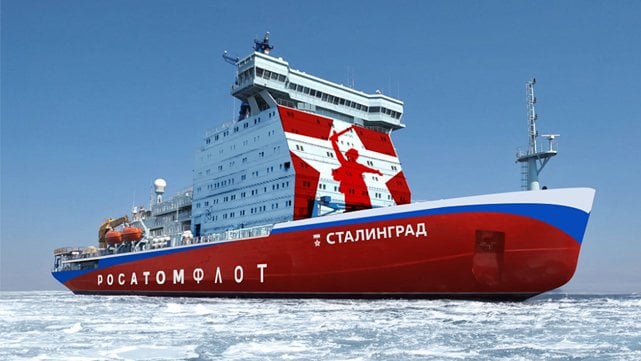
Rosatom highlighted last fall that it had completed the nuclear cores for the fifth vessel, Chukota, which was also undergoing dock trials. Work is also underway on the next vessel, Leningrad, and in November, in a ceremony that included the video participation of Vladimir Putin, the keel blocks were laid for the next icebreaker, which was named Stalingrad, in celebration of the World War II victory by the Soviet Red Army against the Nazi forces.
During the November 2025 event, they said the Stalingrad was four percent complete, and through the use of prefabrication, they were accelerating the construction cycle. The current vessels require five years to build, but they said construction time for Stalingrad would be reduced to 4.5 years. They are also incorporating a number of design improvements based on experience in the operation of the first Project 22220 vessels.
Each of the Project 22220 vessels is 173 meters (567 feet) in length and powered by two commercial reactors, each with a thermal capacity of 175 megawatts. They are reported to have a top speed of 22 knots and a capability to break through ice blocks up to three meters (nearly 10 feet) in thickness.
The shipbuilding is one key element of the broader plan. In total, he reported they have defined 155 activities to support the development over the next decade. This will also include the formation of a cargo base and the modernization of the infrastructure. They will also further develop the shipping lane.
During the November keel laying ceremony, Alexei Likhachev, CEO of Rosatom, announced that traffic on the NSR in 2025 had maintained the record levels of 2024. He said transit shipments would reach 3.2 million tons with strong growth in container volumes. A total of 23 voyages, he said, had been completed as of November 18, a 50 percent increase over 2024. Container tonnage he reported was up 160 percent, reaching a record 400,000 tonnes.

that matters most
Get the latest maritime news delivered to your inbox daily.
Rosatom forecasted a strong outlook for 2026. They pointed out that the first Chinese containership transits, including the voyage by Sea Legend’s Istanbul Bridge, which in October completed the transit from China to the UK in just over 20 days. Russia’s Aurora Line also claimed a record, completing a 28-day transit from Saint Petersburg to China in October.
Likhachev noted that other countries are expected to operate international voyages through the NSR in 2026 while saying they expect a significant increase in transits during the coming season. The forecast is for cargo transport along the Northern Sea Route to reach 170 million tons by 2035.