
Report: United States is Deploying USS Ford CSG to the Middle East
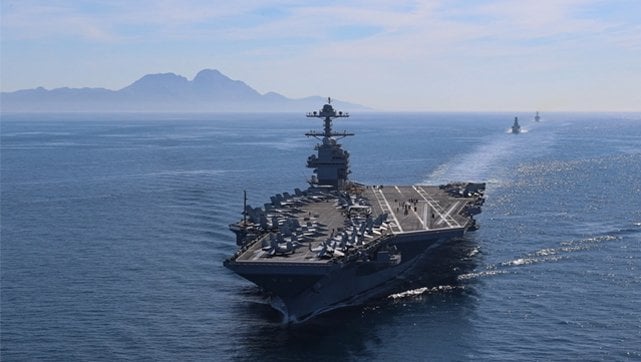
The crew of the USS Gerald R. Ford (CVN-78) was reportedly warned yesterday, February 12, that they will not be returning to their home port after operations in the Caribbean and will instead deploy to the Middle East, according to reports based on briefings from officials carried by The New York Times. The USS Gerald R. Ford left her homeport of Norfolk, Virginia, on June 24, heading first to Europe, and even after its long commitment to Operation Southern Spear in the Caribbean, is now apparently embarking upon what is likely to be a very extended and busy operational extension to its deployment.
The Wall Street Journal has also carried a report that the carrier USS George W. Bush (CVN-77), currently in training exercises off the Virginia coast, is also being prepared for deployment. It is unclear if this would be a third carrier to be deployed to the region, a substitute on rotation with others already deployed, or if the plan has now been superseded.
The USS Ford would deploy to the Middle East with a Carrier Strike Group (CSG) and logistic support vessels. Recently in the Caribbean, USS Ford has been alongside Arleigh Burke Class destroyers USS Winston S. Churchill (DDG-81), USS Bainbridge (DDG-96), and USS Mahan (DDG-72). There is scope, however, for rotating the Arleigh Burke Class destroyer escorts from Destroyer Squadron Two, so whether vessels within the CSG have been adjusted or reinforced will not become apparent until the CSG passes through the Straits of Gibraltar. The missing element in a balanced force package able to take on a full range of tasks is an Amphibious Ready Group, a capability provided during Operation Southern Spear by Marine-laden vessels led by the USS Iwo Jima (LHD-7).
Within the Middle East region, CENTCOM is restructuring and withdrawing its engagement in anti-Islamic State operations in Syria, so its attentions are divided. But training and deployments elsewhere in the Gulf region appear to be focused on strengthening a reactive posture. For example, US Air Force A-10C aircraft have been seen rehearsing defensive measures needed to protect Mine Counter Measures (MCM) vessels in the Gulf, should Iran attempt to impede movement through the Straits of Hormuz by laying mines. U.S. Navy MCM capability in the Gulf is provided by three Independence Class littoral combat ships optimized for MCM missions, namely USS Tulsa (LCS-16), USS Canberra (LCS-30), and USS Santa Barbara (LCS-32), supported by the Hunt Class HMS Middleton (M34). Preparation of deployment positions for additional air defense assets brought into the region has also been seen.
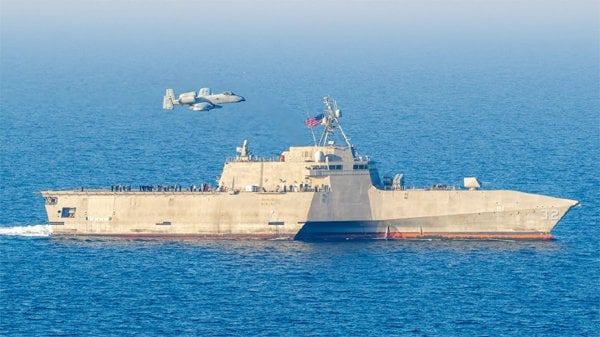
A-10C Warthog ground attack jets exercising with the USS Santa Barbara (LCS-32) in the Gulf (US Navy/MCS Iain Page)
The deployment of a second U.S. carrier to the Middle East follows extended talks between Prime Minister Netanyahu and President Trump in Washington this week. Netanyahu warned about the dangers of concluding a deal with Iran that only covered nuclear weapons, wanting progress as well on limiting Iran’s ballistic missiles, regional expansionism, and internal repression, while Trump sought to continue the dialogue process with Iran. However, it has transpired that the initial round of discussions in Muscat between U.S. and Iranian leaders led to very little progress, reinforcing the impression that Iran is seeking to string out negotiations until it has strengthened its vulnerable position internally within Iran.
If Israel is now pressing for a harder negotiating line, and is worried about its own security if a broader deal is not reached, then it is now realistic to start including Israeli strike assets among the forces arraigned against Iran.
Gulf States have been urging restraint, fearful that any Iranian counterattack might strike infrastructure targets and do devastating damage to economic security. Should however Iran attack targets in the Gulf countries, they might no longer wish to stand on the sidelines of any confrontation with Iran.
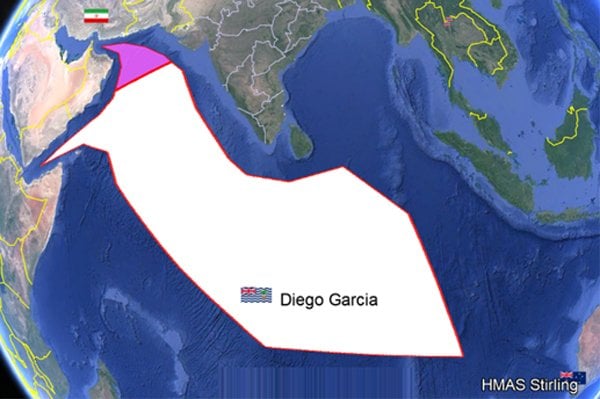
Traveling at over 400nm per day and having transited the Suez Canal on January 31 en route to Australia, HMS Anson could be anywhere in the white area, and could attack any target in Iran from the pink area (Google Earth/CJRC)

that matters most
Get the latest maritime news delivered to your inbox daily.
The United Kingdom has positioned an unusual number of strike and refueling aircraft forward, based at RAF Akrotiri in Cyprus and in Qatar, and has even stripped out training aircraft from its Operational Conversion Unit to boost the number of F-35s that can be forward deployed. It also has a Tomahawk-armed nuclear attack submarine HMS Anson (S124) within range.
Meanwhile, there is very little good news for Iran. Reports have emerged this week that advanced Russian Su-57 strike aircraft have arrived at Algeria’s Oum El Bouaghi Air Base at the eastern end of the Atlas Mountains. Iran ordered its Su-57s long before Algeria did, but has still not yet received any deliveries. There is also little evidence of foreign air defense system destroyed in last year’s war being replaced as yet, although Israel can be expected to bring any enhancements to US attention forthwith.