
Proposals to End Gulf Conflict Could Preserve Iranian Control of Hormuz
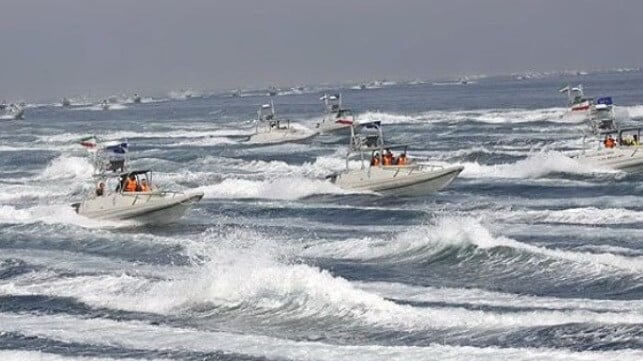
On Tuesday, shortly after President Donald Trump proposed leaving the Strait of Hormuz as a matter for other nations to address, China and Pakistan released a peace proposal that would provide for "normal passage" - without calling for a withdrawal of Iranian administration of the strategic waterway. Both China and Pakistan have already reached initial deals with Tehran for safe transit of their vessels, acknowledging de facto Iranian supervision, and both proposals align with an extended period of Iranian control over the strait.
Officials have told the Wall Street Journal that Trump is open to ending U.S. involvement in the conflict without first taking action to remove Iran's newfound control over Hormuz. In comments Tuesday, the president appeared to confirm that the strait was not an active policy concern for his administration.
"When we leave the strait will automatically open," President Trump claimed in a conversation with the New York Post. "I don’t think about it, to be honest."
Iran has given no indication that it will give up authority over the waterway voluntarily. It has declared sovereignty over the strait, and it demands international recognition of its claim as a condition for a ceasefire. Its parliament has passed a bill formalizing regulations for administering the strait; it has partially mined the waterway to deter transits outside of an Iranian-controlled lane; and it has set up a "tollbooth" between the islands of Qeshm and Larak, reportedly charging up to $2 million per passage for safe transit rights. AIS data confirms that nearly all of the visible traffic through the strait is using this tolling arrangement and submitting to Iranian instructions.
In a social media message Monday morning, Trump suggested that future access to the strait would be up to the nations most dependent upon it, not the U.S. military. "Build up some delayed courage, go to the strait, and just take it," the president wrote. "Go get your own oil!"
The president's comments could be tactical: he has previously signaled the opposite of his intentions in military affairs, and he has moved troops into theater for a potential ground offensive, multiple analysts observed. But if Trump does pull out with Iran still in control of the waterway, foreign nations' least risky option to "get their own oil" would be to negotiate with Tehran and pay transit fees, just like at the Panama Canal and the Suez Canal. Most of the Gulf region's energy customers have no major disputes with Iran: almost all of the oil passing Hormuz goes to Asian buyers. Less than ten percent is purchased by European buyers, who have access to other alternatives and little physical exposure to Gulf oil terminals.
China is by far the most dependent upon oil shipped through the strait, and buys about four out of ten barrels passing through it (including almost all Iranian barrels). Chinese shipping interests have already reached an agreement with "relevant parties" for limited use of the waterway, Chinese foreign ministry spokeswoman Mao Ning said Tuesday - a tacit acceptance of a new status quo of Iranian control.

that matters most
Get the latest maritime news delivered to your inbox daily.
"An Iranian regime that retains control over the Strait of Hormuz, gets paid for passage and chooses which nations can access the Persian Gulf will use this vital leverage . . . to pressure America’s European and Asian allies to lift sanctions, will coerce Gulf states, and will turn from a weakened regional pariah to the Middle East’s foremost power," warned the Wall Street Journal's senior foreign correspondent, Yaroslav Trofimov.
Iran's Gulf neighbors would be disadvantaged by Iranian control of the strait, and the UAE is reportedly concerned enough that it is urging a coalition effort to forcibly reopen the waterway. It is hoping to convince the Trump administration to lead such an operation, and has lobbied European and Asian powers as well, according to the Wall Street Journal.