
Pacific Basin Cancels Methanol Vessels Due to Climate-Rules Uncertainty
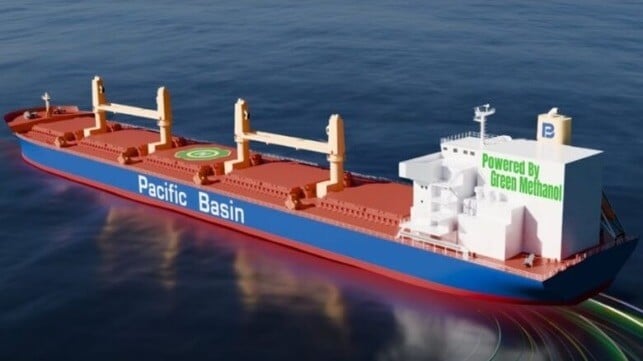
Pacific Basin Shipping, one of the world's largest operators of dry bulk vessels, is partially abandoning plans to anchor its future fleet growth on green methanol after terminating a contract for four dual-fuel Ultramax newbuilds.
As one of the world's leading owners and operators of Handysize, Supramax and Ultramax dry bulk vessels, Pacific Basin operates around 250 ships, of which over 100 are owned and the rest chartered. Four years ago, the Hong Kong-based shipping company said it was putting green methanol at the center of its ambitions to build zero-emission vessels. In November 2024, it went ahead and placed its first order for the construction of four 64,000 dwt dual-fuel vessels at Nihon Shipyard Co. through Mitsui & Co.
In a reversal announced April 16, the company announced it had reached agreements with the two yards to terminate the contract for the four vessels and convert the agreements into a purchase of four conventional Ultramax newbuilds, with an option for two more. In making the decision, Pacific Basin cited renewed uncertainty around the timing and final shape of a global regulatory framework designed to drive the green fuel transition.
Converting the deal from dual-fuel to conventional vessels means the company will spend $39.2 million for each of the vessels ($156.8 million cumulatively) as opposed to spending $45.4 million each on the methanol ships ($181.6 million cumulatively). The vessels are expected to be delivered between 2028 and mid-2029.
Despite altering the deal, the company highlighted that the agreement with Mitsui & Co. includes an option to acquire two 64,000 dwt dual-fuel (methanol/fuel oil) Ultramax newbuilds at a cost of $45.5 million each ($91 million in total) with delivery expected between April 2030 and March 2031.
Pacific Basin said that the decision is a financially prudent response to uncertainty around the timing and final shape of the Net-Zero Framework (NZF), the IMO proposal designed to create a global standard for shipping decarbonization. In October last year, International Maritime Organization member states failed to adopt the previously agreed-upon framework owing to political divisions. Members voted to adjourn discussions for one year, and the mechanism's future is uncertain.
Though Pacific Basin expects some form of a NZF-type global mechanism to be adopted eventually, the company sees a better deal for its shareholders if it avoids a near-term investment in expensive dual-fuel vessels.
"The disciplined renewal and growth of our fleet with modern, efficient ships is a core priority for Pacific Basin so that we can continue to meet strong customer demand, comply with tightening fuel-efficiency regulations, increase our market outperformance and deliver long-term shareholder value," said Martin Fruergaard, Pacific Basin CEO.

that matters most
Get the latest maritime news delivered to your inbox daily.
He added that while the newbuild commitments align well with that priority, the importance of having vessels with super-efficient designs cannot be overstated in the current high-fuel-cost environment.
Pacific Basin has also placed another order for two 40,000 dwt Handysize newbuilds at a cost of $59.6 million. The ships, in addition to an order for two placed last year, will be built at China's Jiangmen Nanyang Ship Engineering Co. yard and are expected to be delivered in the second half of 2028.