
NZ Activists Board Research Vessel in Protests Against Deep-Sea Mining
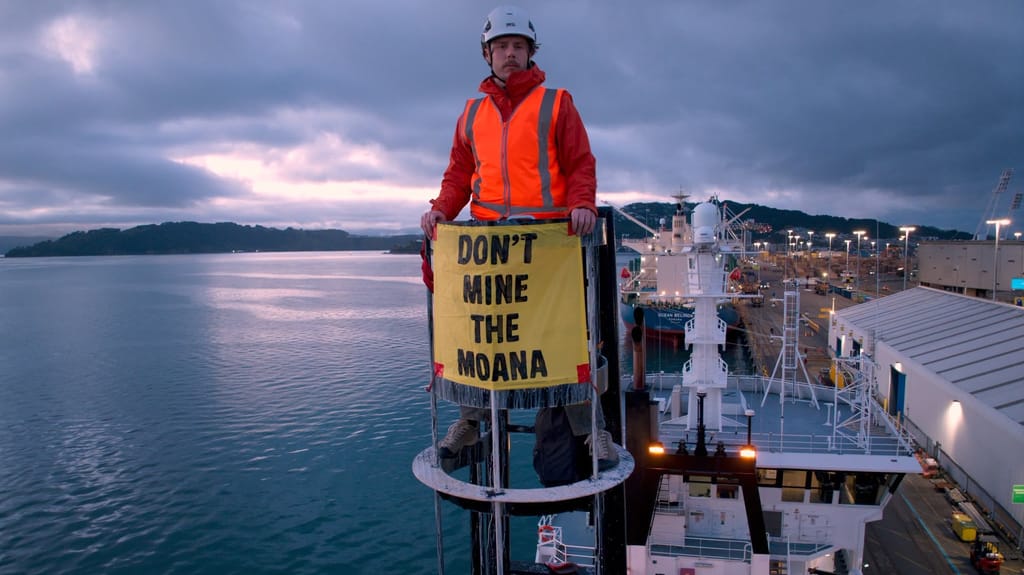
Greenpeace activists in New Zealand are intensifying their opposition to deep-sea mining. They boarded a state-owned research vessel that was returning from an exploration mission in the Pacific on behalf of a U.S. company.
On September 26, the activists boarded the RV Tangaroa, New Zealand’s only ice-strengthened and dynamically positioned deep-water research vessel, to protest the country’s role in facilitating U.S. company Glomar Minerals’ plans to start deep-sea mining in the Pacific Ocean.
The 1991-built Tangaroa, which is 70 meters (230 feet) in length, had just returned to Wellington Harbor after completing exploration work for Glomar. An activist dressed like U.S. President Donald Trump flew an American flag from the vessel while another held a banner reading “Don’t Mine the Moana.” The activists occupied the vessel for about seven hours before they were removed by the police.
Operated by Earth Sciences NZ (formerly NIWA), Tangaroa is equipped for ocean science, exploration, and marine engineering and has carried out environmental survey and ocean science research missions across the South Pacific, Southern Ocean, and Antarctic waters. The vessel is equipped with a range of modern and sophisticated equipment that enables the sampling and measurement of ocean environments.
Greenpeace highlighted that its activists boarded the vessel following her return from the Clarion- Clipperton Zone (CCZ) in the international waters of the Pacific, where the ship surveyed deep-sea minerals. The research was carried out on behalf of UK Seabed Resources Ltd (UKSR), a wholly-owned subsidiary of Glomar Minerals.
According to Glomar Minerals, Tangaroa had departed Tahiti in late July for the CCZ to survey its license area for polymetallic nodules rich in critical minerals. The campaign was the first comprehensive geological and biological survey of the UK2 license area in more than 40 years. UKSR’s license areas cover approximately 133,000 square kilometers of deep seafloor, an area covered in polymetallic nodules containing manganese, cobalt, nickel, copper, and rare earths in a single ore.
The Tangaroa returned to Wellington Harbor after a 65-day campaign armed with environmental and resource data that is expected to inform Glomar Minerals’ decision to embark on commercial exploitation as soon as next year.
“If deep-sea mining is allowed to go ahead, it will strip the seafloor, risking irreversible damage to the ocean we all rely on, to supply minerals for Trump’s war machine. Pacific Peoples are at the frontline of this fight, and deep sea mining puts their way of life and cultural heritage at risk. It must not be allowed to start,” said Juressa Lee, Greenpeace Aotearoa campaigner.
Deep sea mining has become a highly controversial and divisive issue in New Zealand, with environmentalists and activists asserting that it causes massive damage to ocean ecosystems as well as having adverse economic impacts for coastal communities.
President Trump has emerged as the biggest proponent of deep-sea mining. In April last year, he issued an Executive Order to fast-track commercial deep-sea mining in the U.S. and international waters. Earlier this year, the U.S. government launched Project Vault, an initiative to secure a global supply chain and stockpile a reserve of minerals for military and industrial purposes.

that matters most
Get the latest maritime news delivered to your inbox daily.
Greenpeace contends that the Tangaroa expedition comes as the U.S. is preparing to issue unilateral commercial permits for seafloor minerals, a move that bypasses the International Seabed Authority (ISA), where UN member states are negotiating the regulations that will guide deep-sea mining.
The Tangaroa is no stranger to protest. In 2015, Greenpeace activists occupied the vessel in protest of its use by the international oil industry to survey the waters of Aotearoa for deep-sea oil drilling.
