
NTSB: Overlooking Degraded Steering System Caused 2024 Collision
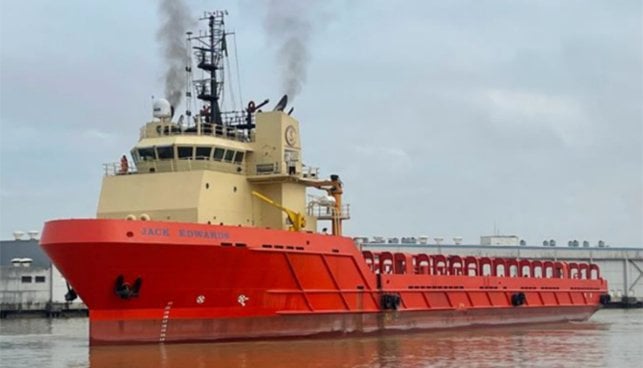
The National Transport Safety Board finds that the “normalization of degradations” to a vessel’s steering system and crew inexperience with bridge controls resulted in a collision that caused more than $1 million in damage to an OSV and a cargo ship and injuries to two crewmembers. It is warning about complacency, the need to properly report maintenance issues and conditions impacting a vessel’s operations, and adhering to written procedures.
The NTSB released a report on a March 17, 2024, collision between the two vessels as they were transiting at the port of Georgetown, Guyana. The U.S.-flagged OSV Jack Edwards (278-foot vessel) was inbound to Georgetown when the vessel veered off course, moving out of its traffic lane. It resulted in a collision with the outbound UK-flagged cargo ship Julie C (453-foot vessel). The OS’s hull plating was breached, letting seawater enter multiple tanks, as well as damage to deck and bulwarks plating. The cargo ship’s bulbous bow was punctured, as well as damage to the shell plating and internal structure members.
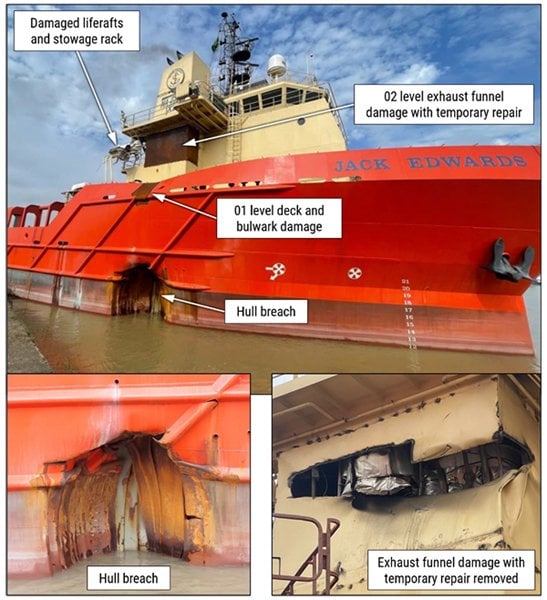
Damage to the OSV from the NTSB report
In reconstructing the sequence of events, the NTSB report finds that the OSV had gotten underway two weeks before the incident, with a crew of nine traveling from Louisiana to Guyana. It had completed a major drydock maintenance period.
The chief mate and second mate told investigators that during the trip to Guyana, they had been frequent steering system alarms. The issue had started while at the shipyard, and they were told the alarms were “something normal.” The vessel’s systems were not logging the steering alarms, so they were not available to be reviewed.
The officers standing watch said they had noticed the vessel’s steering had become erratic and that the autopilot appeared to be “working harder” to maintain the course. The chief mate said the master told him that “steering issues were normal” on the OSV.
On the night of the incident, they were warned by the pilots over the VHF radio that the vessel had traveled out of the entrance channel. The vessel was also “shuddering” and had a “serious vibration.” They also noted the handling was sluggish, possibly because it had contracted the soft mud bottom or had been in shallow waters. The second mate, who was the officer of the watch, said he struggled to keep the vessel on a consistent heading, and finally, the master instructed the chief mate to take over the navigation because of the second mate’s inexperience with the vessel.
The chief mate also experienced problems with the navigation and ordered the tunnel thrusters to be brought online. Although the operations manual said all thrusters should have been turned on in standby during port navigation, the second mate had not turned them on. He went to turn them on from the aft navigation panel, but admitted his lack of familiarity with the controls and inadvertently took navigation control away from the chief mate for 57 seconds.
The pilot from the cargo ship made repeated calls to the OSV, but finally the cargo ship struck the OSV at a near-perpendicular angle on the starboard side forward to midship. Two crewmembers, including the chief engineer, were injured on the OSV, but the vessel remained seaworthy and ultimately would be able to reach a berth.
After the collision, the master and chief engineer began an inspection and reported that the starboard steering gear on the OSV was “out of commission.” It was covered in “black-colored oil,” and “black mud” was coming out of the rudder stock. The NTSB concludes the damage to the steering system was unlikely to have been a result of the collision because it was well aft of the point of contact. Later, when technicians broke down the system, they found a “bad wiper seal, along with a bad upper low-pressure void seal.” They believed a “damaged dust ring” had allowed a buildup of trash in the system, which could have affected other seals and valves.

that matters most
Get the latest maritime news delivered to your inbox daily.
The NTSB concludes “the normalization of degradations to the vessel’s steering system” had reduced the ability to effectively steer. It cascaded into the other problems that precipitated the mistake that resulted in the loss of vessel control just before the collision.
They warn that maintenance and operating issues should be promptly reported. They also point to the hazards of failing to follow the written procedures for maintenance and operations. All this, they believe, increased the risk of a casualty.