
Master and Pilot at Fault as Bulker Contacted Wharf During Departure
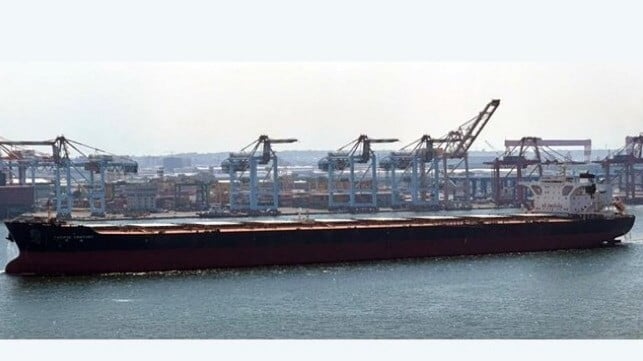
Failure by the master and pilot of the bulk carrier Pacific Century to clearly discuss and agree on the departure procedures caused the vessel to make contact with a wharf and the sinking of a boat at Taiwan’s largest commercial port last year. That was the finding in a report issued by the Taiwan Transportation Safety Board (TTSB).
Investigators found that the 295-meter Hong Kong-flagged bulk carrier made contact with Wharf No. 89 during departure operations at the Port of Kaohsiung on June 9 last year due to a lack of proper communications. Apart from causing damage to the vessel’s rudder and the wharf facility, the incident caused the capsizing and sinking of a working boat that was moored alongside the wharf. The boat was impacted by the propeller wash generated by the Pacific Century.
As Taiwan's largest harbor, Kaohsiung is a crucial transshipment hub in East Asia. Last year, the port handled roughly 8.8 million TEUs of container traffic with total cargo volume reaching over 220 million metric tonnes. During the year, the port recorded a total of 28,899 vessel calls.
In its investigations, TTSB was able to establish that during the departure operation, the pilot and master of the 94,955 gross tonnage carrier operated by the Hong Kong Ming Wah Ship Management Co. completed a basic Master–Pilot Information Exchange (MPX). However, the lateral clearance required for pulling the vessel away from the berth, as well as the timing and procedure for initiating astern propulsion and sternway movement, were not clearly discussed and agreed upon during the information exchange process.
Failure to clearly discuss and agree on the departure procedure resulted in Pacific Century entering continuous sternway before establishing sufficient lateral clearance under restricted water space conditions while departing the port. The result was reduced time and space available for safe maneuvering corrections during departure.
According to the investigation, as the actual maneuver gradually deviated from the pilot’s original expectations, the master and pilot did not identify the deviation at an early stage or adjust the maneuvering approach accordingly.
Investigators were able to establish that during astern propulsion, the vessel developed a starboard-turning tendency due to the transverse thrust generated by the propeller and the pushing force applied to the port bow by the tug, causing the stern to gradually drift toward Wharf No. 89.
When the distance between the stern and the corner of the wharf had reduced to approximately 0.1 nautical miles, and the sternway speed had reached approximately 2.5 knots, the pilot became aware of the drift and initiated emergency corrective actions. However, the available maneuvering space was limited due to the vessel’s distance from the wharf and sternway speed, resulting in contact between the vessel’s stern and the wharf and causing the working boat to capsize and sink.
“After Pacific Century entered the sternway phase, the bridge team primarily provided vessel speed information as part of the vessel’s situational updates, but did not simultaneously incorporate critical information such as Course over Ground (COG), sternway track, and the vessel’s relative position to the wharf as references for continuously monitoring the vessel’s sternway direction, heading, and relative position,” states TTSB.

that matters most
Get the latest maritime news delivered to your inbox daily.
Following the investigation, the Kaohsiung harbor pilot office has taken actions to strengthen pilots’ maneuvering judgment and risk identification, as well as strengthen the mechanism for continuous information exchange between pilots and masters during pilotage operations.
The Hong Kong Ming Wah Ship Management Co. reviewed its existing safety management and berthing/unberthing operational procedures to ensure that masters maintain awareness of the vessel’s movement status during pilotage operations.