
K Line’s Car Carrier Orders Focus on Expanding European Short Sea Shipping
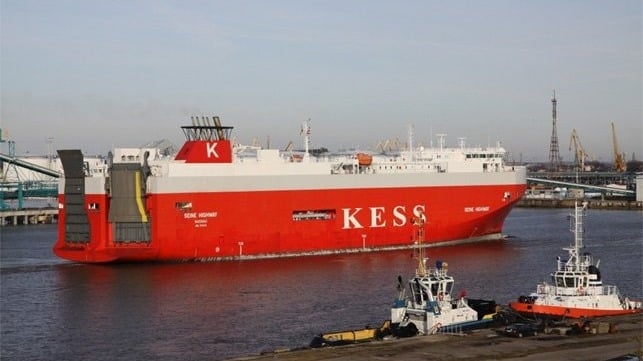
After a rush by many of the large, inter-ocean car and vehicle transport companies to order massive vessels, Japan’s “K” Line (Kawasaki Kisen Kaisha) is focusing on European short sea shipping for vehicles. The company placed an order for four 1,380-vehicle capable vessels fueled by LNG for its European subsidiary.
“K” Line reports that the newly ordered vessels are designed for the frequent transport of small lots in European short sea shipping. They are also designed to comply with size restrictions, which some European ports for imported cars have. The company said it is confident that these vessel specifications will give its European subsidiary, “K” Line European Sea Highway Services (KESS), a competitive advantage in its European short sea shipping operations.
The Japanese company points out that it has been pioneering car transportation since Japan’s first pure car carrier, Toyota Maru No. 10, was deployed for transporting autos in 1970. Like the others in the segment, it has focused on large vessels, building a fleet of super-sized as well as technologically-advanced vessels carrying 7,500 or more cars.
KESS, however, is at the other end of the segment, operating short sea and coastal transport services for completely built-up cars in Europe. It has a fleet of 11 vessels and serves 13 countries and approximately 27 ports. The company reports it is transporting between 800,000 and 1 million cars per year throughout Europe for all major car manufacturers.
The four new vessels will be built by China Merchants Jinling Shipyard (Nanjing) and will measure approximately 426 feet (130 meters). The ships will be specifically equipped for the company’s service in Northern Europe and the Baltic, including a 1A Ice Class rating. They will also have straight stern ramps. Suited to the ports the company services, the ramp with a 60-ton capacity enhances KESS’s capacity to handle heavy and oversized cargo and increases its flexibility to carry a wide variety of cargo types in addition to passenger cars.

that matters most
Get the latest maritime news delivered to your inbox daily.
The vessels will be LNG-fueled and designed so that KESS can consider using bio-diesel and bio-LNG or liquefied biomethane, in addition to LNG. Each vessel will use a high-pressure type ME-GI engine with a shaft generator, reducing emissions of methane slip. While boil-off gas (BOG) generated from LNG tanks is generally used as fuel for generator engines on a vessel with a high-pressure main engine, these vessels are equipped with vacuum-insulated LNG tanks to reduce the generation of BOG. This enables a machinery configuration with lower methane slip emissions.
No timing was announced for the delivery of the vessel, but the company highlights it as a key expansion and enhancement of its short sea capabilities in Northern Europe.