
Indonesian Frigate Order Reflects SE Asian Naval Modernization
During a visit of Indonesian President Prabowo Subianto to the United Kingdom last week, a Letter of Intent was signed by the Indonesians with David Lockwood, CEO of Babcock, for licenses to build two further general purpose frigates drawing on the Arrowhead 140 design. The Arrowhead 140 design forms the basis of the Babcock Type 31 frigates ordered by the Royal Navy and by Poland, and which are also in contention for orders from Denmark and Sweden.
The first two Arrowhead 140 vessels are nearing delivery from the PT PAL Indonesia shipyard at Surabaya. KRI Balaputradewa (F322), the first of what is formally the Balaputradewa Class but which are commonly referred to as the Merah Putih (or Red-White) frigates, was launched on December 18 last year. The second frigate, presumably F323, has not yet been named, but is following on about 18 months behind the lead vessel. Both frigates should be operational well before the originally-planned 2029 in-service date.
These frigates are the first to be built domestically in Indonesia, making this early delivery quite an achievement. The license from Babcock allows PT PAL to develop further the design for export purposes. The new frigates make extensive use of Turkish sub-systems provided by Aselsan, Havelsan and Roketsan, and give the Indonesian a considerable boost in combat capability.
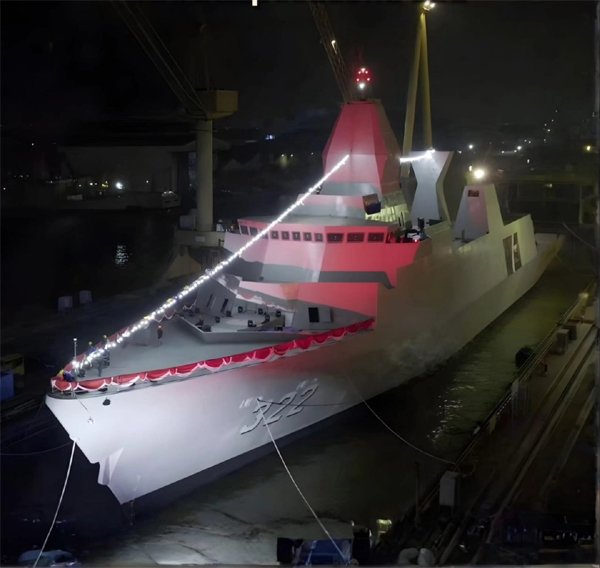
KRI Balaputradewa (F322) at its nighttime launch on December 18, 2025 (PT PAL Indonesia)
The Merah Putih frigates form part of a wider Indonesian naval expansion, the £4 billion Maritime Partnership Program, which started with a modernization of three F2000 frigates built by BAE in Glasgow and acquired half-price but nearly-new from the Royal Brunei Navy. The program upgrading KRI Bung Tomo (357), KRI John Lie (F358) and KRI Usman Harun (F359) is being overseen by Thales Netherlands and is due to be completed in 2028. The Maritime Partnership Programme is aimed at developing local shipbuilding capacity, but also seeks to diversify international sourcing of weapons and sub-systems. PT PAL is at the same time building two French Scorpène Class diesel-electric attack submarines with air-independent propulsion; these will supplement the Korean-built submarines KRI Nagapasa (S403), KRI Ardadedali (S404) and KRI Alugoro (S405). Further submarine orders are under consideration.
The naval expansion program has been supported by successive Indonesian presidents, predicated on Indonesia being a maritime nation spread across hundreds of islands from Sumatra in the West, across Kalimantan, Java, Bali, to New Guinea in the East. But another consideration must also be confrontation with China over disputed maritime borders in the South China Sea, which hitherto Indonesia has sought to downplay. In 2015, President Jokowi embarked upon a policy of destroying fishing vessels caught fishing illegally in Indonesian waters, amongst which were Chinese boats, but the policy has been relaxed in recent years. Under the Nine-Dash line dispute, China contests Indonesian control of the Natuna Islands, one of the smaller disputes China has with various ASEAN nations over the South China Sea.

that matters most
Get the latest maritime news delivered to your inbox daily.
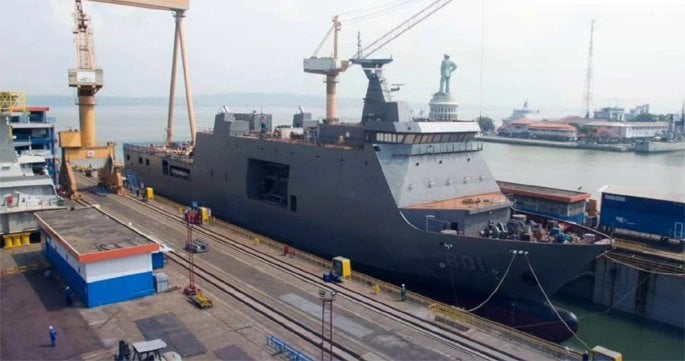
Other ASEAN nations are also building up their navies in response to clashes in the South China Sea. The Philippines is midway through its Horizon 2 expansion program, with the second of the Malvar Class frigates BRP Diego Silangnow (FFG07) in service, with possibly two more to follow, and the first of six 94m Offshore Patrol Vessels now delivered, all vessels being built by HD Hyundai Heavy Industries shipyard in Ulsan, South Korea. The Philippines Navy is also getting two 124-meter landing dock platforms, which are currently being constructed by the very busy PT PAL yard in Indonesia.
But Indonesia also has a number of other dormant territorial disputes over islands and sea areas with its ASEAN neighbors, strengthening its justification for building maritime capability. From its record of receiving naval port visits – recently from Australia, China, Iran, Russia, the United Kingdom, and the United States - it also seeks to maintain a neutral friend-with-all approach.