
Growing Risks for Russia's Shadow Fleet in the Mediterranean
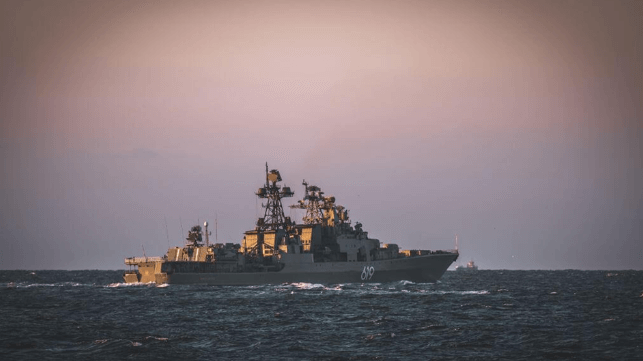
Since their expulsion from their naval base in Tartus, with the probably unforeseen longevity of the closure of the Bosporus to naval traffic, the Russian naval presence in the Mediterranean has been small and fleeting at best, and sometimes entirely absent, for the first time since 1945.
On January 15, corvette Steregushchy Class RFS Boikiy (F532) escorted the tankers General Skobolev (IMO 9503304) and Kama (IMO 8025915) westwards through the Straits of Gibraltar. Both these tankers fulfill a military logistic support role, but in former days they traveled through the Mediterranean without escort. On this occasion, the ships left Port Said with a declared destination of St Petersburg.
Last week the Kama and Udaloy Class destroyer RFS Severomorsk (D619) were escorting the cargo vessels Mys Zhelaniya (IMO 9366110) and Sparta IV (IMO 9743033) off Tobruk in Libya, leading well-informed blogger Italmilradar to speculate that could be the initial phase of a Russian attempt to re-establish a fleet support base in the Mediterranean, post the closure of Tartus. The Severomorsk had escorted the convoy into the Mediterranean past Gibraltar on January 9, and had been subject to surveillance by US Navy P-8 aircraft operating from Sigonella in Sicily. Tobruk is the headquarters of Khalifa Haftar, the Libyan-American officer who controls the Libyan National Army, which in turn is sponsored by the United Arab Emirates.
Prior to the recent convoy activity, the Ropucha Class landing vessel Alexandr Ostrakovskiy (L031) was in the Mediterranean briefly before heading through the Straits of Gibraltar on January 7 towards Equatorial Guinea. But aside from the occasional single-vessel escort, it has been some time since a Russian flotilla - now bereft of support from Tartus - has operated in the Mediterranean. The last major deployment to attract NATO attention was the presence in the Mediterranean for several months of the Kilo Class submarine RFS Novorossiysk (B261) which came to an end on September 18.
The Russian Navy now evidently feels it necessary to escort Russian-registered civilian vessels operating in the military support roles whilst they are in the Mediterranean. But for the Russians, the problems are only getting worse.
Attacks on shadow fleet tankers heading for Novorossiysk in the Black Sea are now becoming routine. The Comoros-flagged Suezmax Dashan (IMO 9299666) was attacked in the Ukrainian EEZ on December 10. Chinese-owned Elbus (IMO 9290385) was attacked off the Turkish coast on January 7, as earlier in December were Gambian-flagged Kairos (IMO 9236004) and Virat (IMO 9832559) (now born again as the Russian-flagged Prometey); after complaints from the Turkish authorities, the Ukrainians are now focusing their attacks on vessels outside Turkish waters. Liberian-flagged tankers Delta Harmony (IMO 9408463) and Delta Supreme (IMO 9585895), Maltese-flagged Matilda (IMO 9407457) and Marshall Islands-flagged Freud (IMO 9804461), all Greek-owned, were attacked by sea drones off Novorossiysk on January 13.
If shadow fleet tankers make it through the Black Sea, then someone, probably the Ukrainians, are now waiting for them in the Mediterranean. On December 18, the flag-hopping Aframax Qendil (IMO 9310525) was hit by drones between Malta and Crete.

that matters most
Get the latest maritime news delivered to your inbox daily.
Escorting both military-tasked civilian vessels and shadow fleet tankers is a commitment beyond the Russian Navy’s capabilities in the Mediterranean. Whereas attack operations of this nature were probably beyond Ukrainian capabilities when the Russians invaded Ukraine in 2022, they are now more than able both to track targets and then attack them, autonomously and entirely without assistance, immune from political pressure from friends of President Putin to prevent them doing so.
While the Ukrainians for the moment are not attacking laden tankers, the damage to ships of questionable insurance status will put off rogue owners who until now have been happy to ignore sanctions listings in their desire to make a profit. The Russian’s consequent loss of revenue is likely to become a critical factor this year in their ability to sustain their offensive operations in Ukraine, even if the Russians manage to re-establish a support base in the Mediterranean to enhance their escort capabilities.
