
First Kamsarmax Methanol-Fueled Bulker Delivered for Cargill Charter
While the industry has seen a slowing in the orders for methanol-fueled ships, the efforts are continuing as shipowners and operators look to understand the segment and the role it can play in sustainable shipping. Cargill, which calls itself one of the world’s largest charters of dry bulk freight, highlights that the vessel will provide critical data as it pursues a multi-solution strategy that also includes wind-assisted propulsion, voyage optimization technologies, energy-efficient retrofits, and a range of alternate fuels, including biofuels and ethanol.
“Technologies like green methanol or wind-assisted propulsion come with uncertainty,” said Jan Dieleman, President of Cargill’s Ocean Transportation business. “But as an industry leader, we have a responsibility to test these innovations on the water, share what we learn, and help shape the systems and standards that will enable wider adoption.”
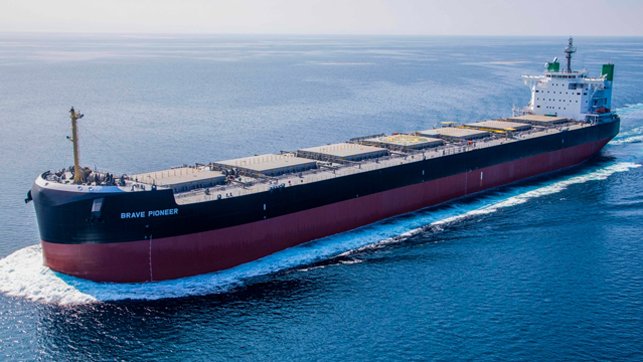
The new vessel, named Brave Pioneer (82,000 dwt), is the first of five green methanol dual-fuel dry bulk carriers that Cargill has chartered. The other ships will join the fleet in the coming years.
Built by Tsuneishi Shipbuilding Co. at the company’s yard in the Philippines, and owned by Mitsui & Co., Brave Pioneer is equipped to operate on both conventional marine fuels and green methanol. At 82,000 dwt, the vessel is larger than the first methanol-fueled bulker, Green Pioneer, which is 62,000 dwt and is operating under charter to NYK Bulk & Projects Carriers.
Tsuneishi highlights that, as a Kamsarmax design, the vessel will be highly versatile. It features a shallow draft and low air draft, which gives it access to a wide range of ports. It is 229 meters (751 feet) in length. It is registered in Panama.
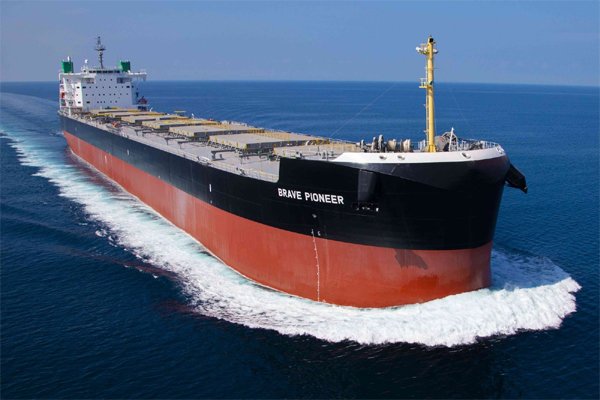
(Tsuneishi Heavy Industries)
By adopting methanol as a propulsion fuel, Tsuneishi says the vessel will achieve a reduction of approximately 10 percent in carbon dioxide (CO2) emissions, 80 percent in nitrogen oxides (NOx), and 99 percent in sulfur oxide (SOx) during operations compared with conventional vessels. The use of green methanol further enhances the vessel’s potential to reduce environmental impact and promote environmentally responsible shipping.
The Brave Pioneer was launched on July 17, 2025, in Balamban, Cebu, by Tsuneishi Heavy Industries. The completion of the vessel also marked a key milestone for shipbuilding in the Philippines. The yard is operated in partnership with Aboitiz Group and has now completed 381 ships.
The President of the Philippines, Ferdinand Marcos Jr. attending the naming ceremony on January 15. He described the event as “a historic milestone for Philippine shipbuilding,” hailing the project as “a showcase of Filipino craftsmanship, ingenuity and competitiveness.”
The ship departs the Philippines and is proceeding to Singapore, where it will bunker green methanol. It will then proceed to Western Australia before sailing onward to Europe.
Cargill reports it will conduct a series of operational trials designed to evaluate green methanol bunkering readiness, understand how environmental attributes can be traced and verified through carbon accounting systems, and assess market appetite for low-carbon freight services.

that matters most
Get the latest maritime news delivered to your inbox daily.
“We know the road to low-carbon shipping will require a mix of solutions and green methanol is one part of that portfolio,” said Dieleman. “Our new fleet is about optionality and adaptability. These vessels are engineered to perform at a best-in-class level on conventional fuel today, while allowing us to switch to greener fuels as availability improves. It’s a practical way to future-proof ocean transport.”
Mitsui ordered two vessels in 2023 that will both be chartered to Cargill. A month later, J. Lauritzen, through its Lauritzen NexGen Shipping division, placed additional orders for Kamsarmax dual-fuel methanol bulkers. They are reported to be building three vessels, which will start delivery later in 2026 and will also be chartered to Cargill.