
Does the Royal Caribbean-Sandals JV Signal a New Paradigm for Cruising?
The overall sentiment is positive after the initial surprise of the news last week that Royal Caribbean Group would make a $3 billion investment in the Sandals resort operation in the Caribbean. Views of the potential synergies between the two operations have sparked the conversation about whether this is in fact the beginning of a new business model for the cruise corporations.
The Florida-Caribbean Cruise Association (FCCA), a trade association started more than 50 years ago by the cruise lines, issued a statement calling the deal a “visionary development for Caribbean tourism.” Royal Caribbean will acquire a 50 percent interest in Sandals through a new joint venture for the 45-year-old chain, which has 20 resorts spread across the Caribbean, with 6,395 rooms, according to the calculations of the analysts at Barclays. By comparison, Royal Caribbean Group, along with its partner lines (TUI and Hapag-Lloyd Cruises), has approximately 190,000 berths across its fleet of 71 ships worldwide.
“This is the kind of forward-looking partnership that recognizes how people actually travel today,” said FCCA President Adam Ceserano. “Cruise and land-based vacations are not competing worlds. They are increasingly part of the same vacation ecosystem.”
Started in the late 1960s by an American entrepreneur with the backing of old-line Norwegian shipping companies and later the Pritzker family, which built Hyatt Hotels, Royal Caribbean was one of the pioneers in the modern era of cruising. It drove industry growth and began to expand with the acquisition of the premium brand Celebrity Cruises in 1997. It rounded out its cruise portfolio with the phased acquisition of the ultra-luxury brand Silversea Cruises between 2018 and 2020 from interests controlled by Manfredi Lefebvre d’Ovidio and recently announced an expansion into river cruising.
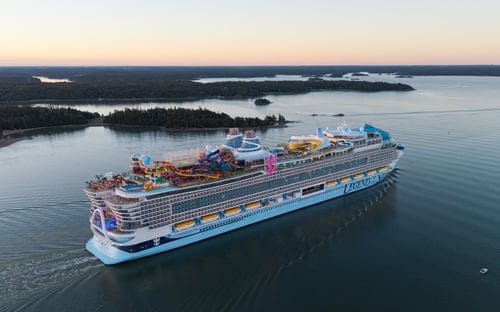
Legend of the Seas is part of Royal's building program of amenity-laden ships for the family market (RCI)
Along the way, Royal Caribbean management’s views of the industry and its opportunities evolved as they spoke of resorts and theme parks as some of its biggest competitors. Since taking over as CEO and President in 2022, Jason Libert has frequently spoken of the strategy to gain more “share of wallet” among travelers.
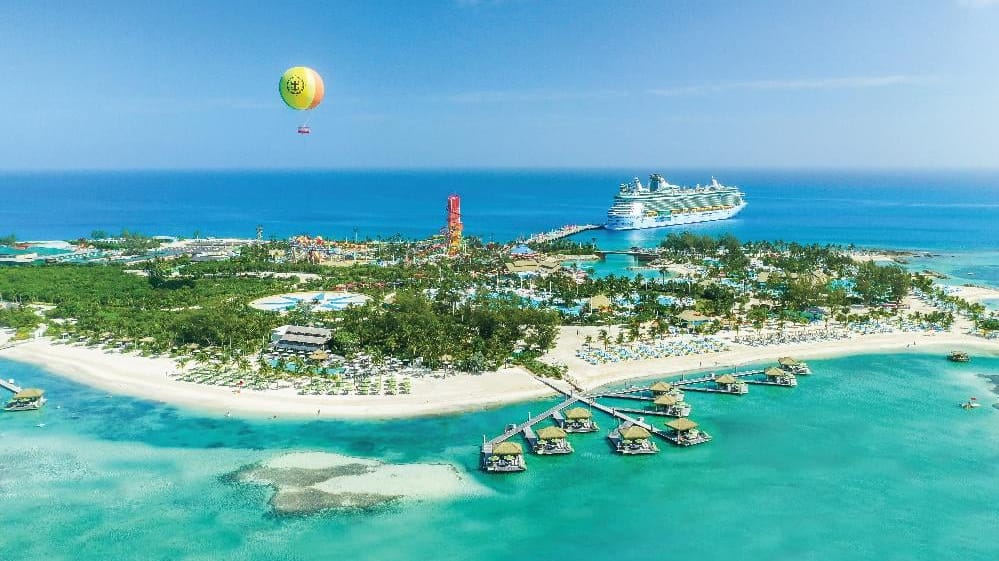
Royal Caribbean is building a portfolio of private destinations, leveraging the model of its successful private island, Perfect Day Coco Cay. It has also begun rolling out beach clubs at destinations sold to passengers with day passes. It also added a hotel in Patagonia in Puerto Williams, Chile, as part of its Antarctica explorations.
The industry sees “strong crossover potential between the two customer bases” of Sandals and Royal Caribbean, observed analyst C. Patrick Scholes of Truist Securities. He said it would all depend on strong execution, while noting that he views Royal Caribbean’s management as one of the strongest in executing initiatives.
Brandt Montor, the gaming, leisure, and lodging analyst at Barclays, expressed a similar sentiment, writing, “We see the strategic rationale of this deal as viable/attractive and expect the shares to recover … but it adds incremental complexity and strategic risk.”
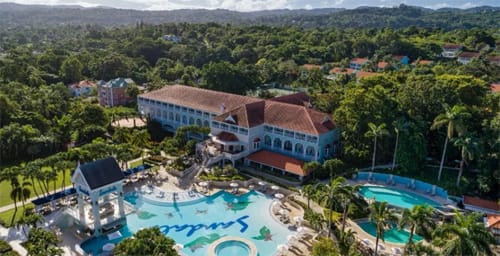
Sandals currently has a total of 20 resorts in the Caribbean (Sandals)
While concerns were raised about exposing Royal Caribbean to more geopolitical risk and weather-related dangers from Caribbean hurricanes, there are those who, however, see the coming together of cruises and resorts as a logical next step.
“The deal is consistent with our view that the sea- and land-based leisure channels converge over time,” says David Katz, an equity analyst at Jefferies. Indeed, in June 2025, Katz presented the case exploring business model fusion in lodging and cruise.
Katz highlights the meaningful synergy opportunities between the two brands, which are strong in the Caribbean. He points out that land-based assets could “enhance itinerary flexibility and support differentiated vacation offerings.” Katz concludes, “Hybrid sea-and-land experiences would likely be well received by guests, as with private islands.”
Royal Caribbean’s management points to Sandals as “an adjacent vacation category” while saying a key focus will be continued growth and accelerated expansion of the all-inclusive, adult-only Sandals brand and its family-oriented Beaches brand. The resort company has already spelled out a strategy to double Beaches from three to six locations, with additions in Barbados, the Bahamas, and Jamaica, as part of a $1 billion investment over the next five years.
Describing the opportunities, Royal Caribbean said, “The companies will explore opportunities to broaden distribution, deepen guest engagement, and make it easier for travelers to discover vacation experiences offered across both portfolios.”
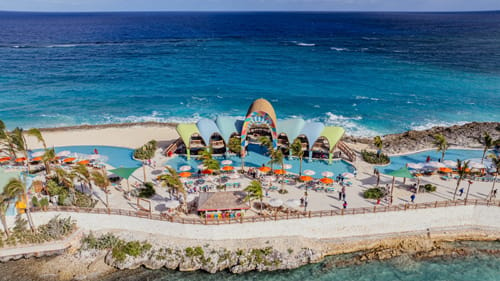
Royal Caribbean is developing beach clubs in ports and a portfolio of private destinations (RCI)
Analysts and industry observers see more opportunities. Montour writes of the challenges the cruise lines face in developing new (profitable) ports and new-to-cruise market penetration to build their customer base. Royal Caribbean Group and its partners have 14 cruise ships on order with 43,230 berths due for delivery between 2027 and 2032, plus additional unexercised options.
“This deal serves to ease both constraints, and it isn’t in any way a negative signal on that long-term outlook for cruise demand in our view… Bigger picture on the strategic rationale, the reality is that RCL has a large amount of future capacity that needs destinations to visit,” said Montour.
There is a perception of strong overlaps in the two customer bases and their demographics. Indeed, Royal Caribbean reported that 30 percent of its passengers overlapped with the Caribbean all-inclusive customer base over the past two years.
Sandals appears to have a large customer base with similar demographics to Royal Caribbean. The typical Sandals customer may be in a higher income bracket and spend more on vacations, which could be a good opportunity for Celebrity Cruises, and indeed, within hours of the deal being announced, Celebrity’s loyalty club received an email about “exciting news” and a “new era of vacations.” Similarly, Royal Caribbean has honed in on family vacations, which could be a major opportunity to fuel the growth of Beaches.
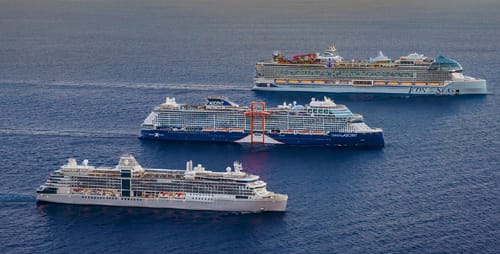
Royal Caribbean linked the loyalty programs of its three brands and has the opportunity to leverage it with Sandals' customer base (RCL)
Analysts look for the companies to quickly form links between their individual loyalty programs. “Royal Caribbean called out expanding their platform and customer penetration,” notes Scholes, “and emphasizes ‘potential synergies’.”
While Sandals has a lot of real estate close to major ports, the opportunities would be longer-term for Royal Caribbean. Plus, Montour notes, Sandals’ portfolio is “somewhat ‘far away’ from Florida and Texas,” where Royal Caribbean is homeported. Still, Royal Caribbean has made private destinations a focal point of its itineraries. Scholes also believes the near-term priority is Sandals’ resort expansion, with the longer-term potential for developing more destinations and beach clubs with Sandals.

that matters most
Get the latest maritime news delivered to your inbox daily.
The stock market initially punished Royal Caribbean’s share price, driving it to a 52-week low of $222 on Wednesday after the initial reports surfaced. Coming from a range of $255 to $266 per share on Tuesday and Wednesday before the news, the shares ended the week at $243, which is still off five percent and down 13 percent from the start of the year when the shares were at $280.
With a tone of optimism among analysts and the leisure/travel industry, the expectations are that Royal Caribbean’s share price will rebound. However, eyes will remain on the execution of the Sandals joint venture, watching to see how it changes the future of the cruise industry.
